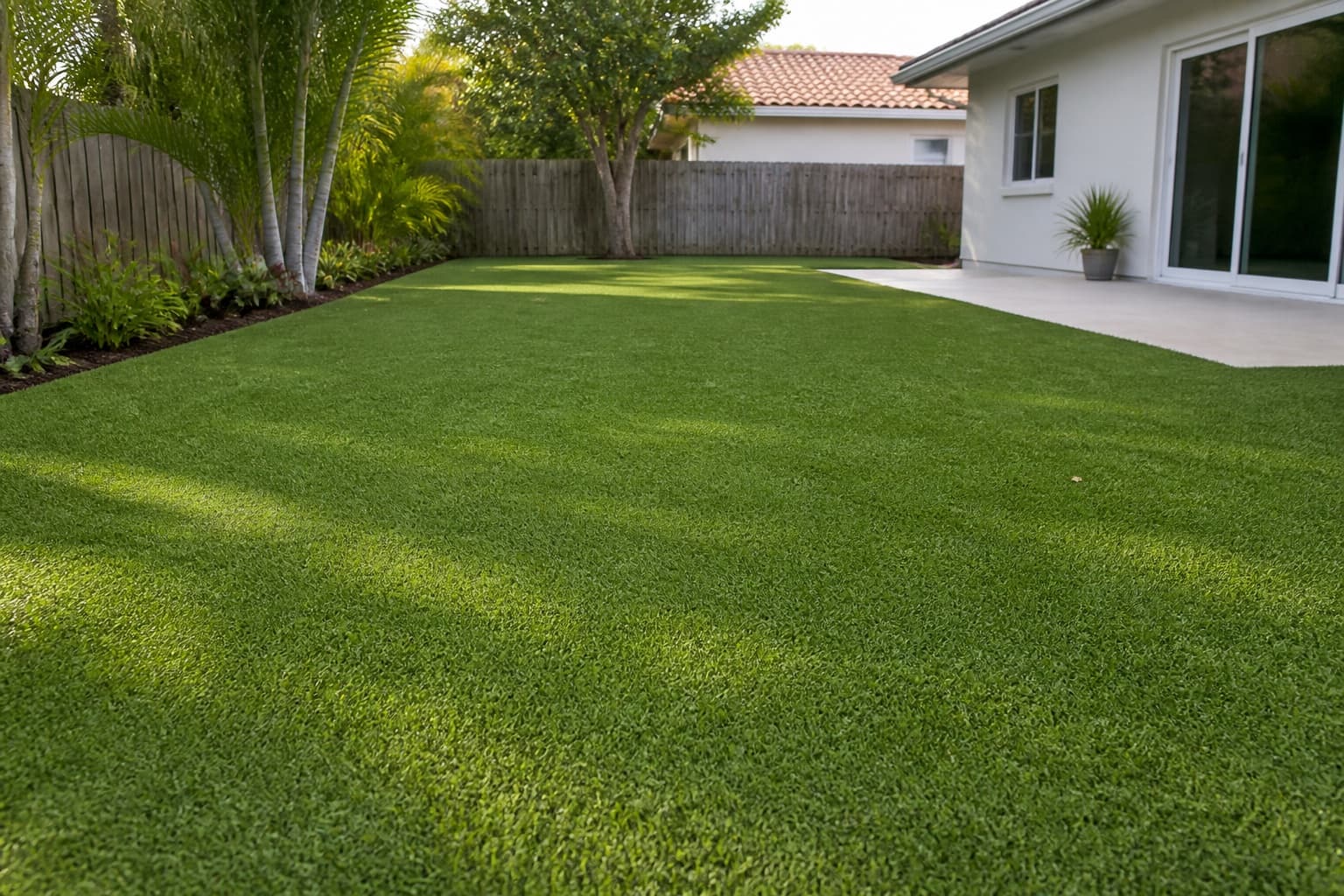
Start with Your Project's Priorities
Before requesting samples, clarify your project's primary purpose. Is it a high-traffic area for pets and children, a decorative accent in a low-traffic courtyard, or a lush backdrop for a roof terrace? Different artificial turf products are designed with varying characteristics to suit specific needs.
For instance, options like Wembley are noted for their performance and resistance to wear and tear, making them suitable for active areas. Anfield offers superb durability with a bright appearance, which might be preferred for spaces where visual appeal is paramount year-round. Understanding these core requirements will help narrow down the types of samples you should request.
Request and Examine Samples
Contact Lumber Plus to request physical samples of artificial turf options that align with your project priorities. Aim to get samples that are large enough to give a representative idea of the texture and color, typically at least 6x6 inches.
When your samples arrive, do not just look at them indoors. Take them to the exact location where the turf will be installed. Observe them at different times of day, under various lighting conditions – morning sun, midday glare, afternoon shade. Natural light significantly impacts how the green hues and textures appear. A turf that looks vibrant under direct sun might appear muted in a shaded corner, or vice-versa.
Assess Texture and Pile Height
The feel and appearance of the turf are crucial. Pile height refers to the length of the individual blades. Shorter pile heights often indicate greater resilience for high-traffic areas, while longer pile heights can offer a softer, more luxurious feel. For example, a product described as having a 'majestic cross-section that makes the turf look natural and dense,' like Stanford, suggests a particular visual and tactile quality that samples will reveal.
Run your hand over the samples. Does the texture feel soft enough for bare feet, or is it more robust for active play? Consider how the blades stand up and whether they spring back after being pressed down. This tactile assessment is essential, especially for areas where people or pets will frequently interact with the surface.
Consider Adjacent Finishes and Colors
Artificial turf rarely exists in isolation. Place your samples next to existing or planned hardscaping materials like pavers, concrete, wood decking, or garden beds. Evaluate how the turf's color and texture complement these adjacent finishes.
A particular shade of green might clash with a warm-toned paver but harmonize perfectly with a cool-toned stone. The goal is to create a cohesive outdoor aesthetic. For instance, if you are planning a backyard project with pets, a soft-feel turf might be chosen, but its green tone should also blend seamlessly with surrounding landscaping or fencing.
Sample Evaluation Checklist: A Hypothetical Scenario
Imagine you are planning to install artificial turf in a 15-foot by 20-foot backyard section that serves as a play area for children and a lounging spot. You have narrowed down your choices to Wembley, Stanford, and Anfield based on initial product descriptions.
Upon receiving samples, you take them to the backyard. In the morning, Wembley appears a rich, deep green, while Stanford shows a slightly lighter, more vibrant hue. Anfield, with its 'marvelous brightness,' stands out. By midday, under direct sun, Wembley maintains its depth, Stanford's density is evident, and Anfield's brightness intensifies, potentially appearing too reflective near your existing light-colored patio pavers. In the late afternoon, as the sun dips and shade covers part of the area, Stanford's natural density helps it maintain a lush look, whereas Anfield's brightness mellows. You also place each sample next to your existing wooden deck and a stone planter. Wembley's deeper tone creates a strong contrast with the deck, while Stanford's more nuanced green offers a softer transition. Anfield's bright green provides a lively pop of color, which might be desirable in some contexts but could feel too artificial next to natural wood.
You also assess the texture: Wembley feels robust underfoot, suitable for active play. Stanford feels dense and natural, while Anfield is soft but still resilient. Considering these observations, Stanford might emerge as a strong contender due to its consistent appearance across different lighting conditions and its harmonious blend with existing finishes, while still offering good durability for the intended use.
Before you order
- What is the primary function of the turf area (e.g., high traffic, aesthetics, pet play)?
- Have I requested physical samples of my top artificial turf choices?
- Have I examined the samples in the actual project location at different times of day?
- How does each sample's color and texture appear under direct sun, in shade, and on cloudy days?
- How does the pile height and texture feel for its intended use (e.g., soft for bare feet, resilient for play)?
- Do the turf samples complement existing or planned adjacent materials (e.g., pavers, decking, garden beds)?
- Are there any specific visual characteristics (e.g., sheen, density) that are more pronounced or less desirable in person?
- Have I considered the overall aesthetic harmony with my outdoor space?
- Does the sample label clearly identify the product for future reference?
Confirm installation details, approved uses and warranty terms in the current instructions for the exact product and profile. Your installer should verify the substrate, structure and applicable project requirements.
Questions to help you decide
How large should artificial turf samples be?
Ideally, samples should be at least 6x6 inches, or larger if available. This size provides a sufficient area to assess the turf's color variation, pile density, and overall texture more accurately than a very small swatch. Larger samples also make it easier to visualize the turf in context with surrounding elements.
Why is it important to view samples at different times of day?
Natural light changes throughout the day, affecting how colors and textures appear. A turf that looks perfect in the morning sun might appear different under harsh midday light or in the softer glow of late afternoon. Viewing samples at various times helps you understand the full range of its appearance and ensures it meets your expectations in all conditions.
Should I consider a turf's backing material when looking at samples?
While the visual and tactile aspects of the pile are primary, the backing material is important for durability and installation. Although samples primarily showcase the surface, inquire about the backing specifications for each product. The backing contributes to the turf's stability, drainage, and overall longevity, even if it's not directly visible in a small sample.
Ready to Select Your Artificial Turf?
Request a material quote today with your project dimensions, desired turf profile, and ZIP code. Confirm current availability and service options to get started on your project.
Request a material quote →