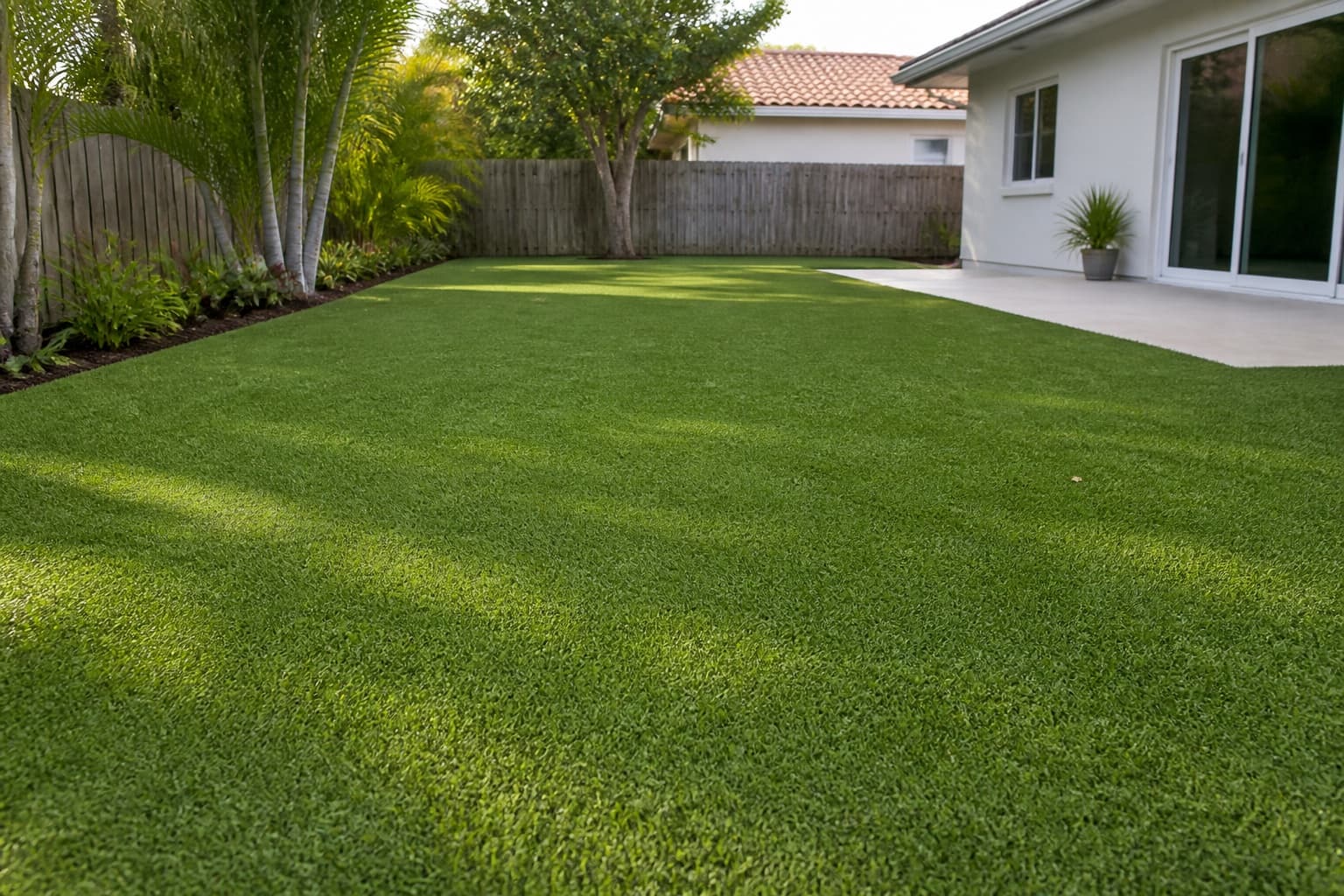
Understanding Artificial Turf Color Profiles
Artificial turf is available in a range of green tones, often incorporating multiple fiber colors to mimic the appearance of natural grass. These color profiles are designed to replicate different types of lawns or specific regional grass varieties.
For example, a turf described as 'Emerald Green' might feature bright, vibrant green fibers, suitable for a lush, manicured look. A 'Field Green' or 'Olive Green' option may combine darker and lighter green fibers, sometimes with a few tan or brown strands at the base, to create a more natural, less uniform appearance that resembles established, healthy grass. The specific blend of colors and the proportion of each fiber type contribute to the overall perceived hue and realism of the turf.
Lumber Plus offers various artificial turf options, each with distinct color characteristics. The Anfield turf, for instance, is noted for its “marvelous brightness,” suggesting a vibrant green. Wembley combines “high durability and a beautiful green color,” indicating a balanced and appealing shade. Stanford also provides a “beautiful green color” with a “majestic cross-section” for a natural, dense look. Celtic turf is described as an “environmentally friendly choice” with a “soft feel” and works for both indoor and outdoor projects, implying a versatile green that complements various settings.
When evaluating samples, observe the individual fiber colors and how they blend together. Some turf products might feature a single dominant green, while others use a mix of several greens, or even include subtle hints of yellow or brown to enhance realism.
The Impact of Natural Light on Turf Appearance
Natural light is a critical factor in how artificial turf colors are perceived. Direct sunlight will make colors appear brighter and more intense, while shaded areas will tend to darken the turf's hue. The angle of the sun throughout the day and across seasons also affects how light reflects off the turf fibers, influencing its perceived color and sheen.
Consider areas that receive full, unobstructed sunlight for most of the day. A turf with very bright green fibers might appear overly vivid or artificial under these conditions. Conversely, a turf with a more subdued, natural green blend might look perfectly balanced. For areas under partial shade, a slightly brighter green might be desirable to prevent the turf from looking too dark.
The direction of light also plays a role. Turf viewed with the sun behind it (backlit) can appear darker, while turf viewed with the sun shining on it (frontlit) will often look lighter and more vibrant. Always observe samples in the actual project location at different times of day to understand these variations.
Considering Surrounding Elements and Hardscaping
The colors and materials of surrounding elements significantly impact the perceived color of artificial turf. Hardscaping features such as patios, walkways, retaining walls, and fences create a visual context for the turf.
If your project includes light-colored pavers or natural stone, a darker, more muted green turf might provide a pleasing contrast. Conversely, if surrounding elements are dark, a brighter green turf could help prevent the area from feeling too enclosed or dim. Wood fences, especially those with natural stains, tend to complement a wide range of green turf colors, while painted fences (e.g., white or dark gray) might require more careful consideration to ensure harmonious color pairing.
The color of existing planting beds, trees, and shrubs also contributes to the overall palette. Aim for a turf color that blends naturally with the existing greenery or provides a desired contrast. For example, if your landscape features deep green foliage, a turf with similar undertones can create a cohesive look. If you prefer a distinct separation, a turf with a slightly different shade of green might be appropriate.
Pile Height and Density: Beyond Color
While color is key, the pile height and density of artificial turf also influence its visual finish. Pile height refers to the length of the turf fibers, while density relates to how closely packed these fibers are.
A shorter pile height (e.g., 1 inch) often results in a neater, more manicured appearance, and the color might seem more uniform. Taller pile heights (e.g., 2 inches or more) tend to create a lusher, more natural look, as the longer fibers can move more freely, creating subtle variations in shading and texture. The Wembley turf, noted for its “great performance and resistance to wear & tear,” is often associated with durability, which can be linked to its pile density and fiber resilience.
Denser turf, where fibers are packed closely together, generally presents a richer, more uniform color. Less dense turf, with more space between fibers, might allow more of the backing material to be visible, subtly affecting the overall color perception, especially when viewed from different angles or under varying light conditions. Stanford turf, with its “majestic cross-section” and dense appearance, exemplifies how fiber structure and density contribute to a natural look.
Consider the intended use of the area. For high-traffic zones, a shorter, denser pile might be preferred for its resilience, while a decorative area might benefit from a longer, softer pile for aesthetic appeal. The Celtic turf, described as having a “soft feel,” could be a suitable choice for areas where comfort is a priority, influencing both the visual and tactile finish.
Illustrative Project Example: Backyard Oasis
Imagine a rectangular backyard measuring 20 feet by 15 feet, with a new 10-foot by 8-foot paver patio on one side. The house faces south, so the turf area receives full sun in the morning and partial shade from a large tree in the afternoon. The existing fence is a weathered cedar.
The homeowner desires a natural-looking lawn that complements the warm tones of the cedar fence and the light gray pavers. After reviewing samples, they narrow down two options:
Option A: A vibrant 'Emerald Green' turf with a 1.5-inch pile height. This turf appears very bright under direct sunlight.
Option B: An 'Olive Green' blend with a 1.75-inch pile height, incorporating subtle tan fibers at the base. This turf has a more muted, variegated appearance.
When placed in the actual backyard:
Under morning sun, Option A appears almost fluorescent against the light gray pavers and can feel too intense. Under afternoon shade, it still holds a strong, bright green, but the artificiality is more noticeable.
Option B, under morning sun, presents a rich, natural green that harmonizes with the cedar fence and offers a gentle contrast to the pavers. In the afternoon shade, the 'Olive Green' blend maintains its natural depth without appearing dull, and the subtle tan fibers enhance the realistic effect.
The homeowner chooses Option B. This decision is based on observing how each turf sample reacted to the specific lighting conditions and surrounding elements of their unique backyard, rather than relying solely on showroom perceptions. This approach helps ensure the final installation achieves the desired aesthetic integration.
Before you order
- Observe turf samples in the actual project location under different lighting conditions (morning, midday, afternoon).
- Compare turf samples against existing hardscaping (pavers, concrete, stone) and softscaping (plants, trees).
- Consider the color of any nearby structures, such as fences, walls, or exterior paint.
- Evaluate how the turf's pile height and density contribute to its perceived color and texture.
- Decide if you prefer a vibrant, uniform green or a more muted, variegated natural look.
- Account for the overall aesthetic you want to achieve (e.g., manicured, wild, modern, traditional).
Confirm installation details, approved uses and warranty terms in the current instructions for the exact product and profile. Your installer should verify the substrate, structure and applicable project requirements.
Questions to help you decide
Does artificial turf color fade over time?
Modern artificial turf products are designed with UV inhibitors to resist fading from sun exposure. While all materials will experience some degree of change over many years, quality turf is engineered to maintain its color stability and appearance for an extended period. Always check product specifications for details on UV resistance.
Can turf color affect its surface temperature?
Darker colors, in general, tend to absorb more solar radiation than lighter colors. Other factors, such as infill type, backing material, and ambient air temperature, also play significant roles. It is important to note that color alone is not the sole determinant of surface temperature.
How do I ensure the turf color matches my vision?
The most effective way is to obtain physical samples of the artificial turf you are considering. Place these samples directly in your project area and observe them at various times of day and under different weather conditions. This allows you to see how the color interacts with natural light and your existing landscape elements. Take photos in different lighting to compare options side-by-side.
Request a Material Quote for Your Artificial Turf Project
Ready to select the perfect artificial turf for your space? Provide your project dimensions, desired turf profile, and ZIP code to request a material quote. Our team can help confirm current availability and service options for your area.
Request a material quote →