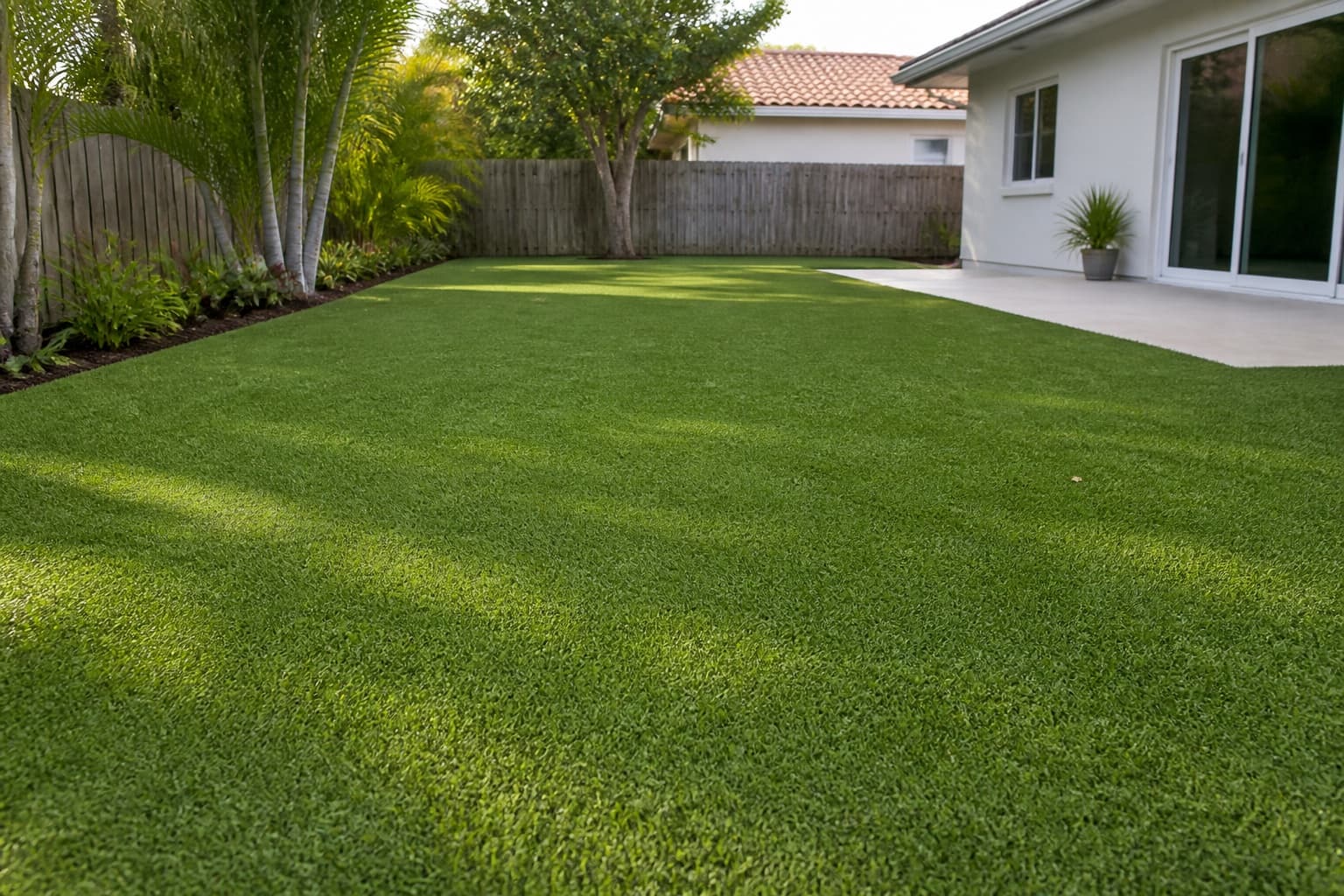
Understanding Artificial Turf Roll Dimensions
Artificial turf is typically sold in large rolls, not individual tiles or small sections. These rolls come in standard widths, which are crucial to consider during your planning phase. Common roll widths are often 12 feet or 15 feet. Knowing the exact width of the turf you intend to purchase is the starting point for all quantity calculations. This information is usually available in the product specifications.
The length of the roll can vary, as it is often cut to your specific project needs. You will specify the length required, but it is the fixed width that dictates how you plan your layout and cuts.
Accurate Area Measurement: Beyond Simple Square Footage
While knowing the total square footage of your project area is necessary, it is not sufficient for ordering artificial turf. You need detailed dimensions. Begin by sketching your project area. For rectangular or square areas, measure the length and width precisely in feet and inches. For irregularly shaped areas, break them down into smaller, manageable geometric shapes (rectangles, triangles, circles) and measure each segment.
Always measure twice to ensure accuracy. Consider any existing structures, pathways, or landscaping elements that will define the turf's perimeter. The goal is to create a scaled drawing that you can then overlay with turf roll layouts.
Planning Your Layout and Seams
Once you have your detailed measurements and a sketch, the next step is to plan how the artificial turf rolls will be laid out. The aim is to minimize seams and waste while ensuring all areas are covered. Turf rolls should ideally run in the same direction to maintain a consistent pile direction and appearance, which can be particularly noticeable in certain lighting conditions.
Draw your turf rolls onto your sketch, using the known roll width. Try different orientations to see which layout results in the fewest seams and most efficient use of material. Seams occur where two pieces of turf meet and require careful installation with seaming tape and adhesive. Fewer seams generally mean a more seamless appearance and potentially less labor.
Calculating Cuts and Accounting for Waste
After determining your optimal layout, calculate the length of each turf strip you will need. Remember that you cannot simply butt rolls together without considering edge trimming. Factory edges are typically straight, but site cuts will require precision. Allow for a small overlap (e.g., 2-4 inches) on all edges that will be seamed or trimmed against an existing border. This overlap provides room for precise cuts and ensures a tight fit.
Waste is an inevitable part of any material installation, especially with large rolls that need to be cut to fit irregular shapes. A general rule of thumb is to add a waste factor of 5-10% to your total calculated area. For very complex or highly irregular areas, this percentage might need to be higher. This accounts for trimming, mistakes, and unusable offcuts. Do not assume small offcuts can be seamlessly joined in visible areas.
Worked Example: A Backyard Turf Project
Let's consider a hypothetical backyard project. You have an L-shaped area you want to cover with artificial turf. The main rectangular section is 20 feet long by 15 feet wide. An adjacent, smaller rectangular section is 10 feet long by 8 feet wide. You plan to use artificial turf available in 15-foot wide rolls.
First, sketch the L-shaped area. The main section is 20' x 15'. The smaller section is 10' x 8'.
With 15-foot wide rolls, the main section is perfectly covered by one roll cut to 20 feet long. This uses 15' x 20' = 300 square feet.
For the smaller 10' x 8' section: Since the roll is 15 feet wide, you would need to cut a piece that is 8 feet wide by 10 feet long from a separate section of a roll. This means you would order a length of 10 feet from a 15-foot wide roll, yielding a 15' x 10' piece. You would then cut an 8' x 10' section from it. The remaining 7' x 10' piece would be an offcut.
Total length needed: 20 feet (for the main section) + 10 feet (for the smaller section) = 30 linear feet of 15-foot wide turf.
Total square footage purchased: 30 linear feet x 15 feet wide = 450 square feet.
Area to cover: (20' x 15') + (10' x 8') = 300 sq ft + 80 sq ft = 380 sq ft.
Waste calculation: Purchased 450 sq ft, needed 380 sq ft. Waste = 70 sq ft. This is approximately 18.4% waste, which is higher than the typical 5-10% but demonstrates how roll widths and cuts can impact material usage for irregular shapes. This example highlights the importance of detailed planning to avoid under or over-ordering.
Before you order
- Measure your project area accurately, noting all dimensions in feet and inches.
- Sketch your project area, including all obstacles and borders.
- Confirm the exact width of the artificial turf rolls you intend to purchase.
- Draw out potential turf roll layouts on your sketch, prioritizing minimal seams and consistent pile direction.
- Calculate the linear feet required for each roll based on your layout.
- Add a waste factor (typically 5-10%, or more for complex shapes) to your total linear footage.
- Double-check all calculations before finalizing your order.
Confirm installation details, approved uses and warranty terms in the current instructions for the exact product and profile. Your installer should verify the substrate, structure and applicable project requirements.
Questions to help you decide
What if my project area is not a simple rectangle?
For irregular shapes, break the area down into smaller, measurable rectangles, triangles, or circles. Measure each segment and sketch them. Then, try to fit the standard-width turf rolls over these segmented areas, imagining the cuts you'll need to make. This approach allows for a more accurate calculation of both total area and the linear feet of turf required from each roll, including necessary waste.
How do I account for seams in my calculation?
While seams do not directly add to the quantity of turf, planning their location is critical for aesthetic and structural integrity. When calculating linear feet, ensure that your layout allows for full-width rolls where possible to minimize seams. If seams are unavoidable, ensure you have enough material to allow for a slight overlap (e.g., 2-4 inches) along the seam edges for precise trimming and secure seaming with tape and adhesive. This overlap is typically part of the waste factor.
Why is a waste factor necessary, and how much should I add?
A waste factor accounts for material lost during cutting, trimming around obstacles, slight measurement errors, or unexpected issues. It is standard practice in material ordering. For relatively simple rectangular projects, a 5% waste factor might suffice. For projects with many curves, angles, or obstacles, increasing this to 10-15% is advisable to ensure you have enough material without needing a separate small, potentially costly, reorder. Review your layout carefully to estimate how much trimming will be needed.
Ready to Transform Your Space with Artificial Turf?
Provide your project dimensions, desired turf profile, and ZIP code to request a material quote. We can help confirm current availability and service options for your project.
Request a material quote →