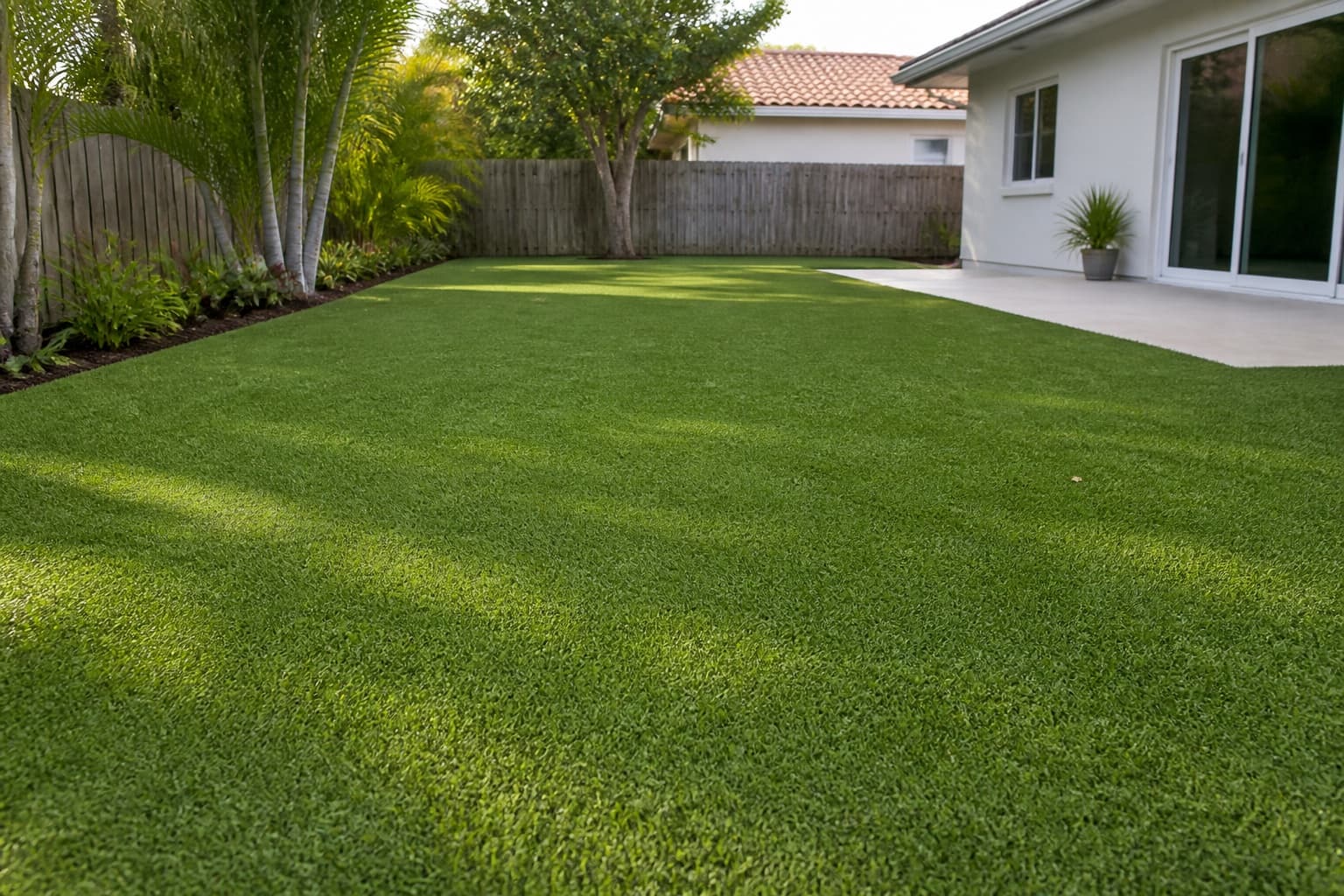
Defining Your Design Vision
Before selecting materials or breaking ground, visualize the overall aesthetic and function of your combined turf and paver area. Consider how people will move through the space, where furniture might be placed, and what visual impact you want to achieve. Common layouts include alternating strips, paver borders around turf, or turf inserts within a larger paver patio.
A clear design vision will guide your choices for paver size, artificial turf pile height, and the overall pattern. For instance, a contemporary design might favor large format pavers with narrow turf strips, while a more organic look could use irregular pavers and wider, natural-looking turf sections. Consider the existing architecture of your home and garden to ensure a harmonious integration.
Planning Strip Widths and Patterns
The width of your artificial turf and paver strips significantly impacts the visual balance and functionality of the design. For a modern, minimalist look, narrow turf strips (6-12 inches) between larger pavers can create clean lines. Wider turf sections (24 inches or more) can serve as distinct green zones within a paver patio or pathway.
Consider the dimensions of the artificial turf rolls, which typically come in standard widths like 12 or 15 feet. Planning your strip widths to align with these dimensions can minimize waste and reduce the number of seams. For pavers, choose sizes that complement your desired strip widths. For example, 24x24-inch pavers might work well with 12-inch turf strips for a balanced appearance. Sketching out your design with actual dimensions will help you visualize the final outcome and optimize material usage.
Managing Levels and Sub-Base Preparation
Achieving consistent levels between artificial turf and pavers is crucial for both aesthetics and functionality. Both materials require a stable and well-draining sub-base. For pavers, this typically involves a compacted gravel base followed by a bedding layer of sand. Artificial turf also needs a compacted aggregate base, often with a fine layer of decomposed granite or crushed rock for a smooth finish.
When combining the two, ensure that the finished grade of the turf's base is slightly below the finished grade of the paver's bedding layer. This allows the turf's backing and pile to sit flush with the paver surface, preventing tripping hazards and creating a seamless transition. A typical approach involves excavating the entire area to a consistent depth, then building up the individual bases for pavers and turf to their respective final heights. Accurate measurements and careful compaction are essential to prevent future settling differences.
For the artificial turf, consider options like Wembley or Stanford, which offer durability and a natural appearance, suitable for various outdoor projects. The choice of turf should align with the anticipated traffic and desired aesthetic. You can find more details on these options at our professional artificial turf systems page: /turf
Ensuring Effective Drainage
Proper drainage is critical for any outdoor surface, especially when combining artificial turf and pavers. While artificial turf is designed to drain water through its backing, the surrounding pavers and their sub-base also need to manage water effectively. Ensure the entire area has a slight slope (typically 1-2%) away from structures and towards a suitable drainage point.
The sub-bases for both materials should be permeable to allow water to percolate through. In areas with heavy rainfall or poor soil drainage, consider installing a perimeter drain or French drain along the edges where turf meets pavers, or beneath the sub-base, to prevent water accumulation. This is particularly important for preventing standing water in the turf and efflorescence on the pavers.
A Worked Example: Patio with Turf Inlays
Let's consider a hypothetical 10-foot by 12-foot patio area where you want to integrate artificial turf inlays. You decide on a design with 24-inch square pavers and 12-inch wide artificial turf strips, running horizontally across the 12-foot length, creating a pattern of Paver-Turf-Paver-Turf-Paver.
This layout would involve five 24-inch paver sections and four 12-inch turf sections. Total width for pavers: 5 sections * 24 inches/section = 120 inches (10 feet). Total width for turf: 4 sections * 12 inches/section = 48 inches (4 feet). This adds up to 14 feet, which is wider than our 10-foot patio. This immediately shows the importance of careful planning.
A revised plan for a 10-foot (120-inch) width could be: Paver (24") - Turf (12") - Paver (24") - Turf (12") - Paver (24") - Turf (12") - Paver (12"). This totals 120 inches. For the 12-foot length, the turf strips would be 12 feet long. You would need four 12-foot long turf strips, each 12 inches wide. For pavers, you would need 5 sections of 24-inch wide pavers, each 12 feet long, and one section of 12-inch wide pavers, also 12 feet long. This configuration simplifies cuts for the turf (straight cuts from a roll) and allows for a clear material list.
For the turf, if using a 15-foot wide roll, you would purchase one 15-foot by 12-foot section, which would yield four 12-inch by 12-foot strips, with some offcut. The paver quantity would be calculated based on the linear feet of paver sections needed. Always factor in extra material for cuts and potential breakage (typically 5-10%).
This example highlights how specific dimensions and product sizes directly influence material takeoffs and layout feasibility. Always draw a detailed plan to scale.
Choosing Compatible Materials
The selection of artificial turf and pavers should complement each other in terms of color, texture, and scale. For turf, consider the pile height and density. A shorter, denser pile like that found in Wembley or Anfield turf might be better suited for high-traffic areas or a more manicured look, while a taller, more open pile could mimic a natural lawn.
Pavers come in a vast array of materials, colors, and finishes. Concrete pavers offer versatility and durability, while natural stone pavers can provide a more rustic or luxurious feel. Ensure your chosen pavers have appropriate slip resistance for their intended use, especially if they will be near water. Consider the overall palette of your outdoor space to create a harmonious design.
You can explore our range of professional artificial turf systems, including options suitable for residential and high-traffic applications, on our website: /turf
Before you order
- Define your project's overall aesthetic and functional goals.
- Sketch a detailed layout, including exact dimensions for turf and paver strips.
- Verify the finished grade for both materials to ensure a flush transition.
- Plan for sub-base preparation and compaction for both turf and pavers.
- Design an effective drainage system for the entire combined area.
- Select artificial turf (e.g., Wembley, Anfield, Stanford) and pavers that are compatible in style and texture.
- Calculate material quantities, factoring in cuts and waste for both turf and pavers.
- Consider edge restraints for both turf and pavers to maintain their positions.
- Review local regulations or HOA guidelines for outdoor material installations.
Confirm installation details, approved uses and warranty terms in the current instructions for the exact product and profile. Your installer should verify the substrate, structure and applicable project requirements.
Questions to help you decide
Can I install artificial turf directly next to pavers without a border?
Yes, it is possible to install artificial turf directly next to pavers. The key is careful preparation of the sub-base for both materials to ensure they are at the same finished height and that the edges are properly secured. An edge restraint system for the pavers is typically recommended to prevent shifting, and the turf edge should be firmly anchored to prevent lifting.
How do I ensure proper drainage when combining turf and pavers?
Proper drainage requires a permeable sub-base beneath both the turf and pavers, and a slight slope (1-2%) across the entire combined area to direct water away from structures and towards a suitable drainage point. In some cases, a French drain or perimeter drain may be necessary, especially in areas with heavy rainfall or poor natural soil drainage.
What kind of artificial turf is best for integrating with pavers?
The best artificial turf depends on your specific design and anticipated use. For areas with foot traffic, a durable turf with good wear resistance like Wembley or Stanford may be suitable. If the area is purely aesthetic, a turf with a natural look and desired pile height might be prioritized. Always consider the turf's backing and infill requirements for optimal performance and drainage.
Ready to Plan Your Turf and Paver Project?
Request a material quote with your project dimensions, exact turf profile, and ZIP code to confirm current availability and service options for artificial turf and complementary materials.
Request a material quote →