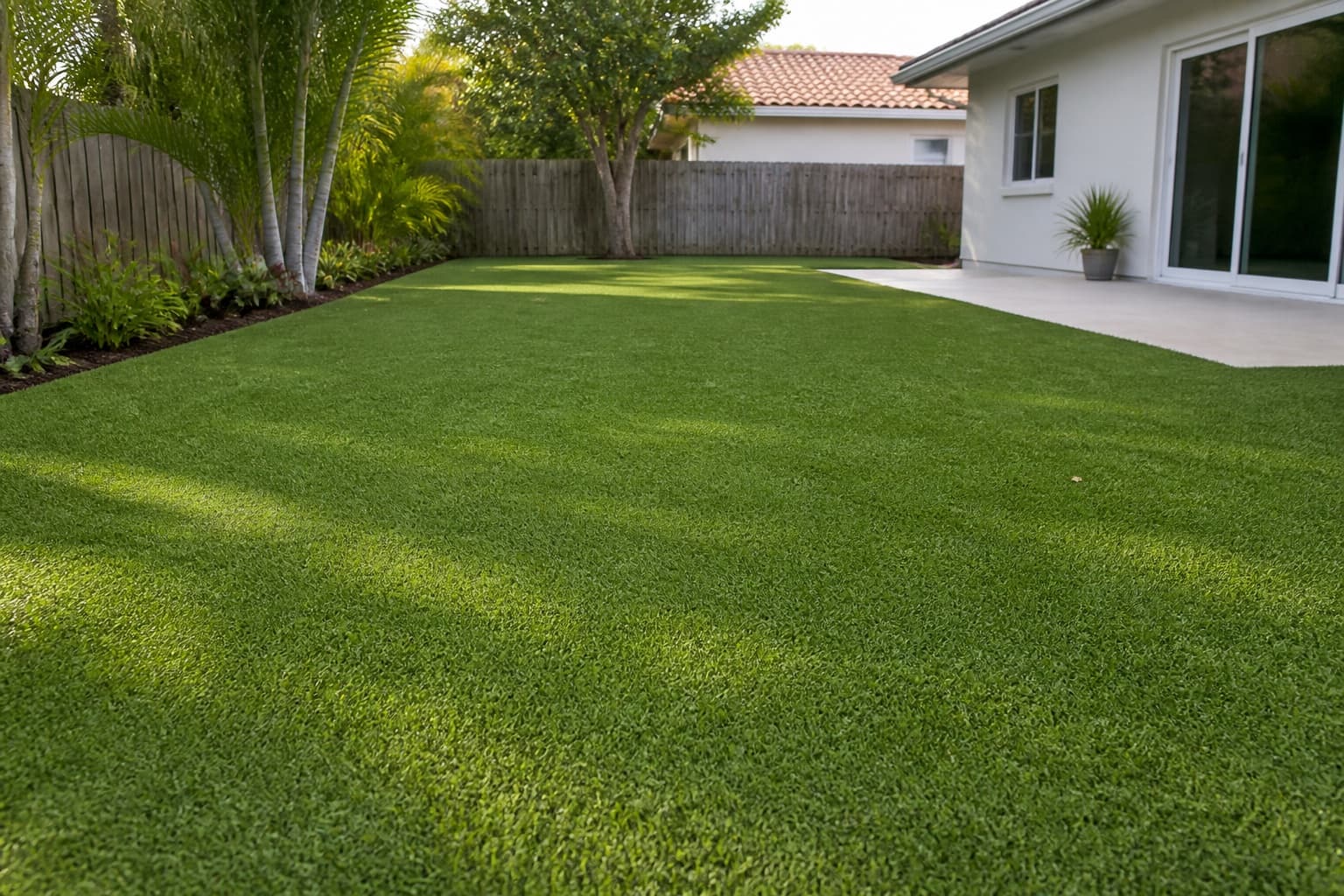
Confirming Project Dimensions and Layout
The first step in any material order is to verify the exact dimensions of the area where the artificial turf will be installed. While you may have initial measurements, your contractor will likely take their own precise measurements, especially if the area involves curves, multiple sections, or integration with other hardscaping elements.
Discuss with your contractor how they plan to lay out the turf rolls. Artificial turf typically comes in specific roll widths, and understanding the proposed layout will help optimize material usage and minimize waste. This also allows for pre-planning of seams, which should be placed in less visible or lower-traffic areas where possible.
For example, if you have an L-shaped area, the contractor might suggest two rectangular cuts rather than attempting a complex single piece, which could impact the total square footage needed and the number of seams. Always confirm the final measured area with your contractor before ordering.
Verifying Artificial Turf Specifications
Lumber Plus offers a selection of professional artificial turf systems, each designed for different applications. It is important to confirm the specific product chosen with your contractor to ensure it meets both your aesthetic preferences and the functional requirements of the project. Key specifications to review include:
Pile Height and Density: These factors influence the turf's appearance and how it feels underfoot. For instance, the Wembley turf is described as combining performance and resistance to wear, making it suitable for active areas, while Anfield offers durability and a bright appearance. Stanford features a dense, natural look.
Backing Material: The type of backing affects drainage and overall durability. Confirm that the chosen turf's backing is compatible with the planned sub-base and drainage system.
Infill Requirements: Some artificial turfs require infill materials to help the blades stand upright, provide cushioning, and add weight. Discuss the type and quantity of infill recommended for your selected turf and project use. Celtic turf, for example, is noted for its soft feel, suitable for pets and general outdoor use.
Confirming these details with your contractor ensures they are aware of the specific installation requirements for the chosen turf.
Product link: [https://www.lumberplus.com/turf](/turf)
Planning for Sub-Base and Drainage Materials
The artificial turf itself is only one component of the system. A properly prepared sub-base and an effective drainage plan are critical for longevity and performance. Your contractor will be responsible for preparing the ground and installing these layers.
Discuss the proposed sub-base materials (e.g., crushed aggregate, decomposed granite) and their depths. Ensure these materials are suitable for your local soil conditions and the intended use of the area. For example, a pet area might require enhanced drainage solutions.
Review the drainage strategy, especially in areas prone to heavy rain or where water might collect. This could involve grading the sub-base, installing perimeter drains, or ensuring proper permeability of the base materials. Effective drainage prevents water pooling and helps maintain the turf's integrity.
Calculating Material Quantities: A Worked Example
Accurate material quantity calculation is crucial. Let's consider a hypothetical rectangular backyard section measuring 22 feet long by 15 feet wide, with a small, curved garden bed cutout along one 15-foot edge, measuring 2 feet deep at its deepest point and 8 feet long.
1. **Total Area:** The main rectangular area is 22 ft * 15 ft = 330 sq ft.
2. **Curved Cutout:** For simplicity in estimation, treat the curved cutout as a rectangle of 8 ft * 2 ft = 16 sq ft. This is an approximation; a precise measurement or template would be needed for the actual cut.
3. **Net Turf Area:** 330 sq ft - 16 sq ft = 314 sq ft.
4. **Roll Widths:** Assume the chosen artificial turf comes in 15-foot wide rolls. To cover a 22-foot length, you would need two cuts from a 15-foot wide roll. One cut would be 15 ft x 15 ft, and the second would be 7 ft x 15 ft. This means you need a total length of turf that is 22 feet long * 15 feet wide. However, since the rolls are 15 feet wide, you would need two strips of turf, each 15 feet wide. The total length of turf needed would be 22 feet. So, you would purchase one roll that is 15 feet wide by 22 feet long. If the turf only comes in fixed lengths (e.g., 100 ft rolls), you would order the smallest length that accommodates your cuts, which might mean ordering a full 15 ft x 22 ft piece. In this case, you would purchase 22 linear feet of a 15-foot wide roll, covering 330 sq ft.
5. **Waste Factor:** Always add a waste factor, typically 5-10%, to account for cuts, trimming, and potential errors. For 330 sq ft, a 5% waste factor adds 16.5 sq ft, bringing the total to 346.5 sq ft. So, you would likely order 24 linear feet of the 15-foot wide roll, which covers 360 sq ft, ensuring enough material for the main area and the cutout, with some buffer for waste.
Work with your contractor to finalize these calculations, as their experience with roll layouts and cutting will be invaluable. This example assumes a single roll width and straightforward cuts; complex shapes or multiple roll widths will require more detailed planning.
Confirming Installation Logistics and Schedule
Before ordering, discuss the installation timeline with your contractor. This includes when the materials need to be on site, where they can be stored, and how long the installation is expected to take.
Consider site access for large turf rolls and delivery vehicles. If access is restricted, alternative delivery or handling arrangements might be necessary. Confirm that your contractor has the necessary equipment and personnel for the job.
Establish a clear communication plan for any unforeseen issues that may arise during installation. This helps ensure that both you and your contractor are prepared and can address challenges promptly without significantly impacting the project schedule or budget.
Before you order
- Have you and your contractor confirmed the final, measured dimensions of the artificial turf area?
- Is the specific artificial turf product (e.g., Wembley, Anfield, Stanford, Celtic) agreed upon, including its pile height, density, and backing?
- Have the sub-base materials and drainage plan been reviewed and approved by both parties?
- Are the total material quantities, including any waste factor, finalized with your contractor?
- Is the installation schedule, including material delivery and site access, clearly established?
- Have you discussed any special considerations for seams, edges, or intricate cuts?
- Is there a plan for infill material, if required for your chosen turf?
Confirm installation details, approved uses and warranty terms in the current instructions for the exact product and profile. Your installer should verify the substrate, structure and applicable project requirements.
Questions to help you decide
Why is it important to involve my contractor in material planning?
Your contractor's expertise in installation methods and site preparation is crucial. They can advise on the most efficient way to lay out turf rolls, identify potential challenges with drainage or sub-base, and ensure the selected turf is compatible with the overall project plan. Their involvement helps prevent costly errors and ensures a smoother installation.
What if my project has complex shapes or multiple turf areas?
For complex shapes, your contractor may create templates or detailed diagrams to ensure accurate cuts and minimize waste. For multiple turf areas, discuss whether different turf types are suitable for different uses (e.g., a high-traffic turf like Wembley for a play area, and a softer turf like Celtic for a relaxation zone). Precise measurements and a detailed layout plan become even more critical in these scenarios.
Should I order extra artificial turf beyond the calculated area?
It is generally recommended to order an additional 5-10% of material as a waste factor. This accounts for necessary cuts, trimming around obstacles, and potential errors during installation. Having a small amount of extra material can prevent delays if a piece needs to be recut or if a minor repair is needed in the future. Discuss the appropriate waste factor with your contractor based on the complexity of your project.
Ready to Plan Your Artificial Turf Project?
Request a material quote with your project dimensions, exact turf profile, and ZIP code. We can help confirm current availability and service options for your artificial turf needs.
Request a material quote →