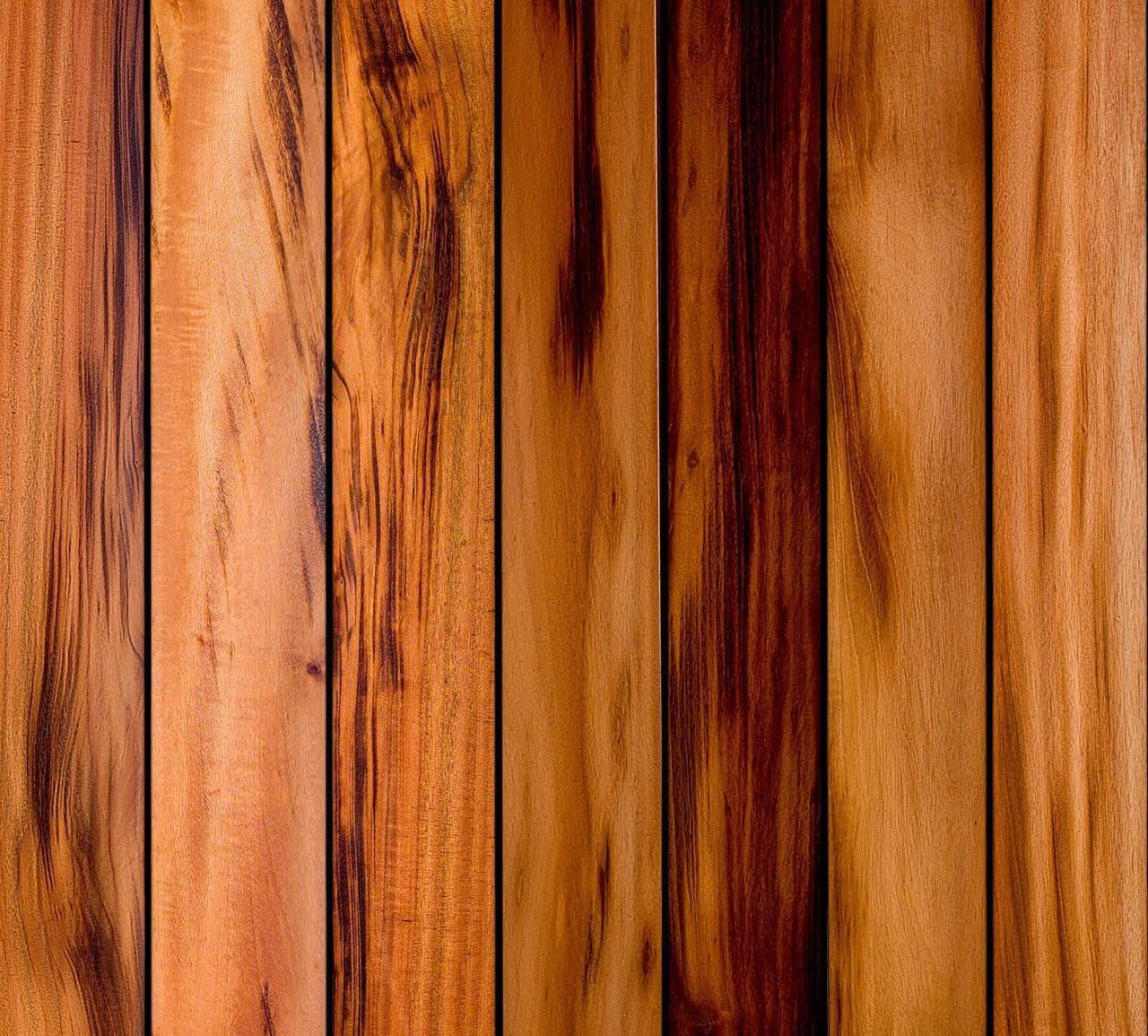
Understanding Tigerwood's Characteristics for Small Spaces
Tigerwood is an exotic hardwood known for its dramatic figure and exceptional durability. Its golden-brown base color is accented by distinctive dark brown streaks, giving it a unique visual texture. This strong visual pattern can be a dominant feature in a small space, making careful layout even more important.
As one of the densest exotic hardwoods, Tigerwood offers resistance to rot, decay, termites, and moisture. This inherent durability means it can withstand the wear and tear of a frequently used urban backyard, requiring minimal upkeep. Its natural oils also contribute to its water repellency. These characteristics make it a resilient choice for areas exposed to varied weather and heavy foot traffic, common in city environments. The material is available in a 1" x 5.5" (5/4"x6") profile, in lengths ranging from 3 to 24 feet. (S1)
Maximizing Space with Board Orientation
In a compact urban backyard, the orientation of your decking boards can significantly influence how spacious the area feels. Running boards parallel to the longest dimension of your yard can create an illusion of greater depth, drawing the eye along the length of the space. Conversely, if your yard is wider than it is long, running boards parallel to the shorter dimension can emphasize width.
For a square or nearly square space, a diagonal layout can add visual interest and help to de-emphasize the boundaries of the deck, making it feel less boxy. However, diagonal layouts typically involve more cuts and potentially more material waste, which is a consideration for any project. The standard 1" x 5.5" board profile of Tigerwood is versatile enough for all these orientations. (S1)
Designing for Circulation and Furniture
A key challenge in small backyards is ensuring enough clear space for movement around furniture. Before finalizing your deck dimensions, sketch out your desired furniture arrangement. Consider a compact dining set, a lounge chair, or built-in seating that can serve multiple purposes.
Aim for a minimum of 30-36 inches of clear pathway around furniture to allow for comfortable circulation. If space is extremely limited, consider multi-functional furniture or pieces that can be easily folded or moved. The deck's primary purpose should guide its design; if dining is key, prioritize space for a table and chairs. If lounging is preferred, ensure ample room for comfortable seating.
Integrating with Existing Structures and Landscaping
Urban backyards often feature existing walls, fences, or small garden beds. Your Tigerwood deck should integrate seamlessly with these elements. Consider using the deck to visually connect different areas of your yard, or to create a distinct zone for relaxation or dining.
For instance, if you have a raised garden bed, the deck can be built to the same height, creating a continuous surface. If a wall offers privacy, the deck can be oriented to direct views towards it, creating a sense of enclosure. Planning how the deck meets these elements will affect the overall flow and functionality of your compact space. A picture-frame border using Tigerwood boards can also provide a clean transition to other surfaces or define the edge of the deck. (S1)
Worked Example: A 10x12 Foot Urban Backyard Deck
Let's consider a hypothetical urban backyard measuring 10 feet wide by 12 feet deep. The goal is to create a functional deck for a small dining area and two lounge chairs, while maintaining a clear path.
Option 1: Full-width deck. A 10x10 foot deck would maximize the available width. If using 1" x 5.5" Tigerwood boards, running them parallel to the 10-foot width would emphasize the depth (10 feet). This leaves a 2-foot strip at the back of the yard, which could be used for a narrow planting bed or a storage bench. For a 10-foot width, you would need approximately 10 feet / 5.5 inches per board = 21.8 boards, so 22 boards across. For a 10-foot depth, you would need 10 feet / 1 foot = 10 linear feet of coverage per board. This means 22 boards at 10 feet each, totaling 220 linear feet. Given that boards come in various lengths (3-24 ft), careful planning for cuts will be necessary. (S1)
Option 2: Offset deck with circulation. Alternatively, a deck could be built 8 feet wide by 12 feet deep, positioned against one side of the yard. This leaves a 2-foot-wide pathway along the remaining side, providing clear circulation. The 8x12 deck can comfortably fit a small bistro table and two chairs, with space for two lounge chairs at one end. For the 8-foot width, you would need approximately 8 feet / 5.5 inches = 17.45 boards, so 18 boards across. For the 12-foot depth, you would need 12 linear feet of coverage per board. This means 18 boards at 12 feet each, totaling 216 linear feet. This option preserves a dedicated walkway, which is often crucial in small spaces.
Both options assume a standard board spacing as per manufacturer guidelines, which must be followed for proper installation and ventilation. Always confirm the exact board dimensions and required spacing for accurate material calculations. This example does not account for waste from cuts or specific joist spacing, which would impact final quantities.
Before you order
- Measure your backyard dimensions precisely (length, width, any irregular features).
- Identify primary use of the deck (dining, lounging, entertaining).
- Sketch desired furniture layouts, ensuring adequate circulation (min. 30-36 inches clear path).
- Consider board orientation: parallel to longest dimension for depth, parallel to shortest for width, or diagonal for visual interest.
- Plan transitions to existing structures (house, fence, garden beds).
- Account for drainage and ventilation, especially in compact spaces.
- Determine fascia and trim details for a finished look.
- Calculate material needs, including waste factor for cuts, especially with diagonal layouts.
Confirm installation details, approved uses and warranty terms in the current instructions for the exact product and profile. Your installer should verify the substrate, structure and applicable project requirements.
Questions to help you decide
Is Tigerwood decking suitable for heavy foot traffic in a small urban space?
Yes, Tigerwood is an excellent choice for areas with heavy foot traffic, such as urban backyards. It is one of the densest exotic hardwoods, offering unmatched hardness and scratch resistance, which helps it stand up to years of use. Its durability and resistance to rot and decay also contribute to a long lifespan. (S1)
How does the color of Tigerwood impact a small backyard?
Tigerwood features golden-brown hues with dramatic dark brown streaks. In a small space, this strong visual pattern can be a dominant design element. Lighter finishes or allowing the wood to weather naturally to a silver-gray can help a small space feel more open, while a rich, oiled finish will accentuate its dramatic striping. The appearance of the wood should complement other elements in your backyard. (S1)
What maintenance does Tigerwood decking require in a city environment?
To preserve its original golden-brown and dark streaked appearance, regular cleaning and periodic application of a UV-inhibiting oil finish are recommended. If left untreated, Tigerwood will naturally weather to a silver-gray patina over time. Regular sweeping and occasional washing are generally sufficient for basic upkeep. (S1)
Ready to Plan Your Tigerwood Urban Backyard Deck?
Request a material quote today. Provide your project dimensions, desired Tigerwood profile (1" x 5.5" is standard), and your ZIP code to confirm current availability and service options for your project.
Request a material quote →