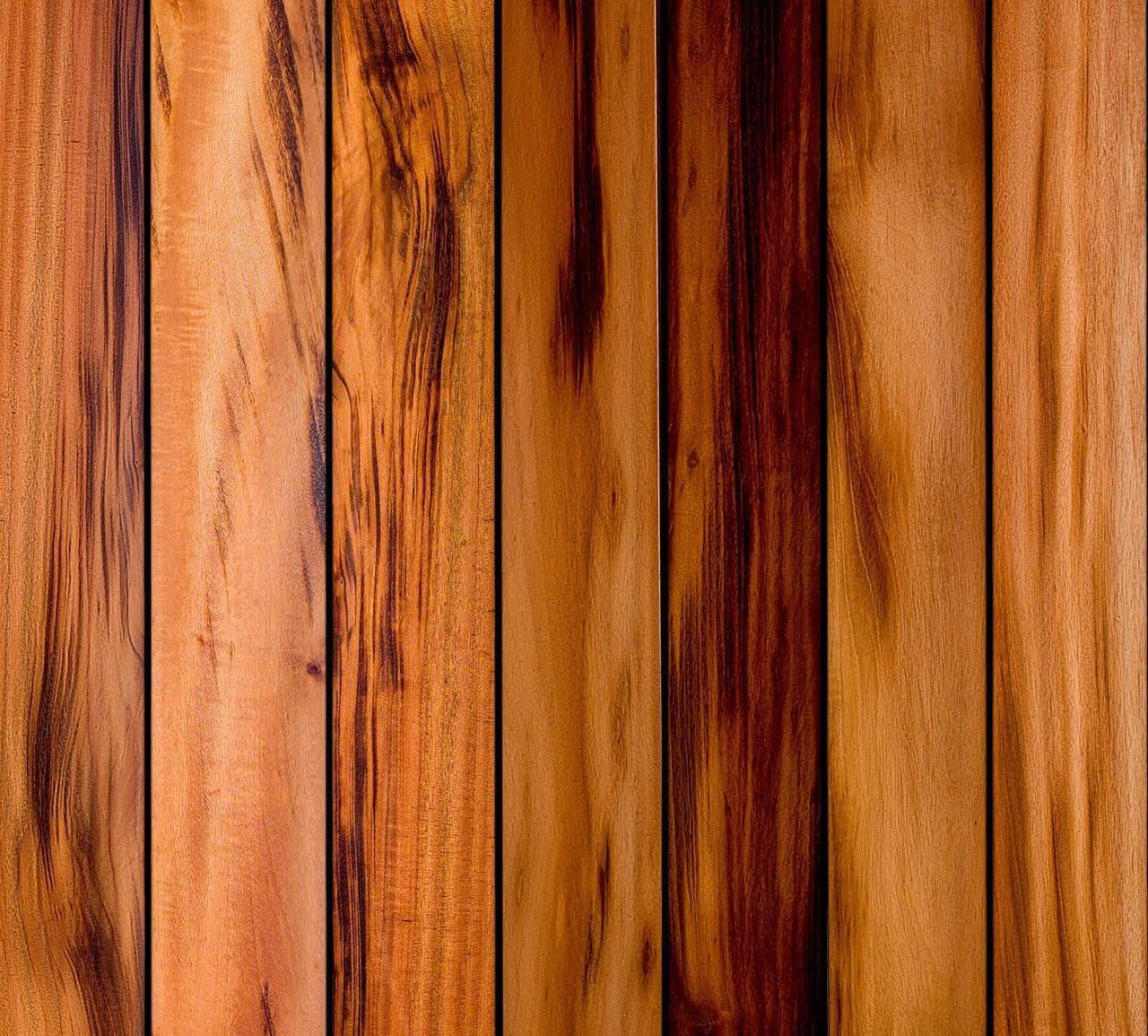
Understanding Tigerwood Decking Profiles and Lengths
Tigerwood decking is typically available in specific profiles and a range of lengths. A common profile is 5/4"x6", which corresponds to an actual dimension of 1" x 5.5". These boards are generally kiln-dried (KD) and come in lengths varying from 3 to 24 feet. Knowing these standard dimensions is essential for calculating how many boards you will need to cover your project area.
The availability of various lengths allows for flexibility in design and can help minimize waste if planned carefully. Longer boards can reduce the number of seams in larger areas, while shorter lengths might be more economical for smaller sections or intricate designs.
Tigerwood's distinct appearance, with its dramatic figure and disciplined performance, makes it a popular choice. This material is naturally water repellent due to its oils and offers unmatched hardness and scratch resistance.
For specific applications like decking and flooring, Tigerwood provides a durable, striped surface. It is also used in cabinetwork, high-class furniture, and various interior and exterior joinery.
Step 1: Measure Your Decking Area
Begin by accurately measuring the dimensions of your decking project. For simple rectangular or square decks, measure the length and width in feet. Multiply these two measurements to get the total square footage. For example, a deck that is 10 feet wide and 20 feet long has an area of 200 square feet.
For more complex shapes, break the area down into smaller, manageable rectangles or squares. Measure each section individually and sum their areas. If you have irregular shapes, consider sketching the layout on grid paper to help visualize and calculate the area. Always measure twice to ensure accuracy.
Remember to account for any existing structures or features within the deck area that will not be covered by decking, such as columns, built-in planters, or stairs, and subtract their footprint from your total area. However, for the purpose of material calculation, focus on the flat surface area that will receive decking boards.
Step 2: Calculate Board Feet Required
Decking materials are often sold by the linear foot or board foot. Since Tigerwood is typically available in 1" x 5.5" (nominal 5/4"x6") profiles, we can convert the square footage to board feet. A board foot is a unit of volume equal to 1 square foot of material that is 1 inch thick.
For a 1" thick board (actual thickness), 1 square foot of coverage is equal to 1 board foot. However, if your decking is nominally 5/4" thick (which is 1.25 inches), then 1 square foot of coverage would be 1.25 board feet. Given the actual dimension of 1" x 5.5", the calculation is straightforward.
To calculate the linear feet needed, divide the total square footage by the actual width of a single board in feet. For example, a 5.5-inch wide board is 5.5/12 = 0.4583 feet wide. If your deck is 200 square feet, you would need 200 / 0.4583 = 436.3 linear feet of decking boards.
Once you have the linear footage, you can convert to board feet. For 1" actual thickness, linear feet and board feet are numerically the same if the width is 12 inches. Since our boards are 5.5 inches wide, one linear foot of 1" x 5.5" board is (1 inch * 5.5 inches / 144 square inches/board foot) = 0.0382 board feet per linear foot. Alternatively, a simpler method is to recognize that a 1" x 5.5" board covers 0.4583 square feet per linear foot. To convert square feet to board feet for a 1" thick board, the square footage is numerically equivalent to the board footage.
Step 3: Account for Waste and Cuts
No project is completely free of waste. Cuts are necessary for board ends, around obstacles, and to create a clean finish. It is standard practice to add a waste factor to your material order. For a typical rectangular deck with straightforward installation, a 5-10% waste factor is often sufficient.
For more complex designs, such as diagonal layouts, decks with many angles, or intricate patterns like picture-frame borders, a higher waste factor of 10-15% or even more might be necessary. Always err on the side of caution with exotic hardwoods like Tigerwood, as obtaining additional material later can be costly and potentially lead to slight color or grain variations.
Consider the available board lengths (3-24 feet). If your deck dimensions are not perfectly divisible by common board lengths, you will have offcuts. Some offcuts might be reusable for shorter sections, but many will be true waste. Factor this into your waste percentage. For instance, if you have a 12-foot wide deck and use 20-foot boards, you'll have 8-foot offcuts. If you can use these 8-foot sections elsewhere, your effective waste is lower.
Worked Example: Calculating Tigerwood Decking for a Rectangular Deck
Let's assume you are building a rectangular deck that measures 15 feet by 25 feet. You plan to use Tigerwood decking with an actual profile of 1" x 5.5". You anticipate a standard installation with minimal complex cuts, so you'll use a 7% waste factor.
1. **Calculate Total Deck Area:** 15 feet * 25 feet = 375 square feet.
2. **Calculate Linear Feet of Decking:** Each board is 5.5 inches wide, which is 5.5/12 = 0.4583 feet. Total linear feet needed (before waste) = 375 sq ft / 0.4583 ft/board = 818.24 linear feet.
3. **Apply Waste Factor:** Add 7% for waste: 818.24 linear feet * 1.07 = 875.51 linear feet.
4. **Determine Number of Boards by Length:** Tigerwood boards are available in 3-24 foot lengths. To minimize waste, try to match board lengths to your deck dimensions. For a 25-foot length, you might use one 12-foot board and one 13-foot board (if available), or two 12.5-foot boards (cut from longer stock). Let's assume you aim for 20-foot boards to run the length of the 25-foot dimension, requiring a 5-foot piece to be added. If you instead run boards across the 15-foot width, you could use 16-foot boards, trimming 1 foot, or 14-foot boards plus an additional cut.
For simplicity, let's assume you will order boards in common lengths that sum close to 875.51 linear feet. For example, if you predominantly use 20-foot boards, you would need 875.51 / 20 = 43.77 boards. Round up to 44 boards of 20 feet. This would give you 880 linear feet, which includes your waste factor and provides some buffer.
It's always recommended to discuss your project dimensions and desired board lengths with a Lumber Plus representative to optimize your order and minimize cuts.
Considerations for Special Layouts and Features
If your deck design includes diagonal layouts, picture-frame borders, or intricate patterns, your waste factor will likely increase. Diagonal installations, for example, often require more cuts and thus more material. For a diagonal layout, a waste factor of 15% or more is not uncommon.
Picture-frame borders, where boards run perpendicularly around the perimeter of the main decking area, also require careful measurement and cutting. These elements can consume additional linear footage and should be calculated separately before being added to the main decking area's requirements.
Additionally, if you are planning to incorporate features like built-in benches, planters, or custom railings that use Tigerwood, remember to calculate these components separately. These specialty items will require specific lengths and cuts, impacting your overall material needs and waste estimation.
For coastal homes or projects with winter exposure, while Tigerwood is highly durable and resistant to moisture, proper planning for board spacing and ventilation is still crucial. These environmental factors do not directly impact quantity takeoff but are important for the longevity of your deck.
Finalizing Your Order
Before placing your order, review your measurements and calculations. It can be helpful to draw a detailed plan of your deck, marking out board placement and cuts. This visual aid can help identify potential issues and refine your material estimate.
When purchasing Tigerwood decking, it's generally better to have a small surplus than a deficit. Small amounts of extra material can be useful for future repairs or replacements, ensuring a consistent look. However, avoid excessive over-ordering to prevent unnecessary expenses.
Confirm the exact profile and lengths available with Lumber Plus. While standard lengths are common, specific project needs might benefit from particular length combinations to minimize waste. Always verify the current availability of the exact profiles and lengths you require.
Tigerwood is a very durable and moisture-resistant exotic hardwood, making it a sound investment for a long-lasting deck. Taking the time to accurately calculate your material needs will ensure a smooth and efficient project.
Before you order
- Have I accurately measured the length and width of my primary decking area?
- Have I identified and measured any irregular shapes or sections of the deck?
- Have I subtracted the footprint of any non-decking features (e.g., columns, planters)?
- Do I know the actual width of the Tigerwood decking boards I plan to use?
- Have I calculated the total linear footage required for the primary decking area?
- What waste factor is appropriate for my project (e.g., 5-10% for simple, 10-15%+ for complex)?
- Have I applied the waste factor to my linear footage calculation?
- Have I considered how available board lengths (3-24 ft) will impact cuts and potential waste?
- Are there any picture-frame borders, diagonal sections, or custom features requiring separate material calculations?
- Have I accounted for any Tigerwood needed for stairs, fascia, or other trim pieces?
- Am I prepared to round up board quantities to ensure full coverage and a buffer?
- Have I confirmed the exact profile and lengths of Tigerwood decking with Lumber Plus?
- Do I have a plan for where longer and shorter boards will be used to optimize material?
Confirm installation details, approved uses and warranty terms in the current instructions for the exact product and profile. Your installer should verify the substrate, structure and applicable project requirements.
Questions to help you decide
What is the typical waste factor for Tigerwood decking?
For straightforward, rectangular decks, a 5-10% waste factor is generally recommended. For more complex designs, such as diagonal layouts, decks with many angles, or intricate patterns, a higher waste factor of 10-15% or more might be necessary. It's always best to be slightly over rather than under, especially with exotic hardwoods.
How do I convert square footage to linear feet for Tigerwood decking?
First, measure your total deck area in square feet. Then, take the actual width of your Tigerwood decking board in inches (e.g., 5.5 inches for a nominal 5/4"x6" board) and divide it by 12 to convert it to feet (5.5/12 = 0.4583 feet). Divide your total square footage by this actual board width in feet to get the total linear feet needed before applying a waste factor.
Does the length of the Tigerwood boards affect the quantity I need to order?
While the total linear footage needed remains constant, the available board lengths (typically 3-24 feet for Tigerwood) significantly impact how efficiently you can use the material and, consequently, your actual purchase quantity. Planning which lengths to use for different sections of your deck can help minimize offcuts and reduce waste. It's often beneficial to mix lengths to optimize material usage for your specific project dimensions.
Request a Quote for Tigerwood Decking
Ready to bring the dramatic figure and disciplined performance of Tigerwood to your outdoor space? Request a material quote today. Provide your project dimensions, desired Tigerwood profile (e.g., 5/4"x6"), and your ZIP code to confirm current availability and service options. Our team can help you finalize your material list for a seamless project.
Request a material quote →