Understanding Thermally Modified Ash: The Basics
Thermally Modified Ash, derived from Fraxinus spp. native to North America and Europe, is a hardwood known for its pronounced grain and denser feel. The thermal modification process enhances the wood's stability, particularly in response to changes in humidity, making it suitable for a broader range of applications compared to untreated ash.
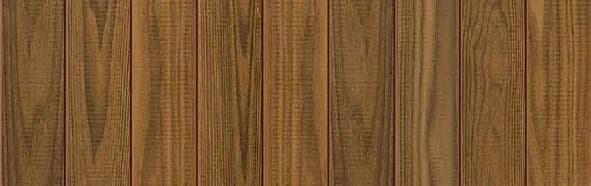
The natural tone of Thermally Modified Ash is a deep brown hue, offering a distinct aesthetic for various design schemes. Its hardwood presence makes it a choice for high-visibility applications where both durability and appearance are key considerations.
Key Specifications: Profiles and Nominal Sizes
The profile and nominal size of Thermally Modified Ash are fundamental specifications that dictate its suitability for different project elements. 'Profile' refers to the shape and machining of the wood, while 'nominal size' indicates the approximate dimensions before final milling. It is crucial to remember that nominal sizes are not always the exact finished dimensions; always confirm actual dimensions for precise planning.
Thermally Modified Ash is available in several profiles and nominal sizes, each designed for specific applications:
For siding, ceilings, and selected decking, 'S4S E4E End Match' profiles are offered in 1 × 6 Plus and 5/4 × 6 nominal sizes. The 'End Match' feature can simplify installation by allowing boards to be joined between supports, reducing waste.
For more robust decking and structural details, 'S4S E4E' profiles are available in 2 × 4 and 2 × 6 nominal sizes. These thicker dimensions provide greater structural capacity.
For trim and molding applications, 'S4S E4E' profiles come in a range of nominal sizes, including 1 × 10, 2 × 2, 2 × 4, and 2 × 6. This variety allows for complementary detailing across a project.
Approved Applications: Where Thermally Modified Ash Excels
Understanding the approved applications for Thermally Modified Ash is essential to ensure both performance and longevity. The material is versatile, suitable for various uses, but specific profiles are better suited for certain environments.
Thermally Modified Ash is generally recommended for cladding, ceilings, and interior feature walls. Its enhanced stability and attractive grain make it a strong candidate for these visible surfaces. For exterior applications like cladding, its improved moisture response is a significant advantage.
For selected decking applications, specific profiles are designated. It is important to confirm that the chosen profile and the intended installation system are appropriate for walking surfaces. Always consult detailed installation guidelines for decking applications to ensure proper support and drainage.
Worked Example: Selecting Ash for a Rainscreen Facade
Let's consider a hypothetical project: designing a 20-foot wide by 10-foot high exterior rainscreen facade for a residential property. The design calls for horizontal cladding with a consistent shadow line. The goal is to specify Thermally Modified Ash that meets these requirements.
First, we review the available profiles. The 'S4S E4E End Match' in a 1 × 6 Plus nominal size is listed for 'Siding, ceilings, and decking'. This profile is a strong candidate for cladding. The 'Plus' in the nominal size often indicates a slightly wider board than standard, which can be verified with actual dimensions.
For a rainscreen assembly, proper ventilation and drainage are critical. The 'End Match' feature means that boards can be joined end-to-end between vertical furring strips, potentially reducing waste from cuts that would otherwise need to land on a support.
Assuming actual dimensions of approximately 0.75 inches thick by 5.5 inches wide for the 1 × 6 Plus, a 10-foot high wall would require roughly 22 boards (120 inches / 5.5 inches per board). For a 20-foot width, if boards are typically supplied in 8-foot or 12-foot lengths, careful planning of cuts and end-matching will be necessary to minimize waste and achieve the desired aesthetic. This example highlights the importance of confirming actual dimensions and available lengths when placing an order.
Considerations for Project Success
When specifying Thermally Modified Ash, several factors beyond just profile and size contribute to a successful project. These include understanding the material's inherent characteristics and planning for its installation.
The 'better moisture response' benefit of Thermally Modified Ash means it exhibits improved stability when humidity levels fluctuate. This characteristic is particularly valuable for exterior applications where exposure to varying weather conditions is expected.
Always confirm the specific installation requirements for your chosen profile and application. For example, a cladding profile for a rainscreen system will have different fastening and spacing guidelines than a ceiling application. Consulting manufacturer guidelines and local building practices is crucial for long-term performance.
Before you order
- Confirm the specific profile (e.g., S4S E4E End Match) required for your application (cladding, decking, trim).
- Verify the nominal and actual dimensions (thickness, width, length) of the chosen profile.
- Ensure the selected profile is explicitly approved for your intended application (e.g., exterior cladding, walking surface).
- Consider how the 'End Match' feature (if present) will impact your installation plan and material yield.
- Evaluate the thermal modification benefits (e.g., improved moisture response) in the context of your project's environmental exposure.
- Plan for any necessary detailing, such as rainscreen gaps for cladding or specific support structures for decking.
- Account for the natural deep brown hue and pronounced grain in your design aesthetic.
Confirm installation details, approved uses and warranty terms in the current instructions for the exact product and profile. Your installer should verify the substrate, structure and applicable project requirements.
Questions to help you decide
What does 'S4S E4E End Match' mean?
'S4S E4E' stands for 'Surfaced Four Sides, Eased Four Edges,' meaning the board has been planed smooth on all four faces and has slightly rounded (eased) edges. 'End Match' indicates that the ends of the boards are also milled with a tongue and groove profile, allowing them to be joined together between structural supports, which can help reduce waste and simplify installation.
Can Thermally Modified Ash be used for both interior and exterior projects?
Yes, Thermally Modified Ash is suitable for a broad range of applications, including both interior and exterior projects. Its enhanced stability makes it a good choice for exterior cladding and selected decking, while its aesthetic qualities are valued for interior feature walls and ceilings. Always ensure the specific profile and installation method are appropriate for the intended environment.
How do I ensure I order the correct quantity of Thermally Modified Ash?
To order the correct quantity, you need accurate project dimensions. Calculate the total square footage or linear footage required, then account for waste due to cuts, miscuts, or design details. It is generally advisable to add a percentage (e.g., 5-10%) for waste. Always confirm the actual dimensions of the boards and available lengths from your supplier, as nominal sizes can vary slightly from finished product dimensions.
Ready to Specify Thermally Modified Ash for Your Project?
To receive a material quote, please provide your project dimensions, the exact profile you are interested in, and your ZIP code. This information will help us confirm current availability and service options for your location. You can explore more about Thermally Modified Ash here: /thermally-modified-wood/ash. Also consider our other related products like /siding-and-cladding and /thermally-modified-wood.
Request a material quote →