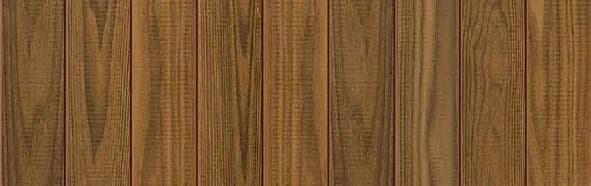
Understanding Thermally Modified Ash Samples
Thermally Modified Ash is a hardwood derived from Fraxinus spp., originating from North America and Europe. The thermal modification process enhances its stability, making it suitable for both interior and exterior applications. When you receive a sample, you're looking at a representation of this material's natural tone and grain. However, a small sample might not fully convey the appearance of a larger installation.
Key characteristics of Thermally Modified Ash include its deep brown hue and distinct grain pattern. The thermal treatment process gives the wood a consistent color throughout, which helps minimize differences between the surface and any cuts. This material is noted for its 'hardwood presence,' offering a denser feel in high-visibility applications.
Samples are typically provided to showcase the wood's appearance and texture. They are not intended to be structural components or to represent every possible variation in grain, but rather to give a realistic impression of the material's aesthetic qualities.
The Impact of Lighting on Appearance
One of the most significant factors influencing how Thermally Modified Ash appears is lighting. The same sample can look dramatically different under natural daylight, direct sunlight, indirect light, or artificial illumination. For exterior projects, evaluate samples at different times of day to observe how the sun's angle and intensity change the wood's perceived color and grain definition.
For interior applications, consider the type of artificial lighting in the space. Warm LED lighting will bring out different undertones than cool fluorescent lighting. Hold the sample at various angles to see how light reflects off its surface, highlighting the grain patterns. This step is crucial for ceilings or feature walls where lighting will play a major role in the overall ambiance.
Evaluating Texture and Profile
While a sample primarily conveys color, it also offers a tactile experience. Thermally Modified Ash has a 'denser feel' compared to some other wood species. Run your hand over the sample to get a sense of its surface texture. Even if the sample is a small piece, it can indicate the typical finish.
Beyond the surface, consider the profile. Thermally Modified Ash is available in various profiles, such as S4S E4E End Match for siding, ceilings, and decking, or S4S E4E for decking and trim. While samples may not always be in the exact profile you plan to use, understanding the intended profile helps visualize how the edges and face will look when installed. For example, an S4S E4E End Match profile for a 1x6 Plus nominal size will create a different shadow line and visual rhythm than a 2x4 S4S E4E profile used for decking. Confirm the profile of your sample against your project requirements.
Refer to the specific profile options for Thermally Modified Ash: S4S E4E End Match (1x6 Plus, 5/4x6) for siding, ceilings, and decking; S4S E4E (2x4, 2x6) for decking and structural details; and S4S E4E (1x10, 2x2, 2x4, 2x6) for trim and moulding.
Pairing Samples with Adjacent Finishes
No material exists in isolation. Bring your Thermally Modified Ash samples into direct contact with other materials planned for your project. This could include paint swatches, stone samples, metal finishes, or even samples of existing flooring or furniture. Observe how the deep brown hue and pronounced grain of the ash complements or contrasts with these elements.
For a facade, hold the sample against brick, stucco, or siding samples. For an interior feature wall, place it next to your chosen wall paint, flooring, or fabric samples. This step helps confirm that the overall palette and material combination achieve your desired aesthetic harmony or contrast. Sometimes, a material that looks appealing on its own might clash when placed next to another key finish.
Sample Labeling and Documentation
Always pay attention to any labels or documentation accompanying your samples. These often include the species (Thermally Modified Ash), the specific profile, and sometimes the nominal dimensions. This information is critical for ensuring you are evaluating the correct material for your project specifications. Misinterpreting a sample can lead to ordering discrepancies.
Even if a sample doesn't perfectly match the exact profile or size you need, the label confirms the material's identity and processing. For instance, a small flat sample might represent a 1x6 Plus S4S E4E End Match profile, which is useful for cladding or ceilings, or a 2x4 S4S E4E profile intended for decking. Always cross-reference the sample's details with your project plans and the product descriptions available at our Thermally Modified Ash product page.
Worked Example: Selecting Ash for a Covered Patio Ceiling
Consider a hypothetical covered patio ceiling measuring 10 feet by 12 feet. The homeowner wants to use Thermally Modified Ash in an S4S E4E End Match profile, nominal size 1x6 Plus, for a warm, natural look. They have received a 6-inch by 12-inch sample.
First, the homeowner takes the sample outside. In the morning, under indirect light, the ash appears as a rich, warm brown. In the afternoon, with some direct sun filtering through the patio cover, the grain becomes more prominent, and the color seems slightly lighter. They note that the existing patio floor is a light gray concrete, and the house exterior is painted a soft cream. Holding the ash sample against the cream wall and gray concrete confirms a pleasant, earthy contrast.
Next, they consider the planned recessed lighting for the patio. They hold the sample under a similar warm-toned LED light fixture, observing how the light plays on the wood's surface. They also place the sample next to a swatch of the outdoor furniture fabric, a deep charcoal gray, to ensure the colors complement each other. By evaluating the sample in situ and against other finishes, they confirm that the Thermally Modified Ash provides the desired aesthetic and warmth for their covered patio ceiling.
Before you order
- Obtain physical samples of Thermally Modified Ash in the closest available profile to your project.
- Evaluate samples under various lighting conditions: direct sun, indirect light, and artificial light (if applicable).
- Examine the texture and grain pattern closely, considering how it will appear across a larger area.
- Place samples next to all adjacent materials (paint, stone, metal, fabrics) to check for aesthetic compatibility.
- Confirm the sample's labeling matches the product specifications you intend to order.
- Consider how the chosen profile (e.g., S4S E4E End Match, S4S E4E) will influence the visual lines and shadow effects.
- Visualize the sample's appearance as part of a larger installation, not just in isolation.
Confirm installation details, approved uses and warranty terms in the current instructions for the exact product and profile. Your installer should verify the substrate, structure and applicable project requirements.
Questions to help you decide
How many samples should I request?
It is often beneficial to request at least two or three samples if possible, especially for larger projects or if you are considering different profiles. Multiple samples allow you to see more of the natural variation in grain and color, and to place them in different areas of your project site for comparison.
Will my ordered material look exactly like the sample?
While samples are representative, wood is a natural product, and some variation in grain, color, and texture is inherent. The thermal modification process helps create a more consistent deep brown hue, but minor differences are expected. Always order slightly more material than your exact calculation to account for cuts and any natural variations you might wish to sort for specific placements.
What profiles are available for Thermally Modified Ash?
Thermally Modified Ash is available in several profiles to suit various applications. These include S4S E4E End Match in nominal sizes 1x6 Plus and 5/4x6, suitable for siding, ceilings, and decking. Also available are S4S E4E profiles in 2x4 and 2x6 for decking and structural details, and in 1x10, 2x2, 2x4, and 2x6 for trim and moulding. Always confirm the specific profile needed for your project.
Ready to Plan Your Thermally Modified Ash Project?
Request a material quote with your project dimensions, exact profile, and ZIP code. Confirm current availability and service options for Thermally Modified Ash. Explore our other thermally modified wood options and related products like siding and cladding, NORX brand products, or Maximo Accoya for complementary materials.
Request a material quote →