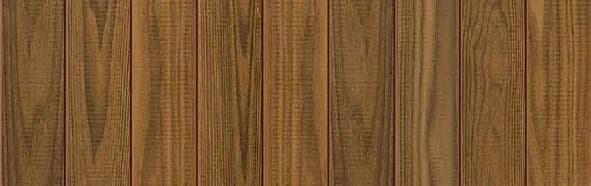
Understanding Thermally Modified Ash for Exterior Use
Thermally modified ash is a hardwood that undergoes a high-heat treatment process without chemicals. This modification alters the wood's cellular structure, enhancing its stability and resistance to moisture fluctuations. These properties are particularly valuable for exterior applications like privacy screens, where exposure to varying weather conditions is constant.
The thermal modification process gives ash a rich, deep brown hue, which can either be maintained with UV-protective finishes or allowed to naturally weather to a silver-gray patina over time. Its pronounced grain offers a distinct hardwood presence, making it suitable for high-visibility applications where aesthetic impact is desired. The improved moisture response helps reduce the likelihood of warping or cracking, contributing to the longevity of the privacy screen.
While thermally modified ash is suitable for exterior use, it is not a structural material for heavy loads without specific engineering. Any privacy screen design must incorporate a robust support structure appropriate for its size, weight, and local wind conditions. The ash itself functions as the visual screening element, requiring a separate and independently designed support system.
Selecting the Right Profiles for Your Privacy Screen
The choice of profile for thermally modified ash is crucial for both the aesthetic and functional aspects of a privacy screen. Different profiles offer varying levels of opacity, shadow lines, and installation methods. Common profiles suitable for vertical or horizontal screen elements include S4S E4E (Surfaced 4 Sides, Eased 4 Edges) boards, which provide a clean, finished look on all visible surfaces.
For privacy screens, nominal sizes like 1 × 6 Plus or 5/4 × 6 S4S E4E End Match are often considered for their balance of visual weight and workability. These profiles are frequently used in siding and ceiling applications, which share similar exposure considerations to a privacy screen. Smaller dimensions like 2 × 2 or 2 × 4 S4S E4E can also be utilized for more open designs or as framing elements within the screen.
Consider the desired spacing between boards when selecting a profile. Tighter spacing with wider boards will create a more solid visual barrier, while wider gaps with narrower boards will allow more light and air to pass through, creating a semi-private effect. The end-match feature on some profiles can simplify installation by allowing boards to be joined between supports, reducing waste and labor.
Design Considerations for Privacy Screens
A successful privacy screen design integrates seamlessly with its environment while fulfilling its primary function. Begin by assessing the level of privacy required. Is it a full visual block, or is a semi-transparent screen acceptable? This will dictate board spacing and orientation.
Consider the screen's dimensions relative to the space. A screen that is too tall or wide can feel imposing, while one that is too small may not provide adequate privacy. Pay attention to the surrounding landscape and architectural style. The deep brown tone of thermally modified ash can complement various palettes, but its natural weathering to silver-gray should also be anticipated.
Wind loads are a significant factor for any outdoor screen, especially taller ones. The design must account for local wind conditions to ensure stability. This involves specifying adequate posts, cross-bracing, and secure connections for the ash boards. The support structure, typically made of treated lumber, metal, or masonry, must be independently designed to carry these loads, with the ash simply attached as the cladding element.
Hypothetical Project Example: Backyard Privacy Screen
Imagine a backyard space where a 12-foot long by 6-foot high privacy screen is desired to shield a patio from a neighboring property. The goal is a semi-private design with horizontal boards. For this hypothetical project, we select Thermally Modified Ash, S4S E4E End Match, nominal size 1 × 6 Plus. These boards are typically 5/8 inch thick and 5 1/2 inches wide.
For a 6-foot (72-inch) height, we would calculate the number of boards. Each board is 5.5 inches wide. Solving for a total height of 72 inches: N * 5.5 + N * 0.5 - 0.5 = 72 => 6N = 72.5 => N = 12.08. The actual height covered would be 12 * 5.5 inches + 11 * 0.5 inches = 66 + 5.5 = 71.5 inches. This leaves a small margin at the top or bottom.
For the 12-foot length, three vertical support posts would be appropriate, spaced 6 feet apart. These posts should be securely anchored. For the ash boards, 12-foot lengths would be ideal to avoid butt joints within the screen. If only 6-foot or 8-foot lengths are available, careful planning for staggered joints or using the end-match feature will be necessary. In this scenario, purchasing 12 boards at 12 feet each would result in 144 linear feet of material.
Installation and Maintenance Considerations
Proper installation is critical for the longevity and appearance of a thermally modified ash privacy screen. Fasteners should be corrosion-resistant, such as stainless steel screws, to prevent staining and ensure a secure attachment. Pre-drilling is recommended to prevent splitting, especially near board ends. Allow for slight expansion and contraction of the wood by not overtightening fasteners.
While thermally modified ash is stable, it will still absorb some moisture. Ensure good air circulation around and through the screen to prevent moisture accumulation. Avoid direct contact with soil. If the screen is close to plants, ensure they do not continuously press against the wood, as this can trap moisture and impede drying.
Maintenance for thermally modified ash is relatively low. If a consistent deep brown color is desired, apply a UV-protective finish periodically. If left unfinished, the wood will naturally weather to a silver-gray. Regular cleaning with a mild soap and water solution can help remove dirt and mildew. Avoid harsh chemical cleaners or pressure washing at high settings, which can damage the wood fibers.
Before you order
- Determine the desired level of privacy (full block, semi-transparent).
- Measure the area for the screen, noting height and length.
- Assess local wind conditions and plan for a robust support structure (not part of the ash material).
- Decide on the board orientation (horizontal or vertical).
- Plan for suitable, corrosion-resistant fasteners.
- Consider the desired aesthetic: natural weathering to gray or maintaining the deep brown with a finish.
- Confirm necessary clearances from ground and adjacent structures for air circulation.
Confirm installation details, approved uses and warranty terms in the current instructions for the exact product and profile. Your installer should verify the substrate, structure and applicable project requirements.
Questions to help you decide
Does thermally modified ash require a finish for outdoor use?
No, thermally modified ash does not strictly require a finish for outdoor use. The thermal modification process enhances its stability and resistance to moisture and decay. If left unfinished, it will naturally weather to a silver-gray patina over time. If you wish to maintain its original deep brown color, a UV-protective oil or stain should be applied periodically.
Can I use thermally modified ash as a structural element for my privacy screen?
Thermally modified ash is generally not intended as a primary structural element for load-bearing applications like the main posts of a privacy screen. While it offers improved stability, the design for any privacy screen must include a separate, robust structural framework (e.g., treated lumber or metal posts) to handle wind loads and support the weight of the ash boards. The ash serves as the non-structural screening material.
How do I calculate the amount of thermally modified ash I need for a privacy screen?
First, determine the total area (height x length) of your screen. Calculate how many boards are needed vertically by dividing the screen height by (board width + gap width) and rounding up. Multiply this number by the screen length to get the total linear footage. Always add a percentage (e.g., 10-15%) for cuts, waste, and future repairs. So, 12 boards x 12 feet = 144 linear feet, plus waste.
Ready to Plan Your Thermally Modified Ash Privacy Screen?
For a material quote tailored to your project dimensions, exact profile, and ZIP code, or to confirm current availability and service options, contact us today. We can help you select the right thermally modified ash for a durable and attractive privacy screen.
Request a material quote →