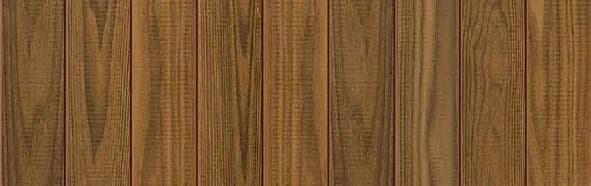
The Inherent Natural Beauty of Thermally Modified Ash
Thermally modified ash is derived from Fraxinus species, originating from North America and Europe. The thermal modification process enhances the wood's stability and introduces a rich, consistent deep brown tone throughout the material. This process is physical, not chemical, and the resulting color is inherent to the wood itself, not a surface stain. This means that even if the surface is scratched or worn, the underlying wood retains a similar deep brown hue.
Ash is known for its distinct, often bold grain patterns, which remain visible and are accentuated by the thermal modification. This pronounced grain contributes significantly to its natural appearance, providing texture and visual interest that differentiates it from more uniform wood species or manufactured composites. When considering a natural look, this inherent grain and color are foundational elements.
Thermally modified ash is suitable for various applications, including cladding, ceilings, feature walls, and specific decking details, provided the profile and installation system are confirmed. Its hardwood presence and improved moisture response make it a versatile material for projects aiming for both aesthetic appeal and enhanced stability.
Understanding the Natural Tone and Grain
The "natural" look of thermally modified ash refers to its deep brown hue and prominent grain. Unlike some treated woods that rely on surface stains, the color of thermally modified ash penetrates the wood, offering consistency. This deep brown tone can vary slightly between boards, reflecting the natural variations within the ash species, which further enhances an organic aesthetic.
The grain of ash is typically open and can feature straight, wavy, or even curly patterns, providing a dynamic visual texture. When installed, these variations combine to create an elevation that feels authentic and visually engaging. For projects aiming to highlight the wood's inherent character, choosing clear finishes or allowing the wood to weather naturally will best preserve and showcase these features.
Finish Options for a Natural Appearance
While thermally modified ash possesses a beautiful natural color, how it is finished significantly impacts its long-term appearance and the degree to which it retains its initial deep brown. There are generally two primary approaches for a natural look:
1. **Clear Finishes:** Applying a clear, UV-inhibiting finish helps to protect the wood from the elements and largely preserves its initial deep brown color. These finishes can be oil-based or water-based, and they typically require reapplication over time to maintain their protective qualities and color stability. A matte or satin clear coat will allow the grain to remain prominent without adding an artificial sheen.
2. **Unfinished/Weathered Look:** Allowing thermally modified ash to weather naturally without a protective finish will result in the wood gradually changing color. Exposure to sunlight and moisture will cause the deep brown to soften and eventually develop a silvery-gray patina, similar to other naturally weathered wood species. This process is gradual and creates a distinct, aged natural look. While the color changes, the underlying stability benefits of the thermal modification remain. It is important to understand that this weathering is an aesthetic choice and does not compromise the wood's enhanced dimensional stability.
Choosing Profiles for a Natural Elevation
The profile of the thermally modified ash boards also contributes to the natural aesthetic of an elevation. Simple, clean profiles tend to emphasize the wood's inherent grain and color without distracting design elements. Common profiles available include S4S E4E (Surfaced Four Sides, Eased Four Edges) with end matching, which allows for seamless installation and reduces waste.
For siding and cladding, nominal sizes such as 1 × 6 Plus or 5/4 × 6 S4S E4E End Match are often selected. These dimensions offer a substantial presence, allowing the natural characteristics of the ash to be fully appreciated across the facade. When planning a natural look, consider how the chosen profile will create shadow lines and how these lines will interact with the wood's grain to enhance visual depth.
Thermally modified ash is also available in sizes like 2 × 4 and 2 × 6 for decking and structural details, and smaller dimensions like 1 × 10, 2 × 2, 2 × 4, and 2 × 6 for trim and molding, allowing for a cohesive natural wood design across various project elements.
Worked Example: Designing a Natural Ash Facade
Consider a hypothetical residential project aiming for a natural-look facade on a 20-foot wide by 10-foot high wall section. The homeowner desires to showcase the deep brown color and prominent grain of thermally modified ash, with a plan to maintain a clear finish.
**Material Selection:** Thermally Modified Ash, S4S E4E End Match profile, nominal size 1 × 6 Plus (actual dimensions approximately 3/4 inch thick by 5.5 inches wide).
**Installation Approach:** Horizontal siding with a rainscreen assembly to ensure proper ventilation and drainage, preserving the wood's integrity. Boards will be installed with a consistent reveal to create subtle shadow lines.
**Finish Choice:** A high-quality, clear, UV-stabilized exterior oil finish will be applied immediately after installation to protect the wood and maintain its deep brown tone. This finish will be reapplied according to the manufacturer's recommendations, typically every 2-3 years, depending on sun exposure.
**Quantity Calculation (Illustrative):**
Wall Area: 20 feet (width) × 10 feet (height) = 200 square feet.
Coverage per board (5.5 inches wide, assuming no overlap): 5.5 inches / 12 inches/foot = 0.458 feet. For a 12-foot long board, this is 0.458 ft * 12 ft = 5.5 square feet.
Number of boards needed (area-equivalent): 200 sq ft / 5.5 sq ft/board = 36.36 boards. Allowing for cuts, waste, and optimizing for standard board lengths (e.g., 12-foot lengths), a practical estimate would be to round up and add a waste factor (e.g., 10-15%). If using 12-foot boards, 37 boards x 12 ft = 444 linear feet. Adding 15% for waste: 444 * 1.15 = 510.6 linear feet. This would translate to approximately 43 boards of 12-foot length.
It's crucial to confirm exact coverage and waste factors with the supplier based on specific board lengths and cutting plans to minimize material waste.
Before you order
- Desired level of grain visibility: Do you prefer a pronounced grain or a more subtle texture?
- Color stability: Is maintaining the initial deep brown tone critical, or do you embrace a weathered silver-gray patina?
- Maintenance commitment: Are you prepared for periodic reapplication of a clear finish, or do you prefer a low-maintenance, naturally weathering approach?
- Profile choice: Which thermally modified ash profile best complements the overall architectural style and desired shadow lines?
- Application: Will the ash be used for siding, ceilings, feature walls, or decking, and is the chosen profile suitable for the intended use?
- Substructure readiness: Is the underlying rainscreen or mounting system prepared to support the thermally modified ash and ensure proper ventilation?
- Project dimensions: Have accurate measurements been taken to facilitate an efficient material takeoff and minimize waste?
Confirm installation details, approved uses and warranty terms in the current instructions for the exact product and profile. Your installer should verify the substrate, structure and applicable project requirements.
Questions to help you decide
Will thermally modified ash splinter or crack easily if left unfinished?
While thermal modification significantly improves the stability of ash, all wood, if left unfinished and exposed to extreme conditions, can eventually show signs of surface checking or minor splintering. However, the thermal process reduces its susceptibility compared to untreated ash. For optimal longevity and appearance, especially in high-traffic or exposed areas, a protective finish is generally recommended.
How does thermally modified ash compare to other wood species for a natural look?
Thermally modified ash offers a unique combination of a deep brown, consistent color and a pronounced hardwood grain that is distinct from other species. For example, thermally modified pine might offer a lighter brown tone and a different grain pattern, while some tropical hardwoods might have tighter grains or different inherent colors. Ash's thermal modification enhances its durability and stability, making it a robust choice for a natural exterior aesthetic.
Can I stain thermally modified ash to change its color while maintaining a natural look?
Yes, you can apply semi-transparent or transparent stains to thermally modified ash. These stains can subtly alter the deep brown hue while still allowing the natural grain to show through. This approach can be used to achieve specific color variations, such as a slightly redder or grayer brown, while still preserving the wood's inherent texture. Always test a stain on a scrap piece of wood first to ensure the desired outcome.
Plan Your Natural Ash Elevation
Ready to bring the authentic beauty of thermally modified ash to your project? Request a material quote today. Provide your project dimensions, desired profile (e.g., S4S E4E End Match 1 × 6 Plus), and ZIP code, and we'll help confirm current availability and service options.
Request a material quote →