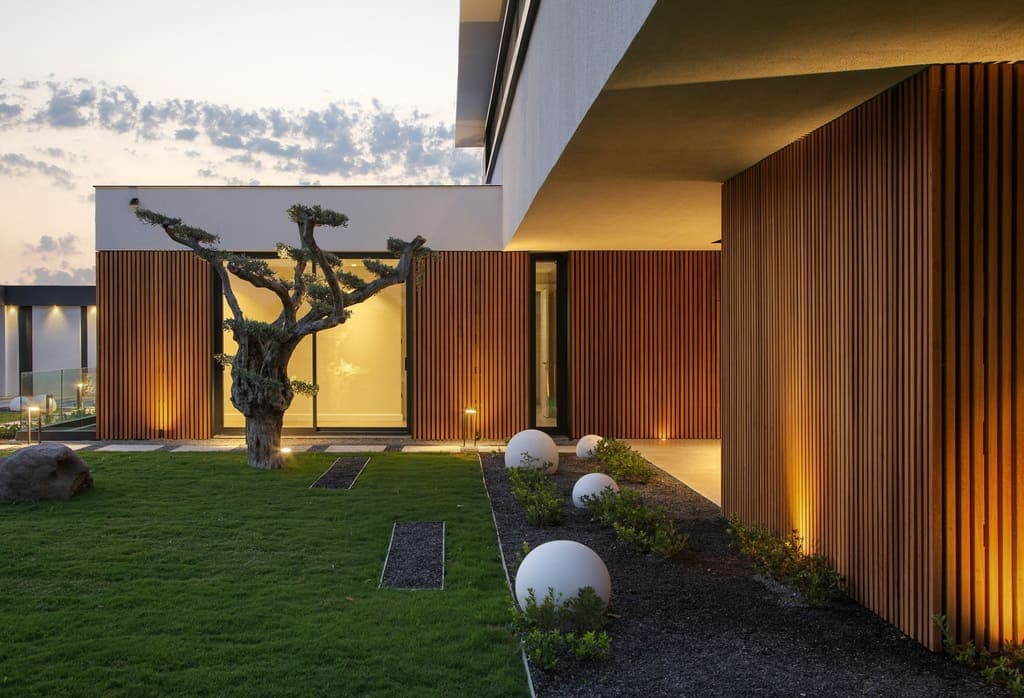
Understanding Thermally Modified Wood
Thermally modified wood undergoes a high-temperature treatment process that alters its cellular structure. This process reduces the wood's moisture absorption and makes it more stable in varying humidity levels. The result is a material less prone to common wood issues like warping, cupping, and twisting, which can be particularly beneficial for outdoor structures exposed to the elements.
The thermal modification process also imbues the wood with a consistent, rich brown tone throughout its thickness. This color can deepen or lighten over time depending on exposure to UV light, eventually weathering to a silvery-gray patina if left unfinished. This natural aging process can be a desirable aesthetic for many privacy screen designs. The material is typically free of the resins and chemicals often found in pressure-treated lumber, offering a different material choice for outdoor use.
Design Considerations for Privacy Screens
When designing a privacy screen with thermally modified wood, consider the desired level of visual obstruction, airflow, and overall aesthetic. Slatted designs are common, allowing for varying degrees of openness. The spacing between boards will dictate privacy and light transmission. Tighter spacing offers more seclusion, while wider gaps can create a more open, airy feel.
The orientation of the boards—horizontal, vertical, or even angled—will significantly impact the screen's appearance and how it interacts with light and shadow throughout the day. Horizontal slats can visually widen a space, while vertical slats can add height. Experimenting with different orientations in your design sketch can help visualize the final outcome.
Remember that a privacy screen is not a structural element on its own. It requires a robust support system, typically posts set securely in the ground or attached to an existing structure. These supports must be designed to withstand local wind loads and the weight of the screen material. Thermally modified wood is suitable for the screen infill, but the structural frame should be engineered separately.
Choosing the Right Profile and Dimensions
Thermally modified wood is available in various profiles, including standard siding and decking boards. For privacy screens, flat-faced profiles are often preferred for their clean lines. Common dimensions for thermally modified wood boards include widths from 4 inches to 8 inches and thicknesses from 3/4 inch to 1 inch. Lengths vary, but typically range from 8 feet to 16 feet.
Consider the scale of your screen and the desired visual impact when selecting board dimensions. Wider boards can create a more substantial, modern look, while narrower boards might lend themselves to a more intricate, textured design. The thickness will contribute to the screen's rigidity and overall presence. Lumber Plus offers thermally modified wood in various profiles suitable for such applications, including those from our NORX product line and Maximo Accoya for specific project needs.
Linked products: [Thermally Modified Wood](/thermally-modified-wood), [Siding and Cladding](/siding-and-cladding), [NORX](/brands/norx), [Maximo Accoya](/products/maximo-accoya)
Installation and Fastening
Proper installation is key to the longevity of any outdoor wood project. For privacy screens, ensure that all cuts are clean and precise. While thermally modified wood is stable, it's still wood and will experience minor movement with changes in atmospheric conditions. Allow for small expansion gaps between boards if a tight, seamless look is not essential for your design, especially if boards are oriented horizontally where water might collect.
Fasteners should be corrosion-resistant, such as stainless steel screws, to prevent staining and ensure long-term holding power. Face fastening is a common and reliable method for privacy screens. Predrilling pilot holes is recommended to prevent splitting, particularly near board ends. Always refer to manufacturer guidelines for specific fastening recommendations for the chosen profile.
A critical aspect is ensuring adequate ventilation around the screen. Avoid designs that trap moisture against the wood, as continuous dampness can lead to issues over time, even with thermally modified material. Maintain a small clearance at the bottom of the screen to prevent direct contact with soil or standing water.
Worked Example: Backyard Privacy Screen
Let's consider a hypothetical privacy screen project for a backyard patio. The desired screen area is 10 feet wide and 6 feet high, designed with horizontal slats to provide a visual barrier from a neighboring property. We'll use thermally modified wood boards, specifically a 1x6 (nominal, actual dimensions approx. 3/4 inch x 5-1/2 inches) profile for a modern, substantial look.
To cover a 10-foot width, we will need to determine the number of boards for each horizontal run. For a 6-foot height, we divide 72 inches (6 feet) by the board face width of 5.5 inches. This gives approximately 13.09 boards. Rounding up, we'll need 14 boards for the height. The total height is 77 + 6.5 = 83.5 inches, which is approximately 6 feet 11.5 inches. This provides a good balance of privacy and airflow.
Each board will be 10 feet long. So, we need 13 boards, each 10 feet long. Total lineal footage: 13 boards * 10 feet/board = 130 lineal feet. When purchasing, it's always advisable to add 10-15% for cuts, waste, and future repairs. For this project, a sensible purchase would be around 145-150 lineal feet of 1x6 thermally modified wood boards.
Before you order
- Determine the primary function: privacy, wind break, or aesthetic accent.
- Assess desired visual transparency and airflow: tighter vs. wider board spacing.
- Choose board orientation: horizontal, vertical, or angled.
- Select a thermally modified wood profile and dimensions (e.g., 1x4, 1x6).
- Plan for structural supports: posts, footings, and attachment methods (not thermally modified wood).
- Verify local building codes for height restrictions and setback requirements.
- Consider the screen's exposure to sun and moisture for long-term weathering.
- Decide on a finish: natural weathering or applied stain/sealant.
- Calculate material quantities, including waste factor.
- Confirm appropriate corrosion-resistant fasteners.
Confirm installation details, approved uses and warranty terms in the current instructions for the exact product and profile. Your installer should verify the substrate, structure and applicable project requirements.
Questions to help you decide
Does thermally modified wood require sealing or staining for a privacy screen?
Thermally modified wood does not require sealing or staining for its durability. It will naturally weather to a silvery-gray patina over time if left untreated. If you prefer to maintain the initial brown tone or introduce a different color, you can apply an exterior wood finish designed for thermally modified wood. Regular maintenance of such a finish would be needed to preserve its appearance.
Can thermally modified wood be used for the structural posts of a privacy screen?
While thermally modified wood is stable and durable, it is typically not recommended for direct ground contact or as primary structural posts without specific engineering. Its primary benefit is in reducing moisture movement, not necessarily in enhanced structural strength for load-bearing applications. For posts, it is generally better to use pressure-treated lumber, steel, or other materials specifically designed for ground contact and structural support. Thermally modified wood is excellent for the screen infill.
How does thermally modified wood compare to cedar or redwood for privacy screens?
Thermally modified wood offers enhanced dimensional stability compared to untreated cedar or redwood, meaning it is less likely to warp, cup, or twist over time, especially in fluctuating humidity. While cedar and redwood have natural resistance to decay, thermally modified wood's process also improves its resistance to rot and insects. All three can achieve a natural weathered look, but the stability of thermally modified wood can result in a more consistent long-term appearance for the screen's form.
Ready to Plan Your Thermally Modified Wood Privacy Screen?
Request a material quote from Lumber Plus. Provide your project dimensions, desired profile, and ZIP code to receive accurate pricing and confirm current availability and service options for your area.
Request a material quote →