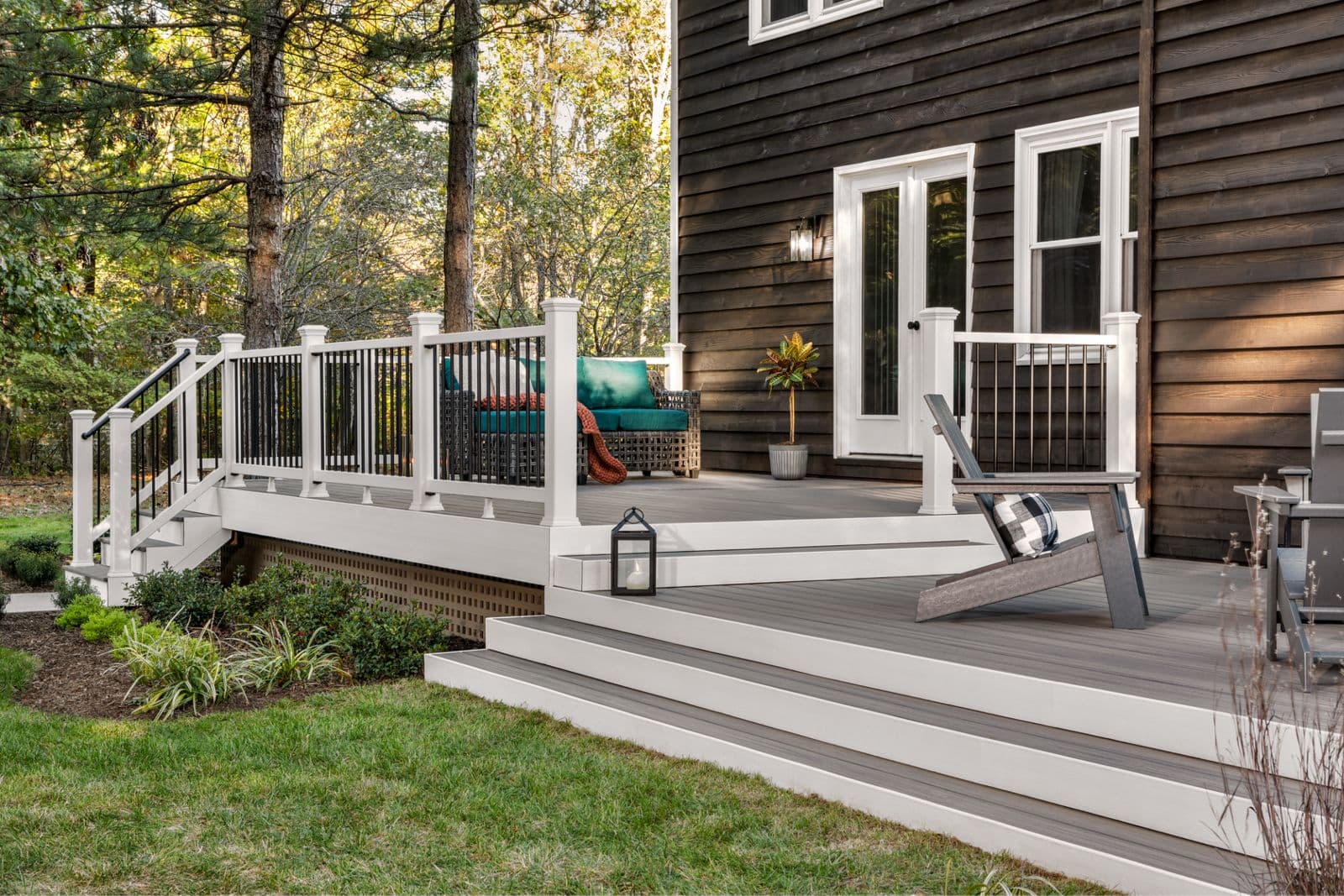
Understanding Decking Board Dimensions and Units
Decking boards are typically sold in linear feet, with various standard lengths and widths available. Common lengths often include 8, 10, 12, 16, and 20 feet. Widths can vary significantly, from standard nominal dimensions like 5/4x6 (which is approximately 1 inch thick by 5.5 inches wide) to wider planks, or even narrower trim pieces. Always confirm the exact dimensions of the specific product you intend to use.
When calculating, it's essential to use the actual, milled dimensions of the board, not just the nominal size. For example, a nominal 6-inch wide board might actually measure 5.5 inches wide. This difference impacts your coverage calculations.
Different decking materials, such as hardwood, thermally modified wood, acetylated wood like Maximo Accoya, composite, and PVC, come in various profiles and dimensions. Hardwood decking like Ipe is known for its durability and often comes in standard profiles. Thermally modified Ash and Maximo Accoya offer enhanced stability. Composite and PVC decking are often available in consistent dimensions and can be ideal for low-maintenance applications. Always refer to the product specifications for exact measurements. (S1)
Measuring Your Deck Area
Start by measuring the total length and width of your deck frame in feet and inches. If your deck has an irregular shape, divide it into simpler rectangles or squares, measure each section individually, and then sum the areas. For any curved sections, it may be necessary to approximate with straight segments or consult with a professional.
For a standard rectangular deck, multiply the length by the width to get the total square footage. For example, a deck that is 10 feet long and 12 feet wide has an area of 120 square feet. This is your base area for calculation, but it is not the final purchase quantity.
Consider any features that will reduce the decking area, such as built-in planters, hot tub cutouts, or support posts. Measure these areas and subtract them from your total deck surface area. Conversely, if you plan to add stairs or a picture-frame border, these will require additional material and should be calculated separately.
Calculating Linear Footage Needed
Once you have the total square footage of your deck, you need to convert this into linear footage based on your chosen board width. The formula is: Total Linear Feet = (Total Square Feet / Board Width in Feet).
For example, if you have a 120 square foot deck and are using boards that are 5.5 inches wide (which is approximately 0.458 feet), your calculation would be: 120 sq ft / 0.458 ft = 262 linear feet. This is the theoretical minimum linear footage.
Remember to account for board spacing. Most decking requires a small gap between boards for drainage and expansion/contraction. This gap is usually specified by the manufacturer. While it doesn't directly change the linear footage of material you buy, it affects how many boards you'll need to cover a given width. For simplicity in initial calculations, use the board's actual width and then factor in waste.
Worked Example: A Rectangular Deck
Let's consider a hypothetical rectangular deck measuring 14 feet by 18 feet. We plan to use 16-foot long, 5.5-inch wide (actual dimension) composite decking boards, laid perpendicular to the 14-foot dimension.
1. **Calculate Total Area:** 14 feet * 18 feet = 252 square feet.
2. **Determine Boards Needed to Cover Width:** The boards are 5.5 inches wide. If laid across the 14-foot dimension, you'll need 14 feet * 12 inches/foot = 168 inches. Number of boards = 168 inches / 5.5 inches/board = 30.54 boards.
3. **Calculate Total Linear Footage (Theoretical):** Each board will run 18 feet. So, 31 boards * 18 feet/board = 558 linear feet. However, boards are sold in 16-foot lengths.
4. **Account for Board Lengths and Cuts:** Since the deck is 18 feet long, each 16-foot board will be too short. You will need to join boards. If you choose to run boards across the 14-foot dimension, each 18-foot run will require one 16-foot board and a 2-foot section from another board. This leads to significant waste if not planned carefully.
A more efficient approach for an 18-foot run with 16-foot boards might be to use one 16-foot board and then cut a 2-foot section from another board. The remaining 14-foot section from that second board could be used for another 18-foot run (paired with another 16-foot board). This strategy requires careful cutting and planning to minimize waste.
For this example, let's assume we are laying boards across the 14-foot width, and the deck length is 18 feet. Each 18-foot run requires two board sections. If using 16-foot boards, you could use one 16-foot board and one 2-foot piece. The 14-foot offcut from the board that provided the 2-foot piece can be used for another run's 14-foot section. This means for every two 18-foot runs, you'd effectively use two 16-foot boards plus one additional 16-foot board (cut into a 2-foot and 14-foot section).
Let's simplify for clarity and assume an 18-foot run. If you use 16-foot boards, you'll need one 16-foot board and one 2-foot cut. This means each 18-foot run effectively consumes two 16-foot boards if the 14-foot offcut cannot be perfectly utilized. If you can perfectly utilize the 14-foot offcut from one board to complete another run, then for every two 18-foot runs, you would purchase three 16-foot boards.
Total 18-foot runs needed: 31 runs (from step 2).
If each run requires two 16-foot boards (one full, one for a 2-foot section with a 14-foot offcut), then 31 runs * 2 boards/run = 62 boards. However, if the 14-foot offcuts are reusable, you essentially get two 18-foot runs from three 16-foot boards. So, 31 runs / 2 runs per 3 boards = 15.5 sets. 15.5 * 3 = 46.5 boards. Round up to 47 boards.
This illustrates why a waste factor is crucial and why longer board lengths, if available, can reduce cuts and waste.
5. **Apply Waste Factor:** For a project with many cuts or an intricate design, a waste factor of 10-15% is common. For simpler, straight layouts, 5-7% might suffice. For this example, let's use 10% waste for the 47 calculated boards. 47 boards * 1.10 = 51.7 boards. Round up to 52 boards.
In this scenario, you would order 52 boards of 16-foot long, 5.5-inch wide composite decking. This calculation assumes careful planning of cuts to minimize waste of the 14-foot offcuts.
Accounting for Waste and Cuts
No decking project is perfectly efficient. Cuts are necessary for ends, around posts, and for creating joints. A waste factor is an additional percentage of material added to your theoretical calculation to account for miscuts, damaged boards, or simply the inefficiencies of cutting boards to fit.
Typical waste factors range from 5% to 15%, depending on the complexity of your deck design and your chosen board lengths. For diagonal layouts, picture-frame borders, or decks with many angles and cutouts, a higher waste factor (10-15%) is advisable. For simple rectangular decks with boards running straight, 5-7% might be sufficient.
Always round up to the nearest full board when calculating your final order quantity. It's generally better to have a few extra boards for future repairs or unexpected issues than to be short during installation.
Consider Fascia, Trim, and Stairs
Don't forget to include materials for fascia boards, trim, and stairs in your calculations. Fascia boards are typically thinner boards used to cover the rim joists around the perimeter of the deck, providing a finished look. Measure the linear perimeter of your deck to determine the fascia length needed. For stairs, measure the length of each tread and riser, and then multiply by the number of steps.
These components often use different profiles or dimensions than the main decking boards, so calculate them separately. For example, some composite decking systems offer matching fascia and riser boards specifically designed for these applications. (S1)
Before you order
- Have I measured the exact dimensions (length and width) of my deck area?
- Have I accounted for any cutouts or irregular shapes in the deck plan?
- Do I know the actual width and length of the specific decking boards I plan to use?
- Have I decided on the direction the decking boards will run?
- Have I calculated the theoretical linear footage required?
- Have I applied an appropriate waste factor (e.g., 5-15%) based on project complexity?
- Have I rounded up to the nearest full board for the final quantity?
- Have I separately calculated material needed for fascia, trim, and stairs?
- Have I considered potential board joining if my deck length exceeds standard board lengths?
Confirm installation details, approved uses and warranty terms in the current instructions for the exact product and profile. Your installer should verify the substrate, structure and applicable project requirements.
Questions to help you decide
What is the difference between nominal and actual board dimensions?
Nominal dimensions are traditional names for lumber sizes (e.g., 2x4 or 5/4x6), while actual dimensions are the exact measurements of the board after milling. For decking, a nominal 5/4x6 board might actually measure closer to 1 inch thick by 5.5 inches wide. Always use actual dimensions for accurate quantity calculations.
Why do I need a waste factor, and how much should I add?
A waste factor accounts for material lost due to cuts, miscuts, damaged boards, or design complexities. It's an essential buffer to ensure you don't run short. For simple, straight layouts, 5-7% is often sufficient. For more complex designs, diagonal patterns, or decks with many cutouts, a 10-15% waste factor is recommended.
Should I order extra boards for future repairs?
Yes, it is often advisable to order a few extra boards beyond your calculated quantity and waste factor. Having spare boards from the same batch can be invaluable for future repairs, ensuring a perfect match in color and profile. Store them properly to maintain their condition.
Ready to Get Started?
Request a material quote for your decking project. Provide your project dimensions, desired decking profile (e.g., Ipe, thermally modified Ash, Maximo Accoya, composite, or PVC), and your ZIP code to confirm current availability and service options.
Request a material quote →