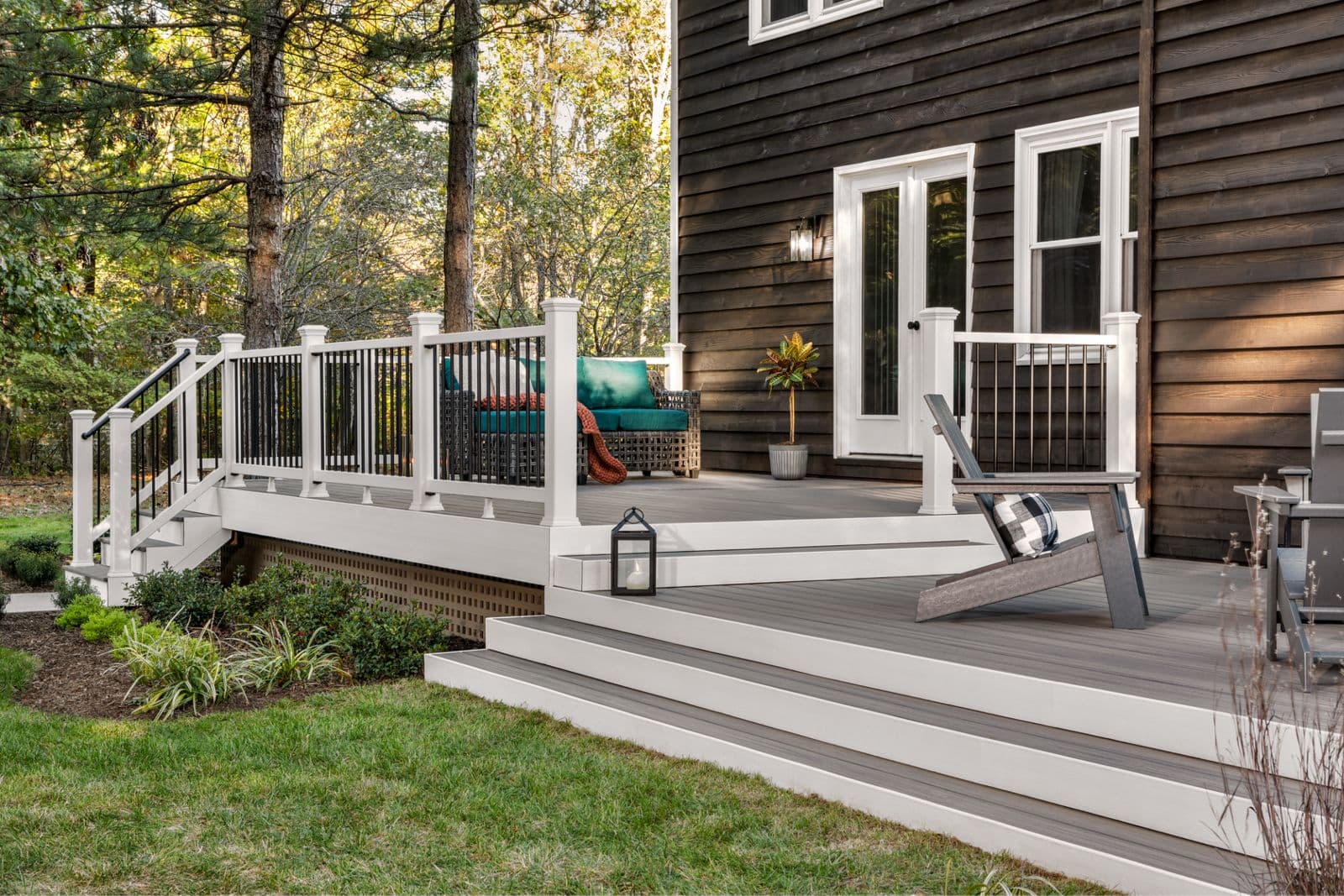
Choosing Your Trex Collection: Style Meets Durability
Trex offers several decking collections, each with distinct aesthetics and performance characteristics. For a backyard gathering space, the choice often comes down to balancing desired appearance with budget and specific site considerations. All Trex lines feature a core of 95% recycled wood fiber and plastic film, capped on three sides for enhanced protection against stains and fading.
The Trex Enhance® collection, including Basics and Naturals, provides an entry-level option with a lightweight profile and traditional or multi-tonal wood grain appearances. Enhance Basics offers colors like Clam Shell, Beach Dune, and Saddle. Enhance Naturals expands with options such as Foggy Wharf, Rocky Harbor, Toasted Sand, and Coastal Bluff, aiming for a more authentic wood look. For a mid-range option, Trex Select® Earth Tones offers hallmark high-performance shell technology in colors like Pebble Grey, Winchester Grey, Woodland Brown, and Madeira.
For a premium gathering space, the Trex Transcend® collection, available in Earth Tones and Tropical, provides elevated aesthetics and a high level of performance. Transcend Earth Tones includes colors like Gravel Path, Rope Swing, and Vintage Lantern, while Transcend Tropical offers vibrant options such as Havana Gold, Island Mist, Tiki Torch, Spiced Rum, and Lava Rock. Consider the overall architectural style of your home and the desired ambiance for your gathering area when making your selection.
Planning Deck Dimensions and Layout
Accurate measurements are crucial for any decking project. For a backyard gathering space, consider how people will move, where furniture will be placed, and if you plan to incorporate elements like an outdoor kitchen or fire pit. Trex boards are typically 1 inch thick by 5.5 inches wide, available in 12, 16, and 20-foot lengths. Both grooved and square-edge profiles are offered.
A common layout involves running boards perpendicular to the house, which can make the space feel larger. For a more sophisticated look, a diagonal layout can add visual interest but may result in more material waste due to angled cuts. Picture-frame borders, using square-edge boards to frame the deck perimeter, create a finished edge and can help define different zones within a larger gathering space. When planning, account for board spacing as specified by Trex to allow for proper drainage and thermal expansion/contraction. This is a critical detail for long-term performance.
For example, consider a rectangular gathering deck measuring 16 feet by 12 feet. If using 16-foot Trex boards running along the 16-foot dimension, you would need 26 boards (12 feet / 5.5 inches per board = 26.18, rounded up to 27 boards, then accounting for a 16-foot length for each board). If you opt for a picture-frame border, you'll need additional square-edge boards for the perimeter. Always factor in extra material for cuts and potential waste, typically 5-10%.
Fascia and Edge Finishes: Completing the Look
Fascia boards are essential for a polished deck appearance, covering the visible rim joists of your deck structure. Trex offers matching fascia boards for each decking collection, ensuring a consistent aesthetic. These typically come in complementary colors and finishes to your chosen deck boards.
Beyond aesthetics, fascia boards protect the deck's substructure from direct exposure to the elements, contributing to the overall longevity of your deck. When planning, measure the perimeter of your deck, including any stairs or multi-level sections, to determine the required length of fascia. Like deck boards, it's advisable to order slightly more than the exact measurement to allow for cuts and any adjustments.
For open-air gathering spaces, especially those elevated, the fascia is a prominent visual element. Selecting a color that either matches or subtly contrasts with your deck boards can enhance the design. For instance, a lighter fascia might highlight the deck's edges, while a matching color creates a seamless flow.
Fastening Systems: Hidden vs. Face Screws
Trex decking can be installed using either hidden fastening systems or face screws. The choice impacts both the deck's appearance and the installation process. Hidden fasteners create a smooth, uninterrupted deck surface, as the clips are installed in the grooved edges of the boards and are not visible from above. This is often preferred for gathering spaces where a clean, sophisticated look is desired.
Hidden clips are typically installed into the deck joists, securing the boards while allowing for appropriate spacing. Trex boards are designed to be compatible with various hidden fastening systems. Always confirm compatibility with your chosen Trex collection and consult the manufacturer's installation guidelines for specific clip types and spacing requirements.
Alternatively, face screws involve screwing directly through the face of the deck board into the joist. While visible, this method provides a strong, secure connection. If using face screws, consider using color-matched screws or plugs to minimize their visual impact. This method may be preferred in areas requiring maximum structural integrity or for projects where a more traditional aesthetic is desired. Regardless of the method, proper installation is key to ensuring the deck's stability and longevity.
Maintenance for Long-Term Enjoyment
One of the primary advantages of Trex composite decking for a gathering space is its low-maintenance profile. Unlike traditional wood, Trex does not require sanding, staining, or sealing to maintain its appearance or validate its warranty. This means more time enjoying your deck and less time on upkeep.
General maintenance for Trex decking involves periodic cleaning with soap and water. This helps remove dirt, pollen, and other debris that can accumulate over time. For tougher stains or spills, consult Trex's specific cleaning recommendations, as certain products may not be compatible. Regular cleaning helps preserve the deck's original color and finish, ensuring it remains an attractive space for entertaining year after year.
In Green Bay's climate, which experiences all four seasons, routine cleaning is particularly beneficial after winter to remove any accumulated snowmelt residues or salt, and before summer gatherings to refresh the surface. Ensuring proper ventilation underneath the deck also contributes to its long-term performance, as it helps manage moisture and temperature fluctuations.
Before you order
- Determine the primary function and desired aesthetic of your gathering space.
- Select a Trex collection (Enhance, Select, or Transcend) based on style, performance, and budget.
- Measure your deck area accurately, considering furniture placement and traffic flow.
- Plan your board layout (perpendicular, diagonal, picture-frame border).
- Calculate the required quantity of deck boards, accounting for lengths and cuts.
- Choose between grooved (for hidden fasteners) or square-edge boards.
- Select matching fascia boards for a finished perimeter.
- Decide on the fastening system: hidden clips for a seamless look or face screws for visible security.
- Review Trex installation guidelines for specific spacing and ventilation requirements.
- Plan for ongoing soap-and-water cleaning to maintain your deck.
Confirm installation details, approved uses and warranty terms in the current instructions for the exact product and profile. Your installer should verify the substrate, structure and applicable project requirements.
This is a planning guide for projects in Green Bay, WI. Ask our team to confirm availability, delivery to your ZIP code and which branch can support your order.
Questions to help you decide
What makes Trex decking suitable for Green Bay's climate?
Trex composite decking is engineered to withstand various weather conditions, including the freeze-thaw cycles, snow, and humidity common in Green Bay, WI. Its three-sided capping helps resist moisture absorption, fading, and staining, offering a durable surface that requires minimal maintenance compared to traditional wood, even with seasonal changes.
Can I use Trex decking for a multi-level gathering space?
Yes, Trex decking is suitable for multi-level deck designs. When planning a multi-level gathering space, ensure that all structural elements meet local building codes. You'll need to coordinate board lengths, fascia, and railing systems across different levels for a cohesive look. Hidden fasteners can maintain a clean aesthetic on all visible surfaces.
How do I calculate the amount of Trex decking I need for my project?
To calculate the amount of Trex decking, first determine the total square footage of your deck. Then, divide this by the square footage of a single Trex board (e.g., a 1"x5.5"x16' board is 0.4583 sq ft/linear ft * 16 ft = 7.33 sq ft). Round up to the nearest whole board. Always add an additional 5-10% for cuts, waste, and future repairs. Also, calculate linear footage for fascia boards separately based on your deck's perimeter. It's recommended to consult with a professional or use a decking calculator for precise estimates.
Ready to Plan Your Trex Decking Project?
Request a material quote today. Provide your project dimensions, desired Trex profile (e.g., Trex Transcend Tropical, Island Mist, grooved), and your Green Bay ZIP code to confirm current availability and service options.
Request a material quote →