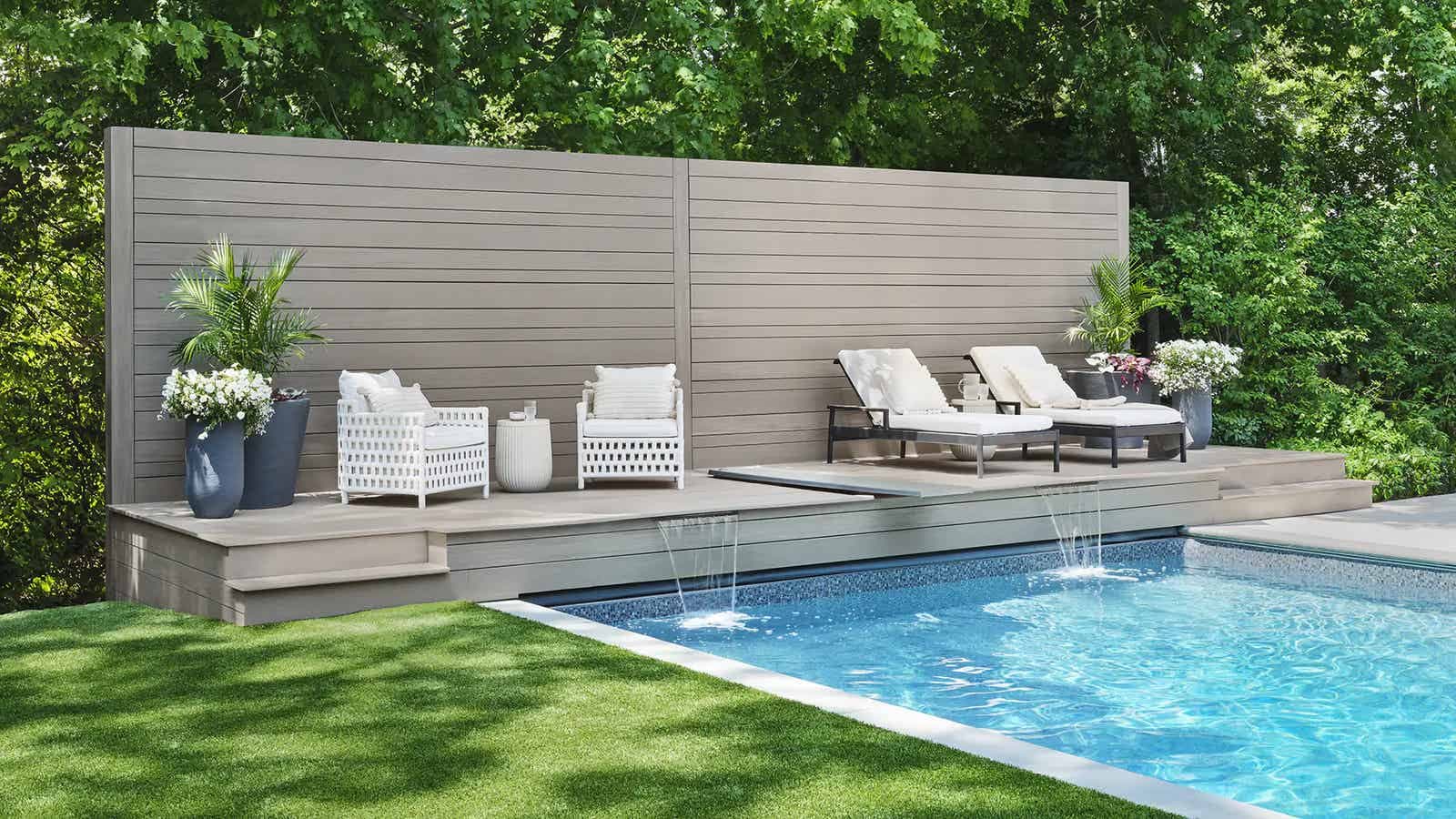
Why PVC Decking for Pool Terraces?
PVC decking is a 100% synthetic material, meaning it contains no wood fiber. This composition is a significant advantage for areas consistently exposed to water, such as pool surrounds. Unlike wood or even some composite materials, PVC boards are waterproof to the core, which means they are not susceptible to swelling, staining, or rot when exposed to standing water, splash zones, or even salt spray.
This inherent water resistance makes PVC decking a practical choice where boards are expected to live wet. It simplifies maintenance related to water exposure and helps maintain the deck's structural integrity and appearance over time. The material also tends to weigh less than hardwood and some composite options, potentially easing handling and installation.
Manufacturers like Azek and TimberTech offer PVC decking lines that are specifically marketed for applications such as docks and pool decks, highlighting their suitability for these demanding environments.
Key Benefits for a Poolside Environment
The primary benefit of PVC decking around a pool is its superior resistance to moisture and its associated problems. With zero wood fiber, there's nothing in the board structure to swell, stain, or rot from prolonged water exposure, making it a robust choice for high-splash areas.
Beyond water resistance, PVC decking is known for its low maintenance requirements. Capped polymer surfaces are designed to shed common spills like grease and wine, allowing for easy cleaning with just soap and water. This is particularly useful around a pool where spills from beverages, sunscreen, or food are common.
Many PVC decking lines also offer heat-mitigating color options. While no material will eliminate heat absorption entirely under direct sun, these options can contribute to a more comfortable surface temperature, which is an important consideration for bare feet around a pool.
The material is also 100% recyclable, which can be an environmental consideration for some homeowners.
Design and Aesthetics: Achieving the Right Look
PVC decking is available in a range of collections that offer diverse aesthetics, including deep wood looks. For example, TimberTech Azek's Vintage, Landmark, and Harvest collections are noted for providing sophisticated appearances in PVC. This means you don't have to compromise on visual appeal when choosing a high-performance material.
When planning your pool terrace, consider how the decking color and texture will complement your home's exterior and the pool's finish. Lighter colors may offer better heat reflection, while darker tones can provide a striking contrast. Sample boards can help visualize the final look in various lighting conditions.
Think about the overall layout, including board direction, potential picture-frame borders, and how the decking transitions to other hardscaping or landscaping elements around the pool. The flexibility in design allows for custom layouts that enhance the pool area's functionality and visual appeal.
Installation Considerations for Pool Terraces
While PVC decking offers advantages in material properties, proper installation remains crucial, especially in a wet environment. Ensure that the deck frame and substructure are designed to accommodate the specific requirements of a pool terrace, including adequate ventilation and drainage beneath the deck surface.
Board spacing is critical for proper water runoff and material expansion/contraction. Always follow the manufacturer's specific guidelines for spacing, as these can vary by product line and expected temperature fluctuations. Incorrect spacing can lead to water pooling or boards buckling.
Consider fascia and edge finishes that complement the main decking boards and provide a neat, finished appearance around the pool. These details contribute significantly to the overall aesthetic and safety of the pool terrace. Fastener systems, whether hidden or face-fastened, should also be compatible with the specific PVC decking product and suitable for wet conditions.
Maintenance and Longevity for Poolside Decks
One of the primary appeals of PVC decking is its low maintenance. Regular cleaning with soap and water is typically sufficient to keep the surface looking good. For specific stains or heavier cleaning, consult the manufacturer's cleaning product compatibility guidelines to avoid damaging the surface.
While PVC decking is resistant to many common issues, it's not entirely maintenance-free. Periodically inspect the deck for any debris accumulation in board gaps, ensure proper drainage is maintained, and check for any signs of wear or damage. Promptly addressing any issues can help preserve the deck's appearance and performance.
Manufacturers often offer warranties that cover aspects like fade and stain performance. Understanding the terms of these warranties can provide peace of mind regarding the long-term investment in your pool terrace.
Worked Example: Designing a Rectangular Pool Terrace
Let's consider a hypothetical rectangular pool terrace project measuring 20 feet by 15 feet, designed to surround a swimming pool. For this example, we'll use a standard PVC decking board width of 5.5 inches and assume available lengths of 12, 16, and 20 feet. We'll plan a straightforward layout with boards running parallel to the 20-foot dimension.
To cover the 15-foot width, we need to calculate the number of board courses. 15 feet is 180 inches. Dividing 180 inches by the 5.5-inch board width gives approximately 32.73 boards. Since we can't use a fraction of a board for a full course, we'll need 33 courses of boards. Each course will be 20 feet long.
For the 20-foot length of each course, using 20-foot boards is the most efficient, as it avoids seams within the main decking area. Thus, for 33 courses, we would need 33 boards, each 20 feet long. This totals 660 linear feet of decking. If 20-foot boards are not available or practical for handling, two 12-foot boards could be used for each course (totaling 24 feet per course), with a 4-foot offcut from one board, or a 16-foot board and a 4-foot board, if that length is available. For simplicity and minimal seams, the 20-foot length is preferred here.
This calculation assumes no waste for cuts around the pool edge or for a picture frame border. In a real project, additional material would be needed to account for these elements, as well as a waste factor (typically 5-10%). For a picture frame border, additional linear footage of fascia or matching decking would be required to frame the perimeter, considering mitered corners. Always measure the specific dimensions of your pool and surrounding area, including any curves or irregular shapes, to get an accurate material takeoff.
Before you order
- Confirm the exact dimensions of your pool terrace area, including any curves or unique shapes.
- Review PVC decking samples in various lighting conditions to assess color and texture.
- Verify manufacturer-specific installation guidelines for board spacing and substructure requirements in wet areas.
- Consider heat-mitigating color options if the deck will receive significant direct sun exposure.
- Plan for drainage and ventilation beneath the deck surface.
- Choose compatible fasteners and edge finishing options for a complete look.
- Understand the manufacturer's cleaning and maintenance recommendations for poolside use.
Confirm installation details, approved uses and warranty terms in the current instructions for the exact product and profile. Your installer should verify the substrate, structure and applicable project requirements.
This is a planning guide for projects in Green Bay, WI. Ask our team to confirm availability, delivery to your ZIP code and which branch can support your order.
Questions to help you decide
Is PVC decking slippery when wet?
The level of slip resistance can vary by manufacturer and specific product line. It is always recommended to review the product specifications and consider the specific conditions of your pool terrace, such as the presence of algae or other residues, which can affect any surface's traction.
Can I use PVC decking directly on concrete around my pool?
Installing decking directly on concrete requires careful planning to ensure proper drainage and ventilation. While PVC decking is waterproof, it still needs airflow to prevent moisture buildup beneath the boards and to ensure the longevity of the substructure. It is generally recommended to install a proper sleeper system or pedestals to lift the decking off the concrete, allowing for water runoff and air circulation. Always consult the manufacturer's installation guide for specific recommendations for concrete slab applications.
How does PVC decking handle pool chemicals?
PVC decking is generally resistant to common pool chemicals. Its synthetic composition means it won't react or degrade in the same way wood might. However, it's always advisable to avoid prolonged exposure to highly concentrated chemicals. Spills should be cleaned promptly with soap and water according to the manufacturer's recommendations to prevent any potential surface discoloration or damage. Refer to the specific product's care instructions for detailed guidance on chemical resistance.
Ready to Plan Your Pool Terrace with PVC Decking?
Request a material quote today. Provide your project dimensions, desired PVC decking profile, and ZIP code to confirm current availability and service options. Explore our full range of <a href="/decking/pvc">PVC decking</a>, <a href="/decking">all decking options</a>, <a href="/decking/hardwood">hardwood decking</a>, <a href="/decking/hardwood/ipe">Ipe decking</a>, and <a href="/decking/composite">composite decking</a>.
Request a material quote →