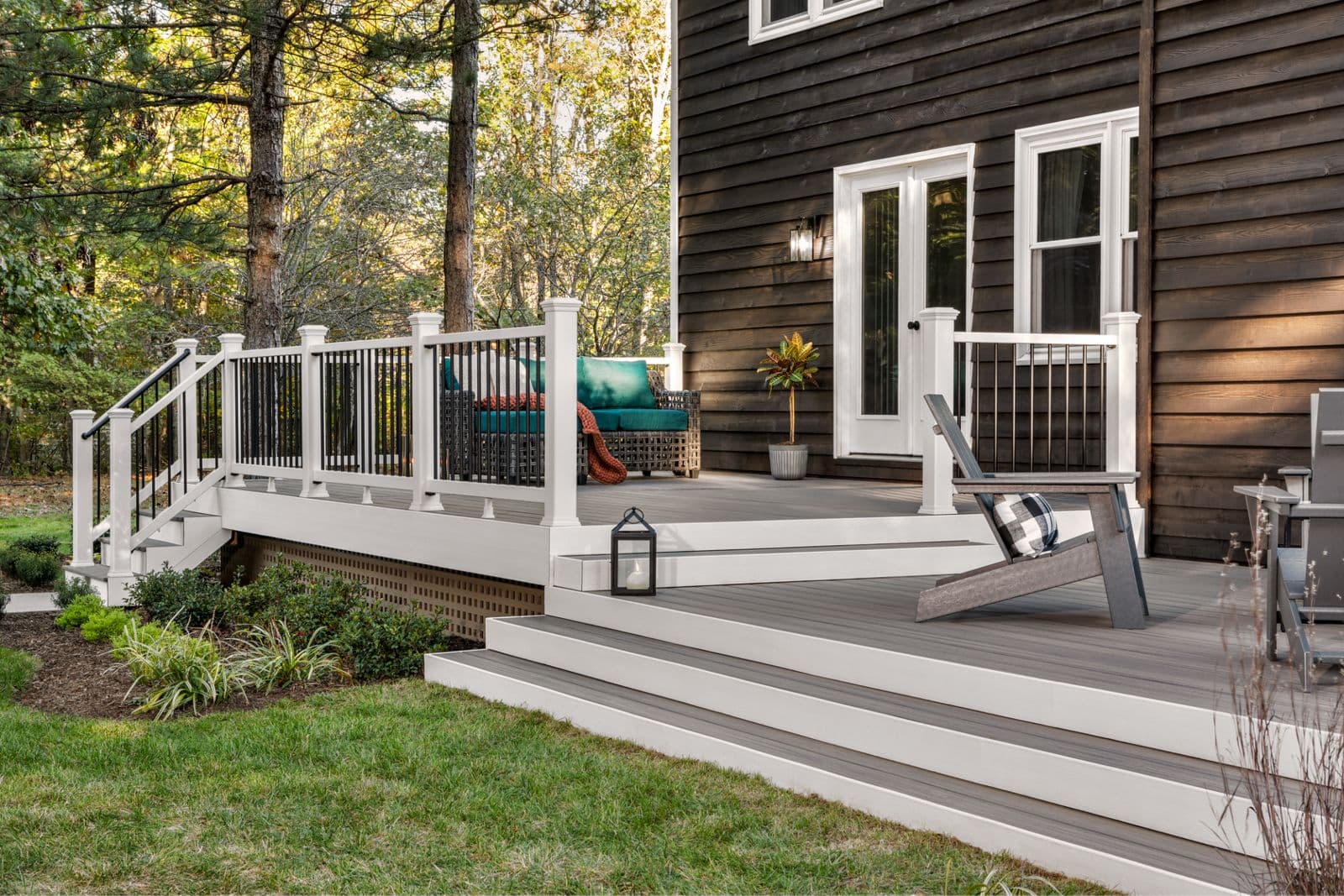
Understanding Trex Collections: Aesthetics and Performance
Trex offers several decking lines, each with varying aesthetics and performance features, all built on a core of 95% recycled wood fiber and plastic film. For a backyard gathering space, the choice of collection often balances desired appearance with budget and specific site conditions.
The Enhance® Basics and Enhance® Naturals lines provide an entry point with traditional and multi-tonal colors, respectively. They are lightweight and capped on three sides. The Select® Earth Tones line steps up with hallmark high-performance shell technology and nature-inspired colors, also capped on three sides.
For a premium gathering space, the Transcend® Earth Tones and Transcend® Tropical collections offer elevated aesthetics and a high level of performance. These flagship lines feature vibrant colors and luxurious finishes, thanks to their three-side shell protection. Consider the overall architectural style of your home in Bend and the surrounding landscape when selecting a collection. For example, a home with rustic elements might lean towards Earth Tones, while a more contemporary design could benefit from Tropical hues.
This consistent performance across lines simplifies long-term care, allowing you to focus on enjoying your outdoor space.
Coordinating Dimensions and Board Profiles
Trex decking boards are manufactured in standard dimensions, typically 1 inch by 5.5 inches, available in both grooved and square-edge profiles. Grooved boards are designed to work with hidden fastening systems, creating a smooth, fastener-free surface ideal for barefoot traffic in a gathering space. Square-edge boards are used for perimeter boards, stair treads, and for face-fastening applications where visible fasteners are acceptable or desired.
Lengths commonly available include 12, 16, and 20 feet. Planning your deck layout to minimize waste and visible seams is crucial. For larger gathering areas, longer boards can reduce the number of butt joints, creating a more continuous appearance. Consider the overall dimensions of your desired gathering space, including areas for dining, lounging, or an outdoor kitchen, to determine the most efficient board lengths.
When designing, account for board spacing as specified by Trex installation guidelines. Proper spacing is essential for drainage and thermal expansion/contraction of the composite material. This is particularly important in areas like Bend, where temperatures can fluctuate.
Fascia and Edge Finishes: The Border Details
The fascia board is a critical component that covers the rim joists of your deck, providing a finished look to the perimeter. Trex offers matching fascia boards for each decking collection, ensuring a consistent aesthetic. These boards are typically thinner than deck boards and are designed for vertical application.
When planning your gathering space, consider how the fascia will interact with any stairs, planters, or other landscape elements. A well-chosen and installed fascia can elevate the perceived quality of the entire deck. For areas visible from multiple angles, such as a raised deck, the fascia becomes a prominent design feature.
Edge finishing also includes how the deck transitions to the ground or other hardscaping. Square-edge boards can be used for picture-frame borders, creating a clean, defined perimeter around the main deck area. This detail can frame the gathering space and differentiate it from surrounding landscaping.
Fastening Systems: Hidden vs. Face Screws
Hidden fastening systems, used with grooved-edge boards, involve clips that secure the boards to the joists from the side, resulting in a smooth, unmarred deck surface. This is often preferred for gathering spaces where aesthetics and barefoot comfort are priorities. The clips also provide consistent spacing between boards.
Face-fastening involves screwing directly through the face of the deck board into the joist. This method uses color-matched screws to blend with the decking. While providing a strong connection, the screw heads remain visible. Square-edge boards, often used for perimeter boards, stair treads, or specific design elements, typically require face-fastening.
When planning for a gathering space, weigh the visual preference for a hidden fastener system against any structural requirements or specific design details that might necessitate face-fastening. Always use fasteners compatible with Trex decking to ensure proper installation and warranty validity.
Maintenance for Lasting Enjoyment in Bend
One of the significant advantages of Trex decking for a backyard gathering space is its low maintenance. Unlike traditional wood decks that require regular sanding, staining, or sealing, Trex composite decking is designed to resist fading, staining, and splintering, making it "barefoot safe."
Routine maintenance primarily involves a simple soap-and-water wash to remove dirt, pollen, and other debris. This keeps the deck looking its best and helps maintain the warranty. For specific cleaning instructions, always refer to the manufacturer's guidelines, as incompatible cleaning products could affect the deck's surface.
In a climate like Bend, with seasonal changes, occasional cleaning is particularly beneficial. While Trex is designed for durability, proactive cleaning helps preserve its appearance, ensuring your gathering space remains inviting year after year without demanding extensive upkeep.
Worked Example: Planning a 16x20 Foot Gathering Deck
Let's consider a hypothetical 16-foot by 20-foot deck in Bend, OR, intended as a primary gathering space. For this example, we'll choose the Trex Transcend® Tropical line in "Island Mist" for its luxurious finish and durability, suitable for an active outdoor area. We'll plan for grooved boards for the main deck and square-edge boards for a picture-frame border and stair treads.
Main Deck Area: 16 ft x 20 ft. Using 12-foot and 16-foot grooved boards (1" x 5.5"). A common layout for a 16-foot wide deck would involve running boards parallel to the 16-foot dimension, spanning 20 feet. This would mean cutting 16-foot boards to fit the 16-foot width, and then using 12-foot boards to complete the 20-foot length, creating seams. Alternatively, if 20-foot boards are available, they would minimize seams. Let's assume using 16-foot and 12-foot boards. For the 16-foot width, we would need approximately 35 boards (16 ft / 5.5 inches per board = 34.9 boards). For the 20-foot length, this would be one 16-foot board and one 4-foot section, or one 20-foot board if available.
Picture-Frame Border: To define the gathering space, a single board picture frame will be used around the 16x20 foot perimeter. This requires 2 boards at 20 feet and 2 boards at 16 feet (minus the width of the end boards, so approximately 19 feet 1 inch and 15 feet 1 inch). These would be square-edge boards.
Fascia: For a raised deck, fascia will be needed for the perimeter. This would require two 20-foot fascia boards and two 16-foot fascia boards.
Fastening: Hidden clips would be specified for all grooved deck boards in the main area. Face screws, color-matched to Island Mist, would be used for the picture-frame border and any stair treads (not detailed here).
This example illustrates the coordination needed between board profiles, lengths, and fastening systems to achieve the desired aesthetic and functionality for a specific gathering space.
Before you order
- Select Trex Collection: Enhance Basics, Enhance Naturals, Select Earth Tones, Transcend Earth Tones, or Transcend Tropical?
- Determine Main Deck Dimensions: What are the length and width of the primary gathering area?
- Choose Board Profile: Grooved for hidden fasteners or square-edge for face-fastening/perimeter?
- Plan Board Lengths: 12, 16, or 20 ft to minimize cuts and seams?
- Specify Fascia: Will matching fascia be used for the deck perimeter?
- Select Fastening System: Hidden clips for a smooth surface or face screws for visible fasteners?
- Consider Stair and Railing Needs: Are these part of the gathering space design?
- Review Local Building Codes: Confirm any specific requirements for Bend, OR.
- Estimate Quantity: Calculate boards, fascia, and fasteners based on your layout.
Confirm installation details, approved uses and warranty terms in the current instructions for the exact product and profile. Your installer should verify the substrate, structure and applicable project requirements.
This is a planning guide for projects in Bend, OR. Ask our team to confirm availability, delivery to your ZIP code and which branch can support your order.
Questions to help you decide
How do Trex collections differ for a gathering space?
Trex collections vary in finish depth, color range, and aesthetic. Enhance lines offer traditional and multi-tonal options. Select provides hallmark performance and nature-inspired colors. Transcend, the flagship line, delivers elevated aesthetics with vibrant tropical or rich earth tones, offering the highest level of finish and performance for a premium gathering space.
Can I use both grooved and square-edge Trex boards on my deck?
Yes, it is common practice to combine both profiles. Grooved boards are typically used for the main decking area with hidden fasteners for a smooth, unmarred surface. Square-edge boards are ideal for perimeter boards, stair treads, and other areas where a finished edge is desired or where face-fastening is necessary.
What kind of maintenance does Trex decking require in Bend's climate?
Trex decking is designed for low maintenance. In Bend's climate, general cleaning with soap and water is usually sufficient to remove dirt, dust, and any seasonal debris.
Ready to Plan Your Trex Deck in Bend, OR?
Request a material quote with your project dimensions, desired Trex profile, and ZIP code. We can confirm current availability and service options for your backyard gathering space.
Request a material quote →