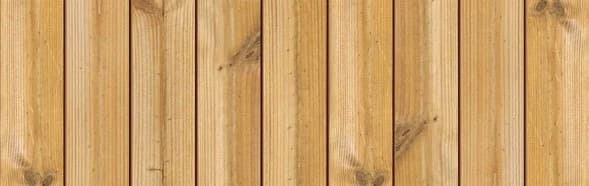
What is Scandinavian Thermally Modified Wood?
Scandinavian Thermally Modified Wood is a selection of Nordic softwood that undergoes a heat and steam treatment process. This modification enhances the wood's dimensional stability without the use of chemical preservatives. The result is a material that retains the visible grain and warm color characteristic of Nordic wood, suitable for modern wall and ceiling systems.
The thermal modification process is designed to improve the wood's performance for various applications, making it a versatile choice for both interior and exterior architectural surfaces. Its natural character and chemical-free treatment are key benefits for projects seeking a sustainable and aesthetically pleasing wood solution.
This material is best suited for walls, ceilings, soffits, facades, and selected decking applications, offering profile options that support coordinated designs across different surfaces.
Understanding Profiles and Nominal Sizes
The profile of a wood product refers to its cross-sectional shape, which dictates its appearance and how it interlocks or attaches to a substrate. Nominal size is a conventional measurement that often differs slightly from the actual, finished dimensions. It's crucial to understand both when planning your project.
For Scandinavian Thermally Modified Wood, specific profiles are offered, each with an associated nominal size and recommended applications:
This profile creates a distinct shadow line between boards.
The Fluted #5 profile, also with a nominal size of 1 × 6, is designed for architectural walls and ceilings, offering a textured surface.
The S4S E4E (Surfaced Four Sides, Eased Four Edges) profile, with a nominal size of 5/4 × 6, is versatile and can be used for siding, ceilings, and decking. Its smooth, eased edges make it suitable for exposed applications.
Approved Applications and Limitations
Each profile of Scandinavian Thermally Modified Wood is intended for specific applications. Understanding these approved uses is vital for the longevity and performance of your project. For instance, while S4S E4E is suitable for decking, V-Joint / Nickel Gap is not typically recommended for walking surfaces.
The material's benefits, such as its natural character and chemical-free process, support its use in a range of interior and exterior settings. However, always confirm that your chosen profile aligns with your intended application. Using a product outside its specified application may affect its performance and appearance over time.
Worked Example: Planning a Feature Wall
Let's consider a hypothetical project: designing an interior feature wall for a living room. The wall measures 10 feet wide by 8 feet high. You want to use the Fluted #5 profile of Scandinavian Thermally Modified Wood to create a textured, warm accent. The nominal size for this profile is 1 × 6.
First, convert the nominal width to inches for calculation: 6 inches. The actual finished width will be slightly less, but for initial material estimation, the nominal width is a good starting point. To cover the 10-foot (120-inch) width of the wall, you would need 120 inches / 6 inches per board = 20 boards.
Since the wall is 8 feet high, you would need boards that are at least 8 feet long. If the material is supplied in 8-foot lengths, you would purchase 20 boards of 1" x 6" x 8' Fluted #5 profile. If longer lengths are available, such as 12-foot, you might optimize cuts to minimize waste, but for an 8-foot height, 8-foot lengths are efficient.
This calculation provides an estimate for covering the surface. It does not account for waste due to cuts, potential defects, or specific installation patterns that might require more material. Always add a percentage (e.g., 10-15%) for waste when ordering.
What to Confirm Before Ordering
Before finalizing your order, take the following steps to ensure you receive the correct material for your project:
Verify the exact dimensions: While nominal sizes are common, always confirm the actual finished dimensions of the chosen profile. This is especially important for precise installations where small differences can accumulate.
Review application suitability: Ensure the profile you've selected is suitable for your specific project area, whether it's an exterior facade, an interior ceiling, or decking.
Consider installation details: Think about how the boards will be fastened and if the profile supports your chosen installation method (e.g., hidden fasteners, face fastening).
Factor in waste: Always include an allowance for cuts, trimming, and potential errors. A standard waste factor is typically 10-15% of the total area.
Before you order
- Do I know the nominal size and actual dimensions of the chosen profile?
- Is the selected profile approved for my intended application (e.g., siding, ceiling, decking)?
- Have I accurately measured the project area to calculate the required linear footage or square footage?
- Have I added an appropriate waste factor (e.g., 10-15%) to my material estimate?
- Do I understand the visual characteristics and expected performance of Scandinavian Thermally Modified Wood for my project?
- Have I considered how the material will be fastened and if the profile is compatible with the chosen fastening system?
Confirm installation details, approved uses and warranty terms in the current instructions for the exact product and profile. Your installer should verify the substrate, structure and applicable project requirements.
Questions to help you decide
What does 'nominal size' mean for wood products?
Nominal size refers to the size of a piece of lumber before it has been planed or finished. The actual, or finished, dimensions will typically be slightly smaller than the nominal dimensions. For example, a nominal 1x6 board will have actual dimensions closer to 3/4 inch thick by 5 1/2 inches wide.
Can Scandinavian Thermally Modified Wood be used for both interior and exterior projects?
Yes, Scandinavian Thermally Modified Wood is suitable for both interior and exterior applications. Its thermal modification process enhances its dimensional stability, making it versatile for uses such as interior feature walls, ceilings, exterior facades, soffits, and selected decking. Always verify the specific profile is approved for your intended use.
What are the primary benefits of choosing Scandinavian Thermally Modified Wood?
Key benefits include its natural character with expressive Nordic grain, a chemical-free modification process using only heat and steam, and its versatility for both interior and exterior applications. It offers improved dimensional stability compared to untreated softwoods, contributing to a more consistent structure.
Ready to Plan Your Project?
Request a material quote today. Provide your project dimensions, desired profile, and ZIP code to confirm current availability and service options for Scandinavian Thermally Modified Wood.
Request a material quote →