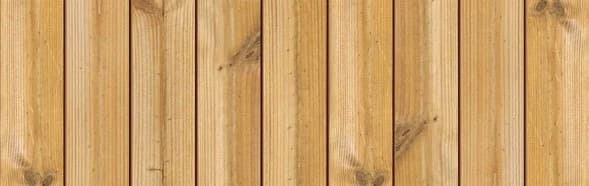
Understanding Profile Types and Their Impact on Aesthetics
The profile of a wood board refers to its cross-sectional shape, particularly how the edges are milled to fit together. This milling creates specific joint types that, in turn, define the visual breaks and shadow lines on a finished surface. Different profiles are designed for various applications and aesthetic goals, from creating tight, nearly seamless surfaces to pronounced, rhythmic patterns.
For Scandinavian Thermally Modified Wood, popular profiles are engineered to enhance its natural appeal and suitability for both interior and exterior applications. The choice of profile directly influences the perceived depth, texture, and overall architectural character of your project. Consider how natural light will interact with the chosen profile throughout the day, as this will highlight the shadow lines and grain patterns.
V-Joint / Nickel Gap Profile: Defined Lines and Classic Appeal
The V-Joint / Nickel Gap profile is a common choice for both siding and ceiling applications. This profile features a slight bevel on the edges of each board, which, when installed, creates a distinctive V-shaped groove or a narrow, consistent gap between boards. This creates a clean, linear shadow line that offers a sense of definition and order.
This dimension, combined with the V-joint detail, is effective in creating surfaces with a classic yet contemporary feel. It is versatile for both horizontal and vertical installations, providing a clear visual rhythm without being overly dominant. The shadow line created by the V-joint helps to articulate each board, contributing to a refined and structured appearance.
Fluted #5 Profile: Texture and Architectural Interest
For projects aiming for increased texture and architectural depth, the Fluted #5 profile offers a distinct alternative. This profile incorporates multiple parallel grooves or 'flutes' along the face of the board, creating a ribbed surface. When installed, these flutes generate a series of fine, intricate shadow lines that add visual complexity and a tactile quality to walls and ceilings.
The Fluted #5 profile for Scandinavian Thermally Modified Wood is also typically offered in a 1 × 6 inch nominal size. This profile is particularly well-suited for architectural walls and ceilings where a more dynamic surface is desired. The interplay of light and shadow across the flutes can create a sense of movement and visual richness, making it an excellent choice for accent walls or areas where texture is a primary design element.
S4S E4E Profile: Smooth Surfaces and Minimalist Edges
The S4S E4E profile, which stands for "Surfaced Four Sides, Eased Four Edges," provides a smooth, uniform appearance. This profile features boards that are planed smooth on all four faces, with slightly rounded or eased edges. When installed, the S4S E4E profile minimizes prominent shadow lines, creating a more continuous and sleek surface.
Commonly available in a 5/4 × 6 inch nominal size for Scandinavian Thermally Modified Wood, the S4S E4E profile is suitable for a range of applications including siding, ceilings, and selected decking. Its minimalist aesthetic allows the natural grain and warm color of the wood to be the primary focus, without the visual interruption of deep grooves or flutes. This profile is often chosen for modern designs where clean lines and an uncluttered look are paramount. While it offers less pronounced shadow lines, the subtle easing of the edges still provides a delicate visual separation between boards.
Worked Example: Calculating Coverage and Shadow Line Impact
Consider a hypothetical wall section measuring 10 feet wide by 8 feet high, intended for Scandinavian Thermally Modified Wood cladding. While both have a 1x6 nominal size, the actual coverage width per board is crucial for accurate calculations.
For this example, let's assume an actual coverage width of 5.125 inches for both 1x6 profiles, accounting for the overlap or joint detail. The total wall area is 80 square feet. To cover the 10-foot (120-inch) width, you would need 120 inches / 5.125 inches per board = approximately 23.4 boards. Since you cannot purchase partial boards, you would need 24 full boards. For an 8-foot height, each board would be 8 feet long. Thus, you would purchase 24 boards, each 8 feet long.
Each shadow line provides a clear visual break. For the Fluted #5 profile, the 24 boards would also create 23 primary joint lines, but each board itself would feature multiple flutes, adding a finer, more intricate pattern of shadow lines within each board's surface. This demonstrates how the same nominal dimension can lead to vastly different visual textures and shadow line densities based on the chosen profile.
Before you order
- What is the desired aesthetic? (e.g., modern, rustic, textured, smooth)
- How will natural light interact with the surface throughout the day?
- Is the project for an interior feature wall, exterior facade, ceiling, or decking?
- Do you prefer pronounced shadow lines (V-Joint), intricate texture (Fluted #5), or a more continuous surface (S4S E4E)?
- What is the overall scale of the project? Larger areas may benefit from more subtle profiles, while smaller accents can handle bolder textures.
- Are there any specific design constraints or existing architectural elements to consider?
- Have you reviewed physical samples of the profiles to see their true appearance and shadow effects?
Confirm installation details, approved uses and warranty terms in the current instructions for the exact product and profile. Your installer should verify the substrate, structure and applicable project requirements.
Questions to help you decide
What is 'nominal size' versus 'actual size' for wood profiles?
Nominal size refers to the rough-sawn dimensions before the wood is milled and planed. For example, a '1x6' board has a nominal size of one inch by six inches. The actual, finished dimensions will be slightly smaller due to the milling process, typically around 3/4 inch thick by 5.125 to 5.5 inches wide, depending on the profile and manufacturer. Always refer to the actual dimensions for precise project planning.
Can I mix different Scandinavian Thermally Modified Wood profiles on one project?
While technically possible, mixing profiles on a single continuous surface is generally not recommended as it can create an inconsistent and visually disjointed appearance. However, you might use different profiles on distinct architectural elements within the same project, such as a Fluted #5 accent wall paired with V-Joint siding on another elevation, to create intentional contrast and interest. Careful planning is essential to ensure a cohesive design.
Are these profiles suitable for both horizontal and vertical installation?
Horizontal installation emphasizes length and can make a space feel wider, while vertical installation can enhance height and create a sense of formality. Always confirm installation best practices for your chosen profile and application.
Ready to Select Your Scandinavian Thermally Modified Wood Profile?
Request a material quote today. Provide your project dimensions, desired profile (V-Joint, Fluted #5, or S4S E4E), and ZIP code. Our team can confirm current availability and service options for your project. Explore our full range of Scandinavian Thermally Modified Wood products, siding and cladding, and other thermally modified wood options.
Request a material quote →