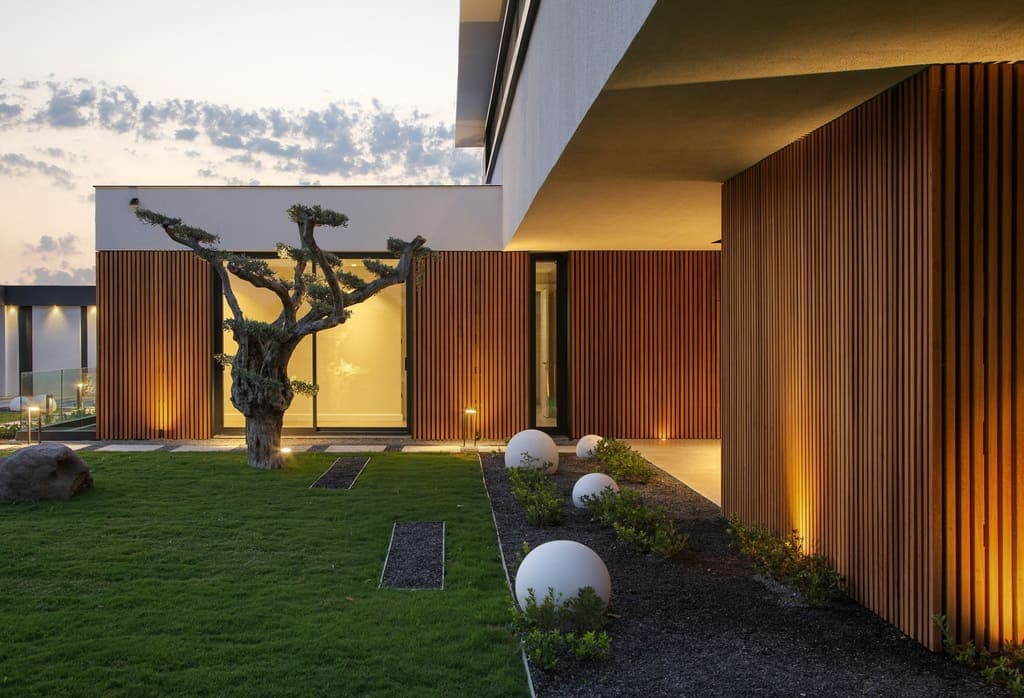
Why Thermally Modified Wood for Covered Patios?
Thermally modified wood undergoes a high-temperature treatment process that alters the wood's cellular structure. This modification generally improves dimensional stability, making the wood less prone to shrinking and swelling due to changes in humidity. For covered patio walls in Phoenix, where temperatures can fluctuate significantly, this stability can be beneficial in maintaining the integrity and appearance of the wood.
The thermal modification process also typically darkens the wood, creating a rich, uniform color throughout the material. This can offer a sophisticated aesthetic for patio walls. While the wood is more stable, it is important to note that it can still be affected by UV exposure, even in a covered area, leading to a natural silvering over time if left unfinished. Covered applications generally slow this process compared to fully exposed surfaces.
Selecting the Right Profile for Covered Patio Walls
The profile of the thermally modified wood planks plays a significant role in the overall look and installation of your covered patio walls. Common profiles include tongue-and-groove, shiplap, and square-edge boards. Each offers distinct visual effects and installation considerations.
Tongue-and-groove profiles create a tight, interlocking fit, often favored for a smooth, continuous surface. Shiplap profiles provide a distinctive shadow line and can be installed horizontally or vertically for different design impacts. Square-edge boards, when installed with a gap, can create a more open, slatted appearance.
Consider the desired aesthetic and the scale of your patio. For a modern, minimalist look, a narrow, clean-lined profile might be suitable. For a more traditional or rustic feel, wider boards with pronounced shadow lines could be preferred. The Norx brand offers a range of thermally modified wood profiles that can be suitable for wall applications.
You can explore available options at: [https://www.lumberplus.com/siding-and-cladding](https://www.lumberplus.com/siding-and-cladding) and [https://www.lumberplus.com/brands/norx](https://www.lumberplus.com/brands/norx).
Finishing and Appearance: Embracing or Protecting the Wood
Thermally modified wood can be left unfinished to gradually weather to a silver-gray patina. In a covered patio setting, this weathering process will be slower and potentially more even than on fully exposed surfaces. If you prefer to maintain the original color or enhance its natural tones, applying an exterior-grade finish is recommended.
Clear or semi-transparent stains can deepen the wood's color and offer some UV protection, helping to slow the silvering process. Pigmented stains will provide more robust UV resistance and can alter the wood's appearance significantly. Ensure any chosen finish is suitable for exterior wood and the local climate, as high temperatures can affect application and curing.
Even with a finish, periodic maintenance will be necessary to preserve the desired appearance. The frequency of reapplication will depend on the product, exposure, and local conditions. Consult the finish manufacturer's recommendations for specific guidance.
Maximo Accoya, while not thermally modified wood, is another option for exterior applications that offers exceptional stability and durability, often chosen when a high-performance, long-lasting finish is a priority: [https://www.lumberplus.com/products/maximo-accoya](https://www.lumberplus.com/products/maximo-accoya).
Attachment and Substructure for Covered Patio Walls
Proper attachment is crucial for the longevity of your thermally modified wood walls. The specific fastening method will depend on the chosen profile and the underlying substructure.
For most wall applications, a rainscreen assembly is recommended, even on covered patios. This involves creating a ventilation gap behind the wood cladding, allowing air circulation and moisture drainage. This is particularly important in Phoenix, where trapped heat and humidity, even under cover, can affect wood stability. The substructure typically consists of vertical furring strips attached to the structural wall.
Fasteners should be exterior-grade, corrosion-resistant screws or nails, suitable for the wood species and local conditions. Hidden fastening systems, often used with tongue-and-groove or shiplap profiles, can provide a clean, fastener-free appearance. Face fastening, where fasteners are visible, is also an option, particularly with square-edge boards, but requires careful placement for aesthetic consistency.
Always refer to the manufacturer's installation guidelines for the specific thermally modified wood product to ensure correct attachment methods and necessary spacing.
Project Example: Covered Patio Accent Wall in Phoenix
Consider a homeowner in Phoenix planning to clad a 10-foot wide by 8-foot high section of a covered patio wall. They want a modern look and choose a thermally modified ash shiplap profile, 5.5 inches wide with a 0.5-inch overlap, sold in 8-foot lengths. The visible face width is 5 inches.
First, calculate the area: 10 ft x 8 ft = 80 sq ft. To determine the number of planks, divide the total width of the wall by the visible width of one plank. 10 feet (120 inches) / 5 inches/plank = 24 planks. Since the wall height is 8 feet and the planks are 8 feet long, no vertical cuts are needed for length. Therefore, 24 planks are required for the coverage.
For waste, it is prudent to add a percentage, typically 5-10%, to account for cuts, handling, or minor imperfections. For this project, a 10% waste factor would mean purchasing 24 planks * 1.10 = 26.4 planks, rounded up to 27 planks. This ensures sufficient material for the project.
The wall will be installed over furring strips to create a rainscreen gap, and stainless steel fasteners will be used for durability in the Phoenix climate. The homeowner plans to apply a clear UV-protective finish to maintain the wood's rich, dark tone, knowing reapplication will be needed every few years.
Before you order
- Determine the exact dimensions of the covered patio wall area to be clad.
- Choose a thermally modified wood profile (e.g., tongue-and-groove, shiplap, square-edge) that suits your design aesthetic and installation preference.
- Decide whether to leave the wood unfinished for natural silvering or apply an exterior-grade finish for color retention and UV protection.
- Research appropriate fastening systems and consider a rainscreen assembly for ventilation and moisture management, even in covered areas.
- Confirm the compatibility of chosen fasteners and finishes with the specific thermally modified wood species.
- Calculate the required quantity of material, including a waste factor, based on the visible width of the chosen profile.
- Plan for periodic maintenance if a finish is applied to preserve the desired appearance.
Confirm installation details, approved uses and warranty terms in the current instructions for the exact product and profile. Your installer should verify the substrate, structure and applicable project requirements.
This is a planning guide for projects in Phoenix, AZ. Ask our team to confirm availability, delivery to your ZIP code and which branch can support your order.
Questions to help you decide
Can thermally modified wood be used on any outdoor wall in Phoenix?
This guide specifically addresses covered patio walls. For fully exposed exterior walls in Phoenix, where the wood would experience constant, direct sun and rain exposure, additional considerations for UV degradation, moisture management, and finish durability become even more critical. While thermally modified wood offers enhanced stability, its long-term performance on fully exposed walls would require more frequent maintenance and careful selection of protective finishes.
Does thermally modified wood require a finish?
No, thermally modified wood does not strictly require a finish. If left unfinished, it will naturally weather to a silver-gray patina over time, similar to other wood species. Applying an exterior-grade finish can help preserve its original color, provide UV protection, and enhance its appearance, but it will require periodic reapplication.
How do I clean thermally modified wood on a patio wall?
For routine cleaning, a soft brush or cloth with water is usually sufficient to remove dust and light dirt. For more stubborn grime, a mild, pH-neutral soap solution can be used, followed by a thorough rinse with clean water. Avoid harsh chemicals or high-pressure washers, which can damage the wood fibers or strip any applied finish. Always test cleaning solutions on an inconspicuous area first.
Ready to Transform Your Phoenix Patio?
Request a material quote today. Provide your project dimensions, desired profile, and ZIP code to confirm current availability and service options for thermally modified wood.
Request a material quote →