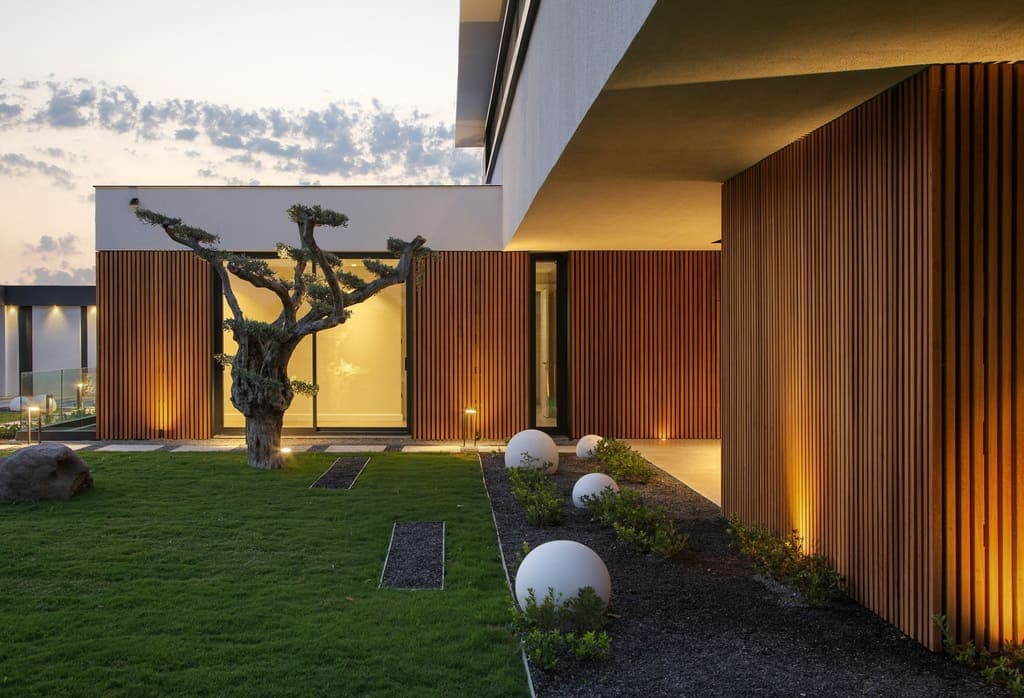
Understanding Thermally Modified Wood for Wall Applications
Thermally modified wood, such as NORX thermally modified products, is suitable for various wall applications, including covered patio walls. The modification process involves heating wood to high temperatures (typically between 320°F and 450°F) in a low-oxygen environment. This treatment removes moisture and extractives, resulting in a more dimensionally stable and durable material.
For covered patio walls, this enhanced stability is particularly beneficial. While not exposed to the full force of weather, these walls still contend with humidity changes. The reduced hygroscopy (tendency to absorb moisture) of thermally modified wood means less expansion and contraction, which helps maintain the integrity of the wall assembly and finish over time. Its natural resistance to decay and insects further contributes to its suitability for outdoor, semi-protected environments.
Common species used in thermal modification include Pine and Spruce, which, after treatment, develop a rich, consistent brown tone that can deepen with finishing. This color is inherent to the modification process, not a surface stain, offering a consistent appearance throughout the material.
Choosing the Right Profile and Appearance
The profile of the thermally modified wood planks significantly impacts the visual texture and shadow lines of your covered patio walls. Lumber Plus offers various profiles, including tongue and groove, shiplap, and square edge, each creating a distinct look.
Tongue and groove profiles, like those found in NORX Siding and Cladding, create a tight, interlocking fit, offering a smooth, continuous surface with minimal visible gaps. This can be ideal for a clean, modern aesthetic. Shiplap profiles, in contrast, create distinct shadow lines that add depth and a more traditional or rustic feel. Square edge profiles allow for custom spacing, offering flexibility for unique design patterns or open-joint rainscreen applications, though for covered patio walls, a more closed system is often preferred to prevent debris accumulation.
Consider the overall architectural style of your home and patio. For a contemporary look, a wider, smooth-faced tongue and groove plank might be appropriate. For a more rustic or transitional design, a narrower shiplap profile with pronounced shadow lines could be chosen. The natural variation in grain patterns of thermally modified wood ensures each installation has a unique character.
Finishing Options and Their Impact
Thermally modified wood can be left unfinished to gradually weather to a silver-gray patina, or it can be finished to maintain its initial brown tones and provide additional protection. For covered patio walls, where exposure is less severe than fully exposed siding, the choice of finish still plays a role in appearance and maintenance.
If you desire to preserve the warm brown color, a UV-inhibiting oil-based finish is generally recommended. These finishes penetrate the wood, enhancing its natural color while offering some protection against UV degradation. Regular reapplication, typically every 1-3 years depending on exposure, is necessary to maintain the color. Examples of suitable finishes include those designed for exterior wood, which can be found alongside products like Maximo Accoya.
Leaving the wood unfinished will result in a natural silvering process. While thermally modified wood's stability helps it weather more evenly than untreated wood, some initial color variation may occur as it transitions. For a truly low-maintenance approach to appearance, embracing this natural patina is an option. Always confirm the compatibility of any chosen finish with thermally modified wood through product documentation.
Attachment and Substructure Considerations
Proper attachment is crucial for the longevity and appearance of your thermally modified wood patio walls. The substructure, typically wood framing, must be sound, plumb, and level to ensure a smooth installation. For covered patio walls, a simple furring strip system is often sufficient, providing an air gap behind the cladding. This gap, even in a covered area, promotes airflow and allows any incidental moisture to dry, contributing to the overall health of the wall assembly.
Fasteners should be corrosion-resistant, such as stainless steel screws or nails. The type of fastener depends on the profile chosen. For tongue and groove or shiplap profiles, concealed fastening methods (nailing through the tongue or the lap) can provide a clean, fastener-free appearance on the surface. For square edge profiles, face fastening is common, requiring careful placement and consideration of fastener head visibility. Pre-drilling may be necessary to prevent splitting, especially near board ends or edges.
Maintain appropriate clearances, particularly at the base of the wall. Consult manufacturer guidelines for specific spacing and fastening recommendations for your chosen profile and species.
Example Project: Covered Patio Wall Dimensions and Material Takeoff
Let's consider a hypothetical covered patio with two walls to be clad with thermally modified wood. One wall measures 12 feet wide by 8 feet high, and the other is 10 feet wide by 8 feet high. We'll use 1x6 (nominal size, actual coverage typically around 5.125 inches for shiplap) thermally modified Pine shiplap boards, commonly available in 8-foot, 10-foot, and 12-foot lengths.
Wall 1 Area: 12 ft x 8 ft = 96 sq ft. Wall 2 Area: 10 ft x 8 ft = 80 sq ft. Total Area: 176 sq ft.
For 1x6 shiplap with an effective coverage of 5.125 inches (or approximately 0.427 feet), each linear foot covers 0.427 square feet. To cover 176 square feet, you would need 176 / 0.427 = 412.18 linear feet. It's prudent to add 10-15% for waste, cuts, and future repairs. Let's use 12% for this example: 412.18 * 1.12 = 461.64 linear feet.
Given the 8-foot wall height, using 8-foot planks minimizes vertical cuts. For the 12-foot wall, each row requires one 12-foot plank. For the 10-foot wall, each row requires one 10-foot plank. This means for the 12-foot wall (96 sq ft), we need 96 / (8 ft * 0.427 ft) = 28.09 planks. Round up to 29 planks of 12-foot length. For the 10-foot wall (80 sq ft), we need 80 / (8 ft * 0.427 ft) = 23.41 planks. Round up to 24 planks of 10-foot length. This approach avoids many small cuts and maximizes efficiency for these specific dimensions. Always confirm actual coverage per board with the specific product chosen.
Before you order
- Confirm species and profile of thermally modified wood are approved for vertical, semi-exterior wall applications.
- Determine desired aesthetic: smooth (tongue and groove) or textured (shiplap) and choose appropriate profile.
- Decide on finish: Unfinished (silvering patina) or finished (color retention with maintenance).
- Verify substructure is sound, plumb, and suitable for direct attachment or furring strips.
- Select corrosion-resistant fasteners appropriate for the chosen profile (concealed vs. face fastening).
- Plan for proper clearances at the base of the wall and around any openings.
- Calculate material quantities, including waste factor, based on actual board coverage and available lengths.
- Consider long-term maintenance requirements based on finish choice.
Confirm installation details, approved uses and warranty terms in the current instructions for the exact product and profile. Your installer should verify the substrate, structure and applicable project requirements.
This is a planning guide for projects in Green Bay, WI. Ask our team to confirm availability, delivery to your ZIP code and which branch can support your order.
Questions to help you decide
Can thermally modified wood be used in a Green Bay winter climate?
Yes, thermally modified wood's enhanced dimensional stability and resistance to decay make it well-suited for varying climates, including those with cold winters like Green Bay. The modification process reduces its susceptibility to moisture-related movement, which can be beneficial during freeze-thaw cycles. For covered patio walls, where direct snow and ice exposure is limited, its performance is generally robust. However, proper installation with adequate ventilation and drainage remains important.
Does thermally modified wood require a specific type of cleaning or maintenance?
The maintenance for thermally modified wood on covered patio walls depends largely on whether it's finished or unfinished. Unfinished wood will weather to a silver-gray and requires minimal cleaning, typically just a gentle wash with water and a soft brush to remove dirt or mildew. If a finish is applied to maintain the original color, periodic reapplication according to the finish manufacturer's instructions will be necessary. Avoid harsh chemical cleaners or high-pressure washing, which can damage the wood or its finish.
Is thermally modified wood compatible with rainscreen systems?
Yes, thermally modified wood is highly compatible with rainscreen systems. While covered patio walls might not always require a full rainscreen assembly due to reduced direct exposure, incorporating an air gap behind the cladding is a good practice. This gap allows for ventilation and drainage, preventing moisture buildup and extending the life of the wall system. For more exposed wall applications, a full rainscreen system would be essential for optimal performance.
Ready to Plan Your Covered Patio Walls?
Request a material quote with your project dimensions, desired profile, and ZIP code. We can confirm current availability and service options for your Green Bay, WI project.
Request a material quote →