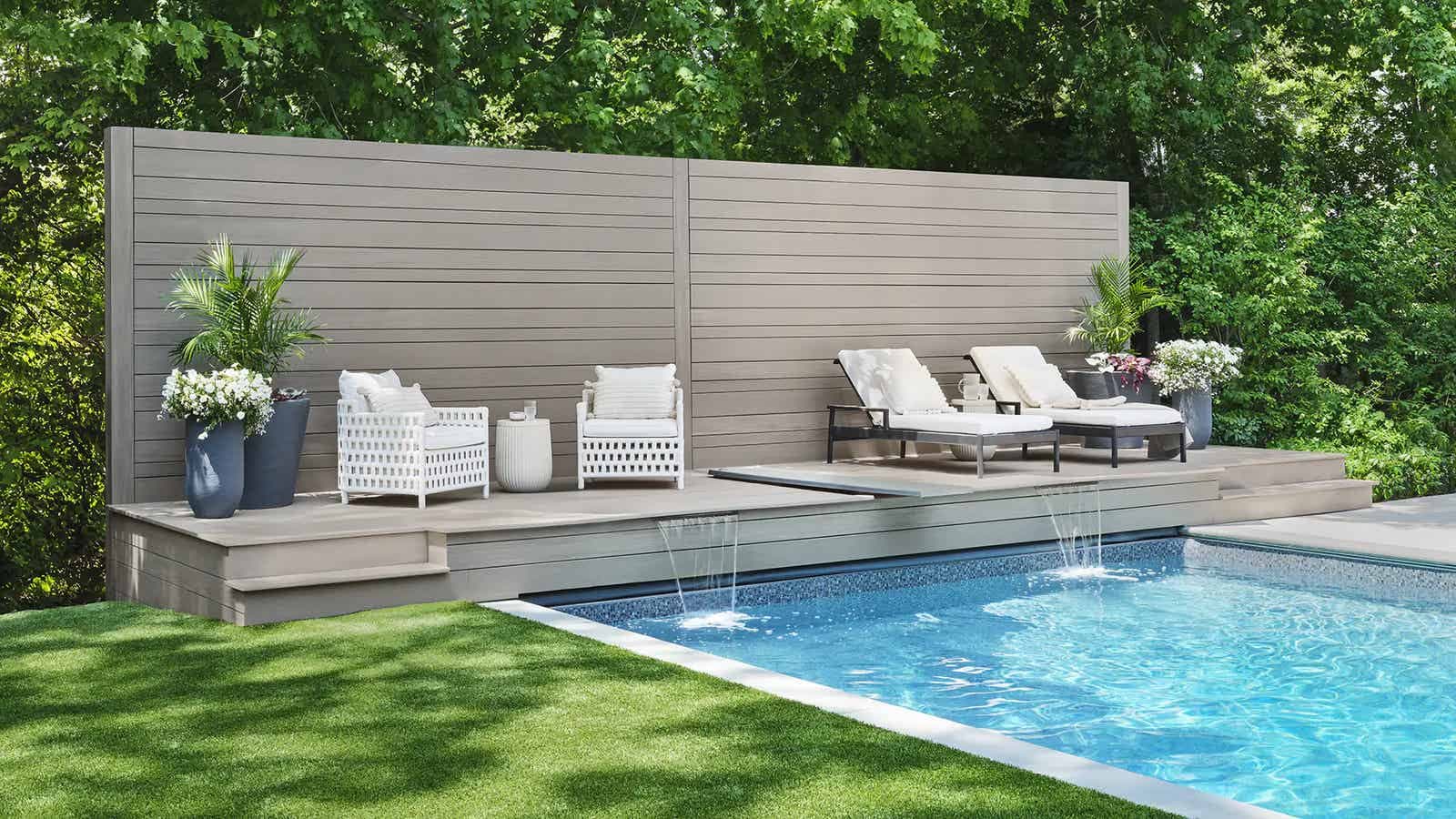
Understanding Commercial Suitability of PVC Decking
For a restaurant patio, the decking material must withstand heavy daily use. PVC decking, being 100% synthetic, offers resistance to moisture, stains, and rot, which are common concerns in outdoor dining areas. Spills from food and beverages, as well as frequent cleaning, are part of daily operations. PVC's non-porous surface is designed to shed grease and wine, allowing for cleaning with soap and water.
This characteristic is particularly beneficial for restaurant patios that may be hosed down regularly or exposed to rain. Its lighter weight compared to hardwood can also simplify installation, especially for rooftop patios or elevated structures where structural load is a consideration.
While PVC decking offers inherent durability, always confirm that the specific product selected is approved for commercial applications and meets any local building codes or restaurant-specific regulations. Not all decking products are rated for the same level of commercial traffic.
Designing for High Traffic and Seating Layouts
A restaurant patio's layout must accommodate efficient movement of staff and patrons, as well as flexible seating arrangements. When planning with PVC decking, consider the board orientation and width to complement the flow of traffic. Wider boards can sometimes create a more expansive feel, while narrower boards might lend themselves to intricate patterns or delineating zones.
For high-traffic pathways, ensure the deck design minimizes seams and incorporates sturdy framing underneath to support continuous heavy loads. While PVC boards themselves are durable, the underlying structure is crucial for commercial longevity. Consider how tables, chairs, and other patio furniture will interact with the deck surface. Furniture often gets dragged or rearranged, so a resilient surface is key. Heat-mitigating color options in PVC decking can be beneficial in sunny locations to enhance guest comfort, as darker surfaces can absorb more heat.
Maintenance and Cleaning Protocols for Commercial Use
Restaurant patios require rigorous cleaning to maintain hygiene and appearance. PVC decking is designed for low maintenance, which is a significant advantage in a commercial setting. Its capped polymer surface resists stains and can typically be cleaned with common soap and water.
Establish a regular cleaning schedule that includes sweeping, hosing, and occasional scrubbing to address spills and general grime. For specific types of stains, always refer to the manufacturer's cleaning guidelines to ensure compatibility with the decking material and to avoid damaging the surface. The goal is to keep the patio looking welcoming and clean with minimal effort, reducing operational costs.
Unlike wood, PVC decking does not require sanding, staining, or sealing, which reduces long-term maintenance tasks and associated downtime for the restaurant.
Specification Review and Material Selection
When selecting PVC decking, a thorough review of product specifications is essential. Look for products explicitly marketed for commercial or high-traffic applications. Evaluate the thickness, width, and length options available to best suit your patio dimensions and design intent. The TimberTech Azek line, for example, offers full PVC boards with advanced capping, available in various collections like Vintage, Landmark, and Harvest, which provide different aesthetic profiles and textures. These products are 100% synthetic, containing zero wood fiber.
Review the product's resistance to fading and staining, often provided in writing by manufacturers for eligible boards. Consider the finish and color options; collections like those from TimberTech Azek offer deep wood looks that can enhance the ambiance of a restaurant patio. Request samples to assess the texture, color, and finish in person, under the lighting conditions of your proposed patio.
Always confirm the specific installation requirements, including joist spacing and fastening methods, to ensure the deck is built to withstand commercial use and meets all structural requirements.
Example: Planning PVC Decking for a 20x30 Foot Restaurant Patio
Imagine a restaurant planning a new 20-foot by 30-foot outdoor patio. The total area is 600 square feet. The design calls for a linear installation of 12-foot long PVC decking boards, running parallel to the 20-foot side, with a slight overhang. The chosen boards are a standard 5.5-inch nominal width.
First, determine how many boards are needed to cover the 30-foot length. Each 5.5-inch board (0.458 feet) will cover a portion of the 30-foot dimension. To cover 30 feet, approximately 30 / 0.458 = 65.5 boards would be needed if they ran the full 30 feet without cuts. However, the boards are 12 feet long. For the 30-foot length, each run will require three 12-foot boards (12 + 12 + 6 feet = 30 feet, assuming a 6-foot cut is used from a 12-foot board).
For the 20-foot width, if boards are laid parallel to this dimension, each row will be 20 feet long. Using 12-foot boards means each 20-foot row will require one 12-foot board and one 8-foot board (cut from another 12-foot board). This creates a repeating pattern where a 12-foot board yields an 8-foot offcut, which can be used for the next 20-foot row. Therefore, for every two 20-foot rows, two 12-foot boards are purchased, yielding two 12-foot sections and two 8-foot sections. This means each 20-foot row effectively uses one 12-foot board.
So, to cover the 30-foot length with boards running parallel to the 20-foot side: 30 feet / 0.458 feet per board = 65.5 boards wide. Since each 'row' is 20 feet long and uses roughly one 12-foot board (with cuts from other 12-foot boards), we need 66 rows for simplicity. Each row is 20 feet long. If we consider full 12-foot boards, and each 20-foot run requires a 12-foot piece and an 8-foot piece, we can get two 20-foot runs from two 12-foot boards (12+8 and 12+8). Therefore, approximately 66 rows / 2 = 33 pairs of 12-foot boards, which is 66 individual 12-foot boards. Add 5-10% for waste and cuts, so around 70-73 boards. This example highlights the importance of a detailed cut plan and waste factor for accurate material ordering.
Before you order
- Confirm commercial rating and local code compliance for chosen PVC decking.
- Evaluate surface texture and color options for slip resistance and heat mitigation.
- Plan for furniture placement and high-traffic pathways to ensure structural integrity.
- Review manufacturer's cleaning guidelines and incorporate into maintenance protocols.
- Obtain product samples to assess appearance under patio lighting conditions.
- Verify joist spacing and fastening requirements for commercial loads.
- Calculate material quantities with a waste factor, considering board lengths and cuts.
Confirm installation details, approved uses and warranty terms in the current instructions for the exact product and profile. Your installer should verify the substrate, structure and applicable project requirements.
Questions to help you decide
Is PVC decking suitable for all climates?
PVC decking is generally robust across various climates due to its synthetic composition. It resists moisture, rot, and insect damage. However, extreme temperature fluctuations can affect any material, so it's always recommended to review the manufacturer's guidelines for specific climate performance. Some PVC options offer heat-mitigating colors that can be beneficial in very sunny environments.
How does PVC decking compare to wood or composite for commercial patios?
PVC decking offers specific advantages over wood and some composites for commercial patios. Unlike wood, it's 100% synthetic, meaning it has zero wood fiber to swell, rot, or harbor mold, making it highly resistant to water and stains. Compared to many composites, PVC often provides superior stain and fade resistance due to its advanced capping technology. It also tends to be lighter than both wood and composite, which can be an advantage for installation, particularly on elevated or rooftop patios. However, initial costs can sometimes be higher than basic wood or composite options.
What kind of sub-structure is needed for PVC decking on a restaurant patio?
The sub-structure for PVC decking on a restaurant patio must be robust and designed for commercial loads, regardless of the decking material chosen. This typically involves a properly engineered wood or steel frame that meets local building codes and can support the weight of the deck, furniture, patrons, and any other anticipated loads. Specific joist spacing requirements will be provided by the PVC decking manufacturer and must be followed to ensure the deck performs as intended and remains stable under heavy commercial use. Adequate ventilation beneath the deck is also important.
Request a Quote for Your Restaurant Patio Decking
Ready to plan your commercial patio? Contact us with your project dimensions, desired PVC decking profile, and ZIP code to receive a material quote. We can also confirm current availability and service options for your project.
Request a material quote →