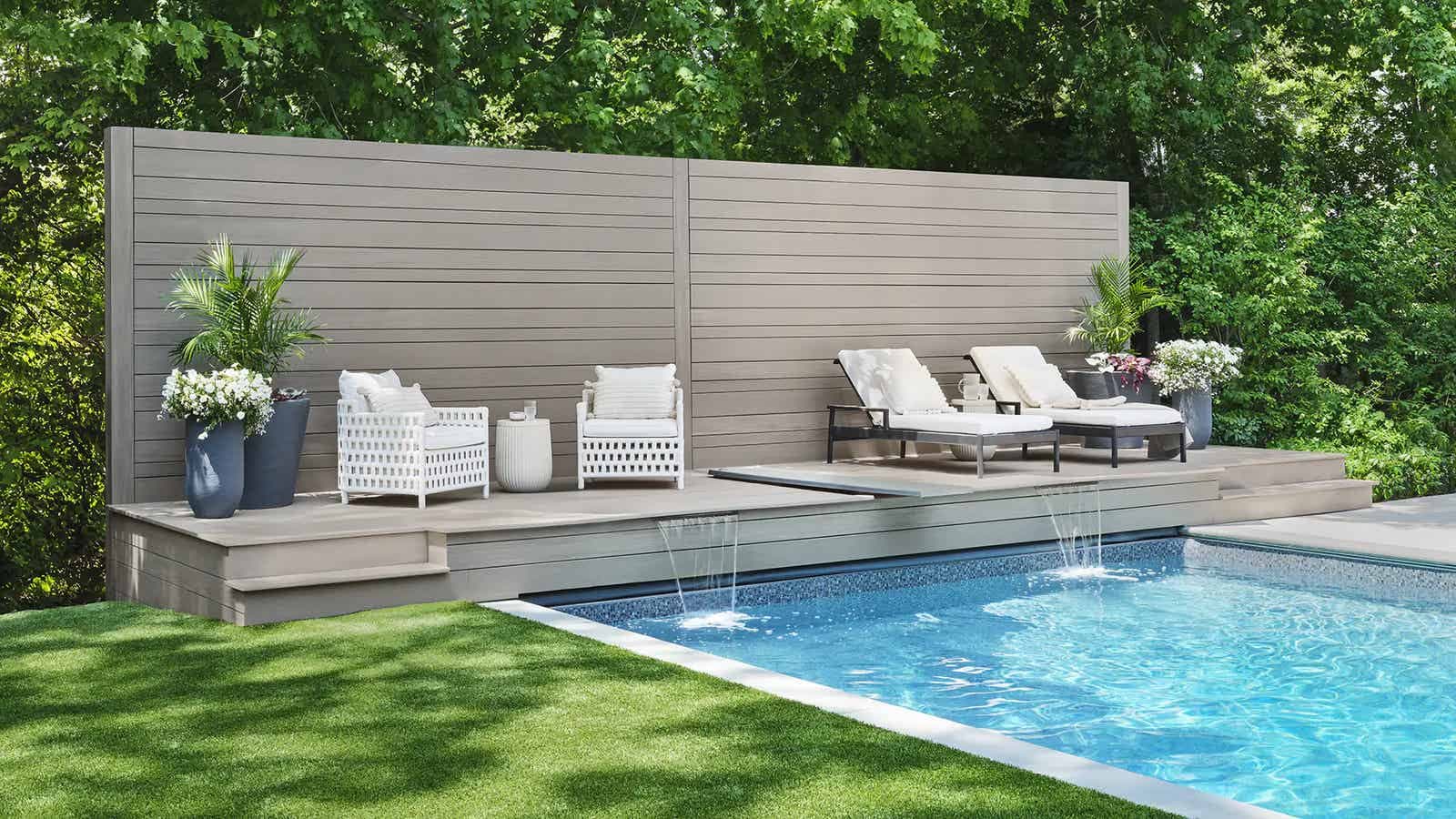
Understanding PVC Decking Units and Profiles
PVC decking boards are typically sold in lineal feet or by individual board lengths. It's important to confirm the specific lengths available for the product line you select, as these can vary by manufacturer and collection. Common lengths might include 12, 16, or 20 feet.
Beyond length, consider the board profile. Most PVC decking is available in standard rectangular profiles, but some may feature tongue-and-groove or specialized edge profiles for hidden fastener systems. The width and thickness of the boards will also impact the overall coverage and how many boards you need for a given area. For example, TimberTech AZEK offers full PVC boards with advanced capping, available in various collections like Vintage, Landmark, and Harvest, which may have different dimensions.
Always refer to the manufacturer's specifications for the exact width, thickness, and available lengths of the specific PVC decking product you intend to use. This information is fundamental for accurate calculations.
Measuring Your Deck Area
Start by creating a detailed sketch of your deck layout, including all dimensions. For rectangular or square decks, measure the total length and width. For irregular shapes, break the area down into simpler geometric sections (rectangles, triangles) and measure each section individually.
Remember to measure the actual usable deck surface. If your deck includes stairs, landings, or a picture-frame border, these areas will require separate calculations for their specific board orientations and cuts.
Double-check all measurements to minimize errors. It's often helpful to measure each dimension twice and compare the results, especially for longer runs.
Calculating Board Coverage for the Main Deck Field
Once you have your deck dimensions, determine the total square footage of the main deck field. For a rectangular deck, this is simply length multiplied by width.
Next, consider the orientation of your decking boards. Will they run parallel or perpendicular to the house? This decision affects the number of cuts and the overall appearance. For example, if your deck is 10 feet wide and 20 feet long, and you plan to run 6-inch wide boards perpendicular to the 10-foot width, you'll need approximately 20 boards (10 feet / 0.5 feet per board = 20 boards). Each of these boards would need to be 20 feet long.
If you plan a diagonal layout, the waste factor will likely increase, and the effective length of each board needed will be longer than the deck's dimensions. Diagonal layouts often require boards that are longer than the longest dimension of the deck field to achieve continuous runs.
Accounting for Cuts and Waste
Even with careful planning, some material will be lost to cuts, mistakes, and unusable offcuts. A standard waste factor for straight decking layouts is typically 5-10%. For more complex layouts, such as diagonal patterns, intricate borders, or decks with many angles and cuts, a waste factor of 10-15% or even higher might be more appropriate.
Consider the usable length of offcuts. If you cut a 20-foot board to 12 feet, you have an 8-foot offcut. If this 8-foot piece can be used elsewhere on the deck, it reduces waste. However, very short pieces or pieces with damaged ends may not be usable.
It's generally safer to round up when calculating the number of boards needed to ensure you have enough material to complete the project without interruption. PVC decking is 100% synthetic and recyclable, meaning any excess can potentially be returned to the material stream, rather than becoming landfill waste.
Worked Example: A Rectangular Deck
Let's consider a rectangular deck that is 16 feet wide and 18 feet long. We plan to use PVC decking boards that are 6 inches wide (0.5 feet) and available in 20-foot lengths. The boards will run parallel to the 18-foot length.
1. **Determine the number of board runs across the width:** The deck is 16 feet wide. Each board is 0.5 feet wide. So, 16 feet / 0.5 feet/board = 32 boards needed to cover the width.
2. **Determine the length of each board run:** Each board needs to be 18 feet long.
3. **Calculate boards per run based on available lengths:** Since boards are available in 20-foot lengths, one 20-foot board can cover the 18-foot length, leaving a 2-foot offcut. This offcut is likely too short for most main deck field applications, so we will not credit it as reusable for this calculation.
4. **Total boards needed before waste:** 32 boards (for width) x 1 (per length) = 32 boards.
5. **Apply a waste factor:** For a straight layout, we'll use a 7% waste factor. 32 boards * 1.07 = 34.24 boards. Round up to the nearest whole board: 35 boards.
Therefore, for this 16-foot by 18-foot deck with 6-inch wide boards running parallel to the 18-foot length, you would need to order 35 of the 20-foot PVC decking boards.
Remember to also calculate for fascia boards, stair treads, and any other trim pieces separately, applying an appropriate waste factor for those elements as well. For example, fascia boards are often wider and used to cover the rim joists.
Before you order
- Have you measured the total length and width of your deck area, including any irregular sections?
- Have you accounted for all deck features like stairs, landings, and picture-frame borders?
- Do you know the exact width, thickness, and available lengths of your chosen PVC decking product?
- Have you decided on the orientation of your decking boards (e.g., parallel, perpendicular, diagonal)?
- Have you applied an appropriate waste factor (5-15% depending on layout complexity)?
- Have you considered the need for fascia boards, stair treads, or other trim pieces?
- Are you rounding up to the nearest full board when finalizing your quantity?
Confirm installation details, approved uses and warranty terms in the current instructions for the exact product and profile. Your installer should verify the substrate, structure and applicable project requirements.
Questions to help you decide
What is the typical waste factor for PVC decking?
A typical waste factor for PVC decking ranges from 5-10% for straightforward, rectangular layouts. For more complex designs, such as diagonal patterns, multi-level decks, or those with numerous cuts and angles, a waste factor of 10-15% or even higher is advisable to ensure you have enough material.
How do I calculate for stair treads and risers?
For stair treads, measure the length of each tread and the number of treads. Account for any overhang. For risers, measure the height and length of each riser. Treat these as separate linear calculations, considering the specific width of the board you will use for each component. Add a waste factor for cuts.
Should I order extra boards for future repairs?
It can be beneficial to order a few extra boards, especially if you have a complex layout or if the specific product line might be discontinued in the future. This provides a buffer for unexpected damage or future repairs, helping to ensure color and profile consistency. Store these extra boards properly to maintain their condition.
Ready to Plan Your PVC Decking Project?
Request a material quote with your project dimensions, exact PVC decking profile preference, and ZIP code. Our team can help confirm current availability and service options for your decking materials. Explore our PVC decking options, including TimberTech AZEK boards, suitable for various applications from pool surrounds to covered porches.
Request a material quote →