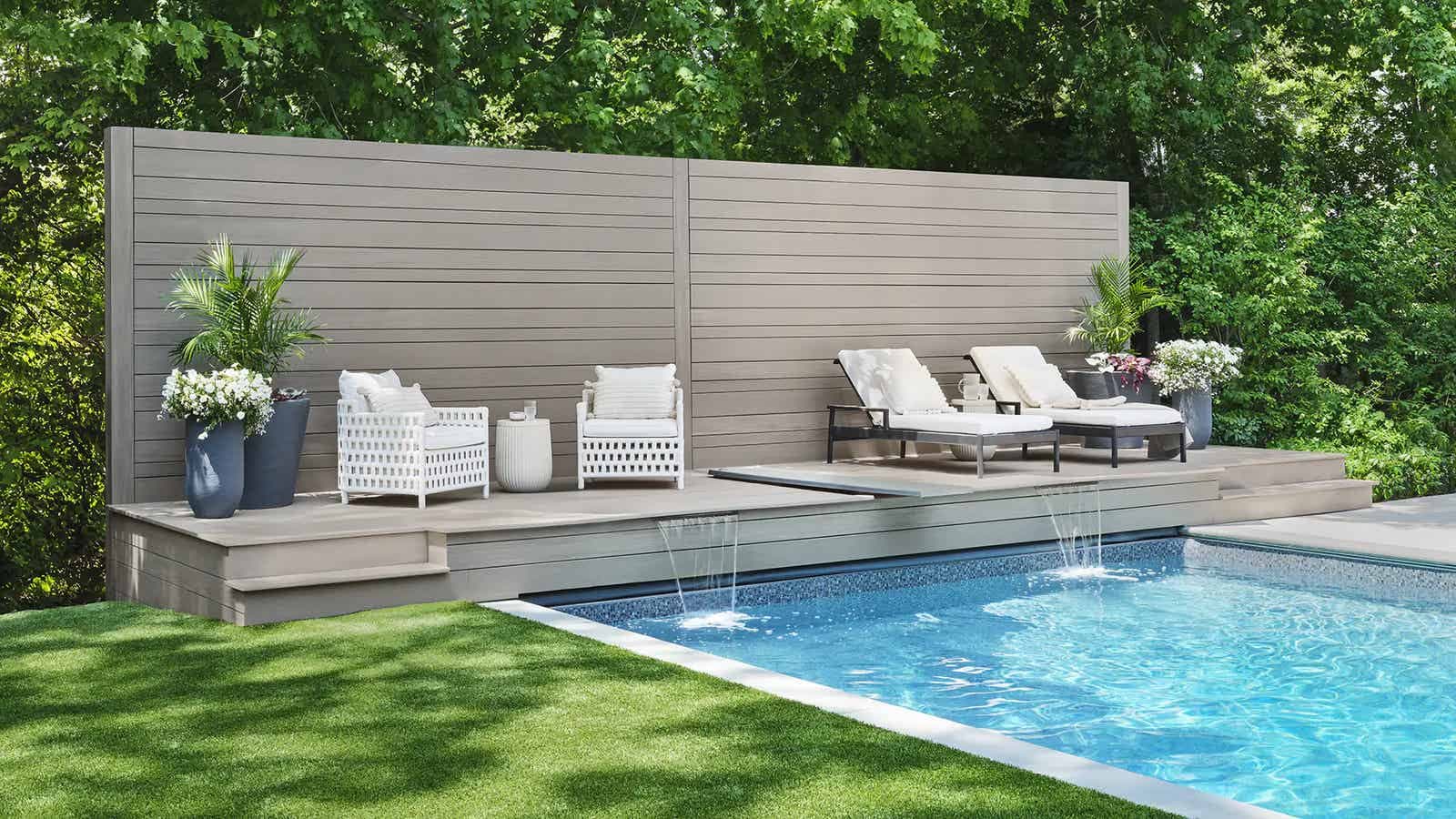
Why PVC Decking for Pool Terraces?
PVC decking is a fully synthetic product, meaning it contains no wood fibers. This fundamental characteristic makes it inherently waterproof to the core. For a pool terrace, where constant splashing, standing water, and humidity are common, this resistance to moisture is a key benefit. It means the boards are less susceptible to swelling, staining, or rot that can affect materials with wood content.
The material's composition also contributes to its low maintenance profile. PVC boards are designed to shed grease and common spills, often cleaning up with just soap and water. For a poolside environment, where sunscreen, food, and drink spills are likely, this ease of cleaning can be a significant advantage. Some PVC decking lines offer heat-mitigating color options, which can be an important consideration for bare feet on sunny New York summer days.
Additionally, PVC decking is often lighter than comparable hardwood or composite options. This can simplify handling during installation, particularly for projects with access challenges or those on elevated structures, which are common in urban settings. The material is also 100% recyclable, offering an environmental consideration for your project.
Understanding Wet-Use Suitability and Drainage
The primary advantage of PVC decking for a pool terrace is its performance in wet conditions. Because it is waterproof to the core, PVC decking is a default specification for applications where boards are consistently exposed to water, such as pool surrounds, docks, and covered porches that may experience weather from both sides.
While the boards themselves are waterproof, proper drainage beneath and around the deck remains crucial. Even with PVC, standing water on the surface can create slip hazards and affect the overall cleanliness of the area. Design your pool terrace with a slight slope away from the main structure and ensure adequate gaps between boards to allow water to drain effectively. This also helps with evaporation and air circulation, contributing to a cleaner, drier surface faster.
Considering Edge Finishes and Fascia
The edges of your pool terrace are important both for aesthetics and safety. PVC decking systems typically offer complementary fascia boards and trim pieces that can be used to finish the perimeter of the deck. These components provide a clean, finished look and can help conceal the substructure.
When planning, consider how the deck will transition to other surfaces, such as coping around the pool, paving, or landscaping. Using matching PVC fascia or specialized edge profiles can create a cohesive appearance. Some manufacturers provide specific recommendations for how their decking should integrate with pool coping, which should be reviewed during the design phase.
Maintenance and Cleaning for a Pool Environment
PVC decking is known for its low maintenance requirements, which is particularly beneficial for a pool terrace. Its capped polymer surface is designed to resist stains from common poolside substances like sunscreens, food, and beverages. Most routine cleaning involves a simple wash with soap and water.
For tougher stains or accumulated grime, always refer to the manufacturer's specific cleaning guidelines for your chosen PVC decking product. Using incompatible cleaning products could potentially damage the surface finish. Regularly removing debris, leaves, and dirt will prevent buildup and help maintain the deck's appearance over time. While PVC is durable, prompt cleanup of spills is still recommended to keep your pool terrace looking its best.
A Hypothetical Pool Terrace Project: Calculating PVC Decking Needs
Consider a hypothetical pool terrace project for a New York brownstone rooftop, where space is optimized for a compact plunge pool and surrounding lounge area. The pool itself is 10 feet long by 5 feet wide. The owner wants to create a decking area that extends 4 feet beyond the pool on all sides, forming a rectangular terrace.
First, calculate the total outer dimensions of the deck: Length = 10 ft (pool) + 4 ft (left side) + 4 ft (right side) = 18 ft. Width = 5 ft (pool) + 4 ft (front) + 4 ft (back) = 13 ft. The total area of the deck is 18 ft x 13 ft = 234 square feet. The area occupied by the pool is 10 ft x 5 ft = 50 square feet. Therefore, the area to be decked is 234 sq ft - 50 sq ft = 184 square feet.
Let's assume the chosen PVC decking boards are 5.5 inches wide (actual dimension) and available in 16-foot lengths. To convert the width to feet: 5.5 inches / 12 inches/foot = 0.4583 feet. Each 16-foot board covers 0.4583 ft * 16 ft = 7.33 square feet. To cover 184 square feet, you would theoretically need 184 sq ft / 7.33 sq ft/board = 25.1 boards. However, you must account for cuts and waste. For straight runs, you'd likely need to order full boards. If the 13-foot width is laid across the 18-foot length, you'd need 13 ft / 0.4583 ft/board = 28.3 boards for each 16-foot run. For a length of 18 feet, you would need 18/16 = 1.125; so two 16-foot boards end to end or strategically cut. This requires a detailed cut plan, but as a general estimate, ordering around 30-35 boards (accounting for 15-20% waste for cuts and errors) would be a reasonable starting point. Always confirm board dimensions and plan cuts carefully to minimize waste.
Complementary Products for Your Pool Terrace
Beyond the PVC decking boards themselves, several complementary products can enhance the functionality and appearance of your New York pool terrace. Consider a robust substructure, potentially using moisture-resistant treated lumber or even steel framing, especially in damp environments. Hidden fastening systems are popular for PVC decking, providing a smooth, fastener-free surface that is comfortable underfoot and visually clean. These systems typically involve clips that attach to the joists and secure the board edges.
For areas around the pool, outdoor lighting can extend the usability of your terrace into the evening and improve safety. Low-voltage LED options are often integrated into deck designs. Additionally, specialized outdoor furniture designed to withstand pool chemicals and constant moisture will complete the space. Ensure any planters or heavy decorative items are placed with consideration for the deck's load-bearing capacity and do not impede drainage.
Before you order
- Confirm the exact dimensions of your pool terrace, including any irregular shapes or cutouts for the pool.
- Review local building codes and regulations for decking materials and substructure requirements in New York, NY.
- Select a PVC decking profile and color that complements your home's aesthetic and offers desired heat mitigation for sunny areas.
- Plan for adequate drainage beneath and around the deck to prevent standing water.
- Choose appropriate fascia and trim boards for a finished edge, especially where the deck meets the pool coping.
- Consider a hidden fastening system for a smooth, barefoot-friendly surface.
- Factor in any necessary substructure upgrades or repairs for a stable and durable foundation.
- Understand the manufacturer's specific cleaning and maintenance recommendations for your chosen PVC decking.
- Request a detailed material quote with project dimensions, exact profile, and your ZIP code to confirm availability and service options.
Confirm installation details, approved uses and warranty terms in the current instructions for the exact product and profile. Your installer should verify the substrate, structure and applicable project requirements.
This is a planning guide for projects in New York, NY. Ask our team to confirm availability, delivery to your ZIP code and which branch can support your order.
Questions to help you decide
Is PVC decking slippery when wet?
However, any surface can become slippery when wet, especially with pool water, algae, or other contaminants. Proper drainage, regular cleaning, and ensuring the deck surface is free of debris can help minimize slip hazards. Always exercise caution on wet surfaces.
Can PVC decking get hot in the sun?
Like many outdoor materials, PVC decking can absorb heat from direct sunlight. The degree to which it heats up depends on the color and specific product line. Lighter colors and certain heat-mitigating formulations are often available and can feel cooler underfoot. If your pool terrace receives significant direct sun, consider these options during selection. Always test the surface with your hand before walking barefoot on hot days.
How do I clean my PVC pool deck?
Most PVC decking can be cleaned with a soft brush or mop, mild soap, and water. For specific stains or heavier grime, always consult the manufacturer's cleaning guidelines for your particular PVC decking product. Avoid harsh chemicals, abrasive cleaners, or pressure washers that can damage the surface finish. Regular cleaning helps prevent the buildup of dirt, pool chemicals, and organic matter.
Ready to Plan Your PVC Pool Terrace?
Request a material quote for your project. Provide your project dimensions, desired PVC decking profile, and ZIP code to confirm current availability and service options.
Request a material quote →