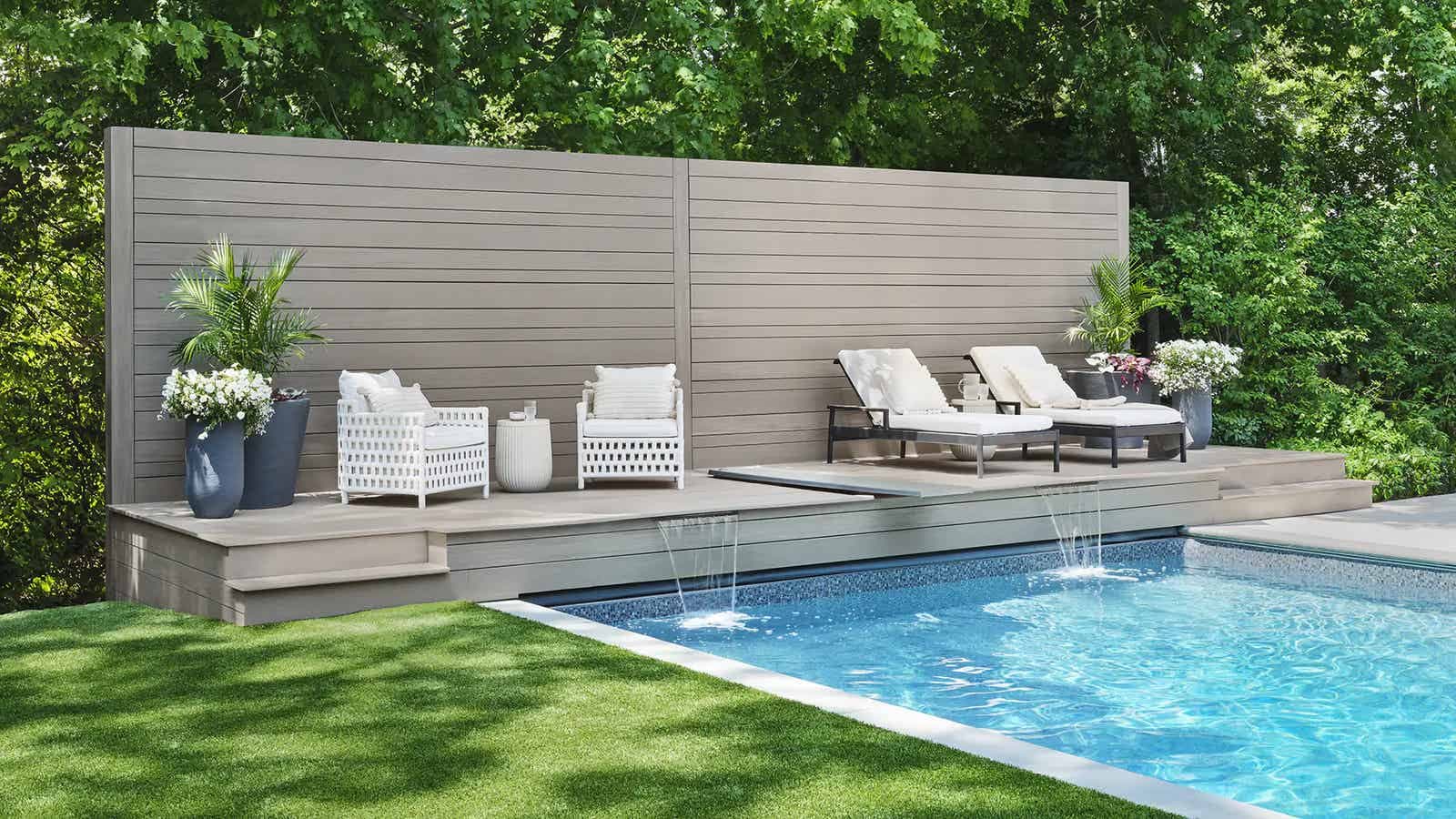
Why Choose PVC Decking for a Pool Terrace?
The primary advantage of PVC decking for a pool terrace is its complete imperviousness to water. This characteristic is especially beneficial in a climate like Chicago's, where decks can experience cycles of wetness followed by drying.
Beyond its waterproof nature, PVC decking is generally lighter than hardwood or many composite options, which can simplify handling and installation. Manufacturers like TimberTech Azek offer advanced PVC lines, known for their durable capping that resists stains and fading. This capping also contributes to easier cleaning, often requiring just soap and water to maintain the surface.
While specific heat-mitigating color options are available, it's important to consider that any dark surface material can absorb heat. For poolside applications, lighter colors may offer a more comfortable surface temperature under direct sun.
PVC decking is also a recyclable material, aligning with sustainability goals for some projects. The material is designed for longevity, with some manufacturers offering extensive limited warranties against material defects.
Understanding PVC Decking Profiles and Appearance
PVC decking is available in various collections and profiles, offering a range of aesthetics to complement your home and landscape. For example, TimberTech Azek's Vintage, Landmark, and Harvest collections provide different visual textures and color palettes, often mimicking the deep grains of natural wood.
When planning your pool terrace, consider how the decking's profile will integrate with the pool's edge and any surrounding hardscaping or landscaping. Fascia and trim boards are available to create a finished look, concealing the edges of the deck boards and supporting structure. These finishing elements are crucial for both aesthetics and safety around a pool.
Board width and length also play a role in the overall design. Wider boards can create a more contemporary feel and potentially reduce the number of seams, while standard widths offer a classic deck appearance. Planning board lengths carefully can help minimize waste and improve the visual flow of the deck surface.
Planning for Drainage and Ventilation Around Your Pool
Even with waterproof PVC decking, proper drainage and ventilation beneath the deck are essential for the overall health of the structure. Water can still accumulate on the sub-structure, leading to issues with joists or fasteners if not managed correctly. Ensure that the deck design allows for adequate airflow to dry out any moisture that gets underneath the boards.
The spacing between deck boards, while typically minimal for PVC, should follow the manufacturer's exact recommendations. This spacing allows for minor expansion and contraction of the boards and facilitates drainage of surface water. Always consult the specific product installation guide for precise gap requirements.
For pool surrounds, consider how water will drain off the deck surface and away from the pool. Sloping the deck slightly away from the pool edge can help prevent standing water. Integrating French drains or other perimeter drainage solutions around the deck can further enhance water management.
Installation Considerations for Poolside PVC Decking
The installation of PVC decking around a pool requires attention to detail, particularly regarding the substructure and fastening methods. While PVC boards are lighter, the substructure must still be robust and properly constructed to support the intended load, including furniture, people, and any planters.
Hidden fastening systems are often preferred for PVC decking to create a clean, fastener-free surface, which can be more comfortable for bare feet around a pool. Ensure that the chosen fasteners are compatible with the specific PVC decking product and the substructure material. Face-fastening is another option, but requires careful alignment and can impact the visual aesthetic.
When cutting PVC boards, use appropriate tools to ensure clean edges, especially for intricate cuts around pool curves or features. Proper planning of the layout can minimize cuts and optimize material use.
Maintenance and Care for Your PVC Pool Terrace
One of the key benefits of PVC decking is its relatively low maintenance. The advanced capping on many PVC boards is designed to shed grease and wine, making spills easy to clean. For general cleaning, a simple regimen of soap and water is often sufficient to remove dirt and grime.
Regular cleaning helps prevent the buildup of mold or mildew, especially in shaded or damp areas. Always refer to the manufacturer's specific cleaning instructions and recommended products to avoid using chemicals that could damage the decking surface or void any warranties. Avoid abrasive cleaners or harsh solvents.
While PVC decking is resistant to many environmental factors, it's still advisable to periodically inspect the deck for any signs of wear, loose fasteners, or damage, particularly after Chicago's winter months. Addressing minor issues promptly can help extend the life and appearance of your pool terrace.
Worked Example: Designing a 10x15 Foot Pool Terrace with PVC Decking
Consider a hypothetical pool terrace project in Chicago, measuring 10 feet by 15 feet, intended to surround one side of a swimming pool. For this example, we'll assume the use of 12-foot long PVC deck boards, 6 inches wide (actual width 5.5 inches) from a premium capped polymer collection.
First, calculate the total area: 10 feet * 15 feet = 150 square feet. To determine the number of boards, we need to consider the layout. We'll need 10 feet / (5.5 inches / 12 inches/foot) = approximately 21.8 boards across the 10-foot width. Since we can't buy partial boards, we'll need 22 full board runs.
Each board run is 15 feet long. However, our available boards are 12 feet long. This means we'll need to use two board segments for each 15-foot run (a 12-foot piece and a 3-foot piece). This will create seams. For a cleaner look, consider a design where boards are laid parallel to the 10-foot dimension, using 10-foot boards. If 10-foot boards are available, we would need 15 feet / (5.5 inches / 12 inches/foot) = approximately 32.7 board runs. So, 33 full 10-foot boards would be needed.
Let's refine for 12-foot boards: If we lay boards parallel to the 10-foot side, we would need 10 feet / (5.5 inches / 12 inches/foot) = 22 boards (rounded up) for the 10-foot width. Each of these 22 boards would be 15 feet long. Since we only have 12-foot boards, we'd need to cut. A better approach might be to orient the boards parallel to the 15-foot dimension. This means each board will be 10 feet long.
We need 15 feet / (5.5 inches / 12 inches/foot) = 32.7 boards wide, so 33 board runs. Each run is 10 feet long. If we purchase 12-foot boards, each 12-foot board can yield one 10-foot piece and a 2-foot offcut. Therefore, we would need 33 boards. This approach generates a significant number of 2-foot offcuts. If the project also includes stairs or a picture frame border, these offcuts might be utilized.
For a simpler calculation assuming full coverage and minimal waste from cuts, if using 12-foot boards (6 inches wide, or 0.5 feet), each board covers 12 feet * 0.5 feet = 6 square feet. For 150 square feet, you would need 150 / 6 = 25 boards. However, this simplified calculation doesn't account for specific dimensions, cuts, or waste. It's always advisable to add 10-15% for cuts, waste, and future repairs. So, 25 boards * 1.15 = 28.75, rounded up to 29 boards. This example highlights the need for careful layout planning to minimize waste and ensure a visually appealing result.
Before you order
- Confirm local building codes and permits required for deck construction in Chicago, especially for pool surrounds.
- Verify the specific PVC decking product's suitability for wet environments and its slip resistance characteristics.
- Plan the deck substructure to ensure adequate support and proper drainage away from the pool and house.
- Choose a PVC decking color that balances aesthetic preference with potential heat absorption in direct sunlight.
- Consider fascia and trim options to create a finished and safe edge around the pool terrace.
- Determine the board layout (e.g., parallel to the house, perpendicular, or diagonal) to optimize material use and visual appeal.
- Select a compatible fastening system (hidden or face-fastened) based on aesthetic preference and installation guidelines.
- Budget for professional installation or confirm your own capabilities for precise cuts and proper assembly.
- Understand the manufacturer's recommended cleaning and maintenance procedures for long-term care.
Confirm installation details, approved uses and warranty terms in the current instructions for the exact product and profile. Your installer should verify the substrate, structure and applicable project requirements.
This is a planning guide for projects in Chicago, IL. Ask our team to confirm availability, delivery to your ZIP code and which branch can support your order.
Questions to help you decide
Is PVC decking slippery when wet, especially around a pool?
Many manufacturers develop specific surface finishes to enhance grip. However, always exercise caution on any wet surface. It's important to check the specific product specifications for any slip resistance ratings or recommendations for poolside applications.
Can PVC decking be installed directly on concrete around a pool?
Installing PVC decking directly on concrete is generally not recommended for several reasons, primarily due to the need for drainage and ventilation. A proper substructure (joists, sleepers) is essential to elevate the decking, allowing air circulation and water runoff. This prevents moisture from being trapped and protects the deck boards and the concrete slab beneath.
How do I clean chlorine or pool chemical spills from PVC decking?
For most PVC decking, immediate cleanup of spills with mild soap and water is recommended. While PVC is highly resistant to chemicals, prolonged exposure to concentrated chlorine or other pool chemicals could potentially affect the surface finish over time. Always refer to the specific manufacturer's cleaning guidelines for approved cleaning agents and methods to ensure you maintain your warranty and the decking's appearance.
Ready to Plan Your PVC Pool Terrace?
Request a material quote for your project. Provide your project dimensions, desired PVC decking profile, and ZIP code to confirm current availability and service options.
Request a material quote →