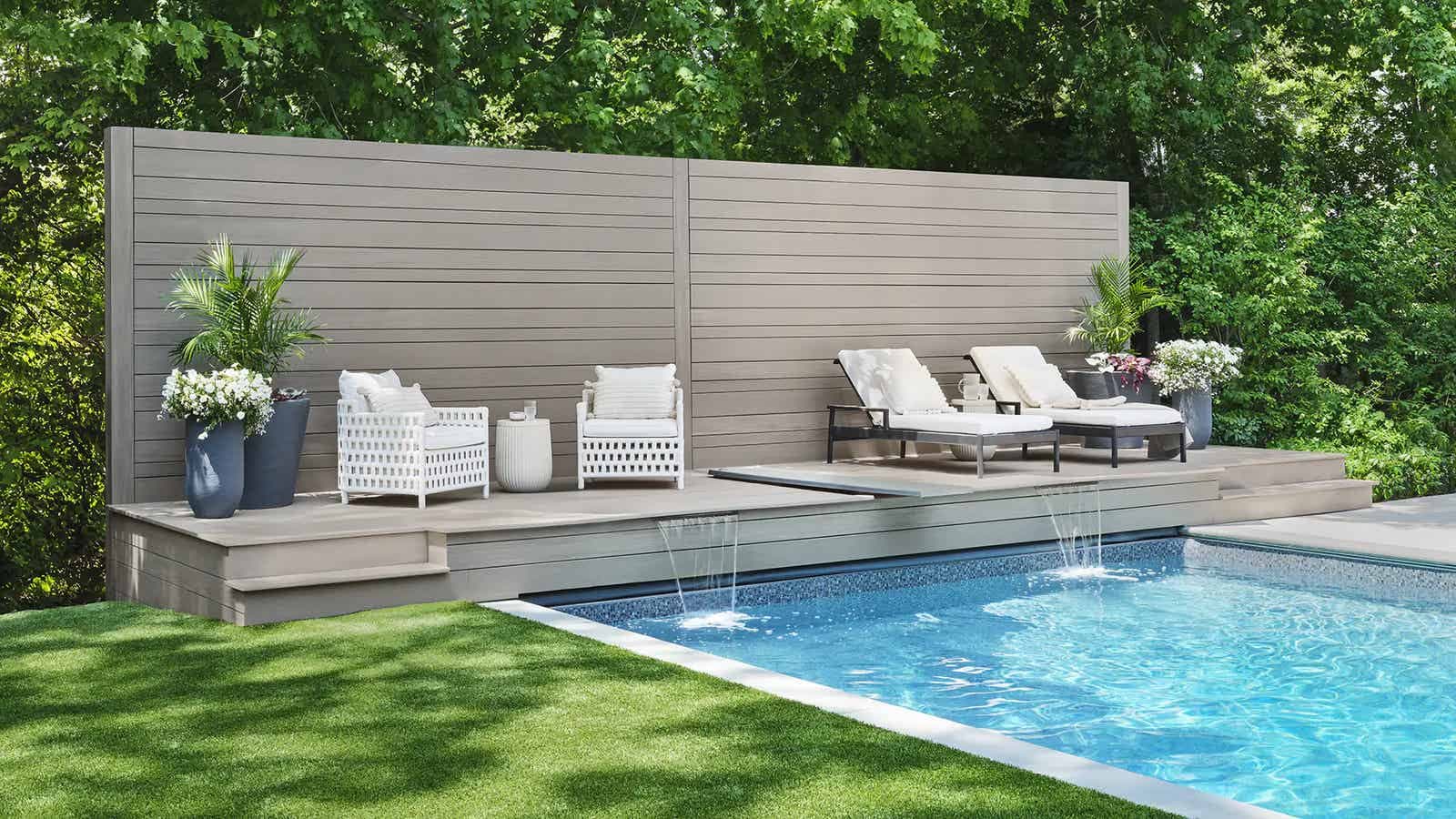
Why PVC Decking for Pool Surrounds?
PVC decking is a 100% synthetic material, meaning it contains no wood fiber. This composition provides inherent advantages for environments consistently exposed to moisture, such as pool surrounds. Without wood, there is nothing in the board that can swell, stain, or rot when exposed to standing water, splash zones, or even salt spray. This characteristic makes PVC a suitable choice where boards are frequently wet.
Beyond its water resistance, PVC decking is designed to be low maintenance. Its capped polymer surface is intended to shed substances like grease and wine, allowing for cleaning with soap and water. This ease of cleaning is a practical benefit for pool areas, where spills and dirt are common.
Understanding PVC Board Construction and Appearance
PVC decking boards feature an advanced capping that encases a full PVC core. This capping is engineered to provide a durable surface while offering various aesthetic options. Collections like Vintage, Landmark, and Harvest offer a range of appearances, including those with deeper wood-like textures and varied color palettes. These options allow for design flexibility to complement different architectural styles and landscaping.
When selecting PVC decking, consider the overall look you want to achieve around your pool. While some options aim to mimic natural wood, others offer more contemporary colors. It's important to view samples in person to accurately assess how colors and textures will appear in your specific outdoor lighting conditions.
Planning for Wet Conditions and Drainage
Even though PVC decking is waterproof to the core, proper planning for drainage remains crucial for a pool surround. Water should not be allowed to pool on the deck surface or beneath it. Ensure that the deck substructure is designed with adequate slope to direct water away from the pool and surrounding structures. This prevents water from accumulating and potentially causing issues with the foundation or landscaping.
Ventilation beneath the deck is also important, especially in areas that may experience prolonged dampness. While PVC itself does not rot, good airflow helps to dry out the substructure and prevents the growth of mold or mildew on surfaces that may accumulate organic matter. Consult manufacturer guidelines for recommended spacing and ventilation requirements for your specific PVC decking product.
Edge Finishes and Fascia for a Polished Look
The edges of your pool surround are critical for both safety and aesthetics. PVC decking systems typically offer coordinating fascia boards or trim pieces that can be used to finish the perimeter of the deck. These components provide a clean, continuous look and conceal the substructure. When planning, consider how the decking will meet the pool coping and any adjacent hardscaping or landscaping.
A well-executed edge detail can enhance the overall appearance of your pool area. Ensure that the chosen fascia boards match or complement the main decking boards in color and texture. Discuss these details with your installer to ensure a cohesive and finished result. For projects requiring specific edge profiles, check the availability of coordinating trim pieces with the selected PVC decking line.
Installation Considerations and Weight
PVC decking is generally lighter than hardwood or composite decking. This reduced weight can simplify handling during installation and may be an advantage for certain project types, such as rooftop decks where structural load is a concern. However, even with lighter materials, proper structural support remains essential.
Follow the manufacturer's installation instructions precisely for joist spacing, fastening methods, and board gapping. Incorrect installation can lead to performance issues, regardless of the material's inherent properties. Hidden fasteners are often used with PVC decking to create a clean, screw-free surface, which can be desirable for bare feet around a pool. Always confirm fastener compatibility with your chosen decking product.
Hypothetical Project: 12' x 20' Pool Surround
Let's consider a hypothetical pool surround project measuring 12 feet by 20 feet. For this example, we'll assume the use of standard PVC decking boards that are 5.5 inches wide and available in 16-foot lengths. The goal is to cover a total area of 240 square feet.
To calculate the number of boards needed, first determine how many 5.5-inch wide boards fit across the 12-foot width. Twelve feet is 144 inches. Dividing 144 inches by 5.5 inches per board yields approximately 26.18 boards. Since you cannot purchase a fraction of a board, you would need 27 boards to cover the width.
Next, consider the 20-foot length. If using 16-foot boards, each 20-foot run will require one full 16-foot board and a 4-foot section. The offcut from the 16-foot board (12 feet) could potentially be used for another section, depending on the layout and any required staggering of seams. For simplicity, if each 20-foot run requires cuts, you will need to account for this. If boards are laid parallel to the 20-foot dimension, you would need 27 runs of decking. Each run would require two 16-foot boards (one cut to 4 feet, with a 12-foot offcut).
This means 27 runs x 2 boards/run = 54 boards. However, the offcuts from the 16-foot boards (12 feet) can be used. Each 20-foot length needs a 16-foot piece and a 4-foot piece. One 16-foot board yields one 16-foot piece. Another 16-foot board can be cut to provide the 4-foot piece, leaving a 12-foot offcut. For 27 runs, you will need 27 x 16-foot boards for the main length. For the remaining 4-foot sections, you would need 27 x 4-foot sections. These 4-foot sections can be cut from additional 16-foot boards. Each 16-foot board can yield four 4-foot sections. Therefore, 27 / 4 = 6.75, so you'd need 7 additional 16-foot boards to create the 4-foot sections. Total boards: 27 + 7 = 34 boards. This simplified calculation assumes minimal waste and ideal cuts. Always add a percentage for waste (typically 5-10%) and verify specific board lengths available and your exact layout plan.
Before you order
- Is the PVC decking explicitly rated for full exposure to water and chemicals (e.g., chlorine)?
- Have you evaluated samples of the chosen PVC decking in outdoor light to assess color and texture?
- Is your deck substructure designed with adequate slope for drainage away from the pool?
- Are there manufacturer-recommended ventilation requirements for the specific PVC decking being used?
- Have you selected coordinating fascia and trim pieces for a finished edge around the pool?
- Are the chosen fasteners compatible with the PVC decking and suitable for wet conditions?
- Have you accounted for a waste factor (e.g., 5-10%) in your material order?
- Is the cleaning and maintenance routine for the PVC decking compatible with your lifestyle?
Confirm installation details, approved uses and warranty terms in the current instructions for the exact product and profile. Your installer should verify the substrate, structure and applicable project requirements.
Questions to help you decide
Is PVC decking slippery when wet?
The surface texture and finish of PVC decking can influence its traction when wet. While manufacturers design for general use, specific slip resistance is not a universal claim. It is recommended to inspect physical samples and consider the specific texture of the boards you are choosing. Regular cleaning can help maintain the surface and prevent the buildup of substances that might reduce traction.
Can PVC decking get hot in the sun?
Like many outdoor materials, PVC decking can absorb heat from the sun. The degree to which it heats up can depend on the color of the board, with darker colors generally absorbing more heat than lighter ones. Some PVC decking lines offer 'heat-mitigating' color options, which are designed to feel cooler underfoot compared to traditional darker decking. Review product specifications for details on heat performance.
How do I clean PVC decking around a pool?
PVC decking is generally easy to clean. For routine maintenance, soap and water are often sufficient to remove dirt, pool chemicals, and light stains. For specific cleaning products, always refer to the manufacturer's cleaning guidelines to ensure compatibility and avoid damaging the decking surface. Avoid abrasive cleaners or harsh chemicals unless explicitly approved by the manufacturer.
Request a Material Quote for Your PVC Pool Surround
Ready to plan your pool decking project? Provide your project dimensions, desired PVC profile, and ZIP code to request a material quote. We can also confirm current availability and service options for your area.
Request a material quote →