Ipe Deck Tiles: The Foundation of Your Pattern
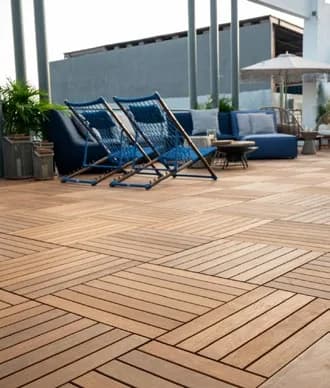
Ipe deck tiles are crafted from Ipe, a tropical hardwood known for its deep chocolate tones. These tiles offer a durable surface for various outdoor applications, from balconies to rooftop terraces. They are available in standard dimensions, such as 12 x 12 inches (1 square foot per tile) and 24 x 24 inches (4 square feet per tile). The consistent square format of these tiles makes them suitable for creating repeatable patterns.
The choice between 12 x 12 and 24 x 24-inch tiles can influence the visual density of your chosen pattern. Smaller tiles introduce more seams, which can emphasize an intricate pattern, while larger tiles create a more expansive look with fewer interruptions. Both sizes provide a solid base for various layout designs.
For additional options, Lumber Plus also offers deck tiles in Garapa, known for its warm golden tones, and Cumaru, which presents a rich reddish-brown grain. These species offer distinct aesthetics while maintaining the same modularity for pattern design.
Straight Lay Patterns: Simplicity and Direction
A straight lay pattern is the most direct approach, where all Ipe deck tiles are installed with their wood grain running in the same direction. This creates a clean, linear appearance that can make a space feel longer or wider, depending on the orientation chosen.
This pattern is particularly effective in rectangular areas where you want to emphasize a specific axis, perhaps drawing the eye towards a view or away from an adjacent structure. It simplifies installation as cuts are typically straightforward, primarily along the perimeter.
Consider a straight lay for walkways, long balconies, or areas where you want an uncluttered visual. While simple, the consistent grain direction of Ipe wood provides a subtle texture that remains interesting without overwhelming the space.
Alternating Patterns: Adding Visual Interest
Alternating patterns involve orienting adjacent Ipe deck tiles so their wood grain runs in perpendicular directions. The most common alternating pattern is a checkerboard or basket-weave effect, where every other tile is rotated 90 degrees.
This pattern introduces a dynamic visual texture and can make a space feel more expansive and less linear. It works well in square or irregularly shaped areas, breaking up monotony and adding depth. The alternating grain direction catches light differently, creating a subtle interplay of tones across the surface.
When planning an alternating pattern, remember that each tile's orientation is critical. This approach requires careful attention during installation to maintain the pattern's consistency. For instance, a 24 x 24-inch Ipe deck tile in an alternating pattern will showcase the larger wood planks within the tile in two different directions, creating a distinct visual effect.
Zoned Patterns: Defining Outdoor Rooms
Zoned patterns combine straight and alternating layouts to delineate distinct areas within a larger outdoor space. This technique is useful for creating 'outdoor rooms' on a terrace, such as a dining area, a lounge space, or a pathway.
For example, you might use a straight lay pattern for a central dining zone, bordered by an alternating pattern for a surrounding lounge area. This creates visual cues that guide movement and define function without needing physical dividers.
Zoned patterns require more detailed planning and precise execution. You'll need to decide where each zone begins and ends, and how the different patterns transition. This can involve more complex cuts at the boundaries between zones, potentially leading to a higher material waste factor if not carefully planned. However, the result is a sophisticated and highly functional outdoor environment.
Consider using a 12 x 12-inch Ipe deck tile for intricate zoned areas, as its smaller size allows for more detailed transitions and tighter curves if needed, though most zones will be rectilinear. The compact format offers flexibility for defining smaller, specific areas.
Worked Example: Planning a Zoned Patio (Hypothetical)
Imagine a rectangular patio measuring 10 feet by 16 feet. We want to create two zones: a 10-foot by 10-foot dining area and a 10-foot by 6-foot lounge area. We'll use 24 x 24-inch Ipe deck tiles (2 feet x 2 feet).
For the 10x10-foot dining area: We'll use a straight lay pattern, with the grain running along the 10-foot dimension. This means 5 tiles (10 ft / 2 ft) in one direction and 5 tiles in the other. Total tiles for dining area: 5 x 5 = 25 tiles. Each tile covers 4 square feet, so 25 tiles cover 100 square feet.
For the 10x6-foot lounge area: We'll use an alternating pattern. Along the 10-foot dimension, we need 5 tiles. Along the 6-foot dimension, we need 3 tiles (6 ft / 2 ft). Total tiles for lounge area: 5 x 3 = 15 tiles. This covers 60 square feet.
Total area: 100 sq ft + 60 sq ft = 160 sq ft. Total tiles needed: 25 + 15 = 40 tiles.
In this example, no partial tiles are needed for the main field, as the dimensions align perfectly with the 2-foot module. However, if the patio were 9 feet by 15 feet, additional tiles would be needed for cuts and potential waste. Always account for a waste factor (typically 5-10%) for cuts, especially with more complex patterns or irregular project dimensions. For this hypothetical 10x16 patio, 40 tiles would cover the area, but ordering 42-44 tiles would be prudent for cuts and spares.
Before you order
- Consider the overall size and shape of your outdoor space.
- Decide if you want to emphasize length, width, or create distinct zones.
- Evaluate the visual impact of more seams (12x12 tiles) versus fewer seams (24x24 tiles).
- Assess your comfort level with more complex cuts and potential waste for intricate patterns.
- Think about how the pattern will interact with existing features like walls, planters, or furniture.
- Confirm the desired grain direction for each section of your layout.
- Account for a waste factor in your material order to accommodate cuts and potential replacements.
Confirm installation details, approved uses and warranty terms in the current instructions for the exact product and profile. Your installer should verify the substrate, structure and applicable project requirements.
Questions to help you decide
Does the pattern direction affect the durability of the Ipe deck tiles?
The pattern direction primarily affects the aesthetic appearance and visual flow of your outdoor space. The inherent durability of Ipe deck tiles comes from the material itself and proper installation on a suitable subsurface. The orientation of the individual tiles does not change their structural integrity or lifespan.
Can I mix different sizes of Ipe deck tiles in one pattern?
While it is technically possible to mix different sizes like 12 x 12 and 24 x 24-inch Ipe deck tiles, it requires careful planning to ensure the module sizes align and the transitions are visually cohesive. This approach is more complex and typically used for highly customized designs. It's often easier to achieve a varied look by changing pattern direction with a single tile size.
How do I calculate the number of Ipe deck tiles needed for a specific pattern?
Start by calculating the total square footage of your project area. Then, divide this by the square footage of a single tile (e.g., 1 sq ft for 12x12, 4 sq ft for 24x24). This gives you a base quantity. For patterns involving cuts, especially around edges, obstacles, or zoned transitions, you must factor in additional tiles for waste, typically an extra 5-10%. It's always best to sketch out your pattern on a grid to visualize cuts and optimize your tile usage before ordering.
Ready to Plan Your Ipe Deck Tile Project?
Request a material quote with your project dimensions, exact profile, and ZIP code to confirm current availability and service options for Ipe deck tiles and related products. We can help you estimate quantities for your chosen pattern.
Request a material quote →