Understand Ipe Deck Tile Dimensions and Coverage
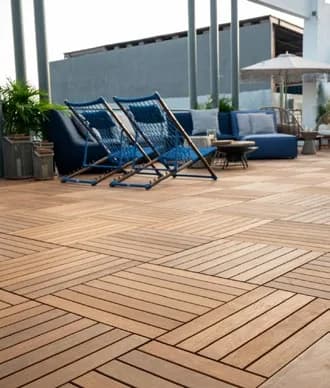
Ipe deck tiles are available in standard square formats, each offering different coverage per tile. The two common sizes are 12 x 12 inches and 24 x 24 inches. Each size has distinct implications for your layout and quantity calculation.
The 12 x 12 inch tile measures 12 inches by 12 inches, covering 1 square foot per tile. This compact format can be suitable for smaller areas, intricate layouts, or spaces with many edges and transitions. The smaller size might mean more individual tiles to handle, but it can offer greater flexibility for fitting into irregular shapes.
The 24 x 24 inch tile measures 24 inches by 24 inches, covering 4 square feet per tile. This larger format is often chosen for more expansive terraces and open surfaces, where fewer tile seams are desired across the finished area. While larger tiles can speed up installation in open spaces, they may require more careful planning for cuts around obstacles or at edges to minimize waste.
Choosing between these sizes depends on your project's scale, the complexity of its perimeter, and your aesthetic preference for the number of visible seams.
Measure Your Project Area Accurately
Begin by measuring the total area where you plan to install Ipe deck tiles. Use a tape measure to determine the length and width of each distinct section of your project. For rectangular or square areas, multiply the length by the width to get the square footage.
For irregular shapes, divide the area into smaller, manageable rectangles or squares. Measure each section and calculate its area, then sum these individual areas to find the total square footage. Always measure twice to ensure accuracy.
Consider any fixed obstacles such as columns, planters, or drains. While you will not be tiling over these, understanding their position will influence how you plan your tile layout and cuts. For areas around obstacles, measure the dimensions of the obstacle and the surrounding space to determine how many tiles will need to be cut.
Calculate Base Tile Quantity
Once you have the total square footage of your project area, you can calculate the base quantity of tiles needed before accounting for cuts and waste. This is a straightforward division.
For 12 x 12 inch tiles (1 square foot per tile): Divide your total square footage by 1. The result is the number of tiles needed.
For 24 x 24 inch tiles (4 square feet per tile): Divide your total square footage by 4. The result is the number of tiles needed.
Always round up to the nearest whole tile. For example, if you need 40.5 tiles, you will purchase 41 tiles. This initial calculation assumes no cuts or waste, which is rarely the case in a real project.
Account for Cuts, Waste, and Future Replacements
Even in a perfectly rectangular space, cuts will almost always be necessary at edges or around obstacles. It is prudent to include a waste factor in your order. A typical waste factor for deck tile projects ranges from 5% to 15%, depending on the complexity of the layout and the size of the tiles.
For projects with many cuts, intricate patterns, or irregular shapes, a higher waste factor (10-15%) is advisable. For simple, open rectangular areas, a lower waste factor (5-7%) might suffice. It is always better to have a few extra tiles than to run short and delay your project.
Beyond initial installation, consider ordering a small number of extra tiles for future repairs or replacements. Accidents can happen, and having spare tiles on hand can save time and ensure a consistent appearance if a tile needs to be swapped out years down the line. Store these spares in a protected, dry location.
Worked Example: Calculating Tiles for a Balcony Terrace
Let's consider a hypothetical balcony terrace that is 10 feet 6 inches (10.5 feet) long and 6 feet 0 inches (6 feet) wide. There is also a small, fixed planter box in one corner, measuring 2 feet by 2 feet.
Step 1: Calculate the total area of the balcony. Length x Width = 10.5 feet x 6 feet = 63 square feet.
Step 2: Calculate the area of the fixed planter box. Length x Width = 2 feet x 2 feet = 4 square feet.
Step 3: Determine the actual area to be tiled. Total Balcony Area - Planter Box Area = 63 sq ft - 4 sq ft = 59 square feet.
Step 4: Choose a tile size. For this example, let's use 24 x 24 inch Ipe deck tiles (4 square feet per tile).
Step 5: Calculate the base quantity of tiles needed. Area to Tile / Tile Area = 59 sq ft / 4 sq ft per tile = 14.75 tiles. Round up to 15 tiles.
Step 6: Apply a waste factor. Given the planter box and potential edge cuts, a 10% waste factor is reasonable. 15 tiles * 0.10 (10%) = 1.5 tiles. Round up to 2 waste tiles.
Step 7: Calculate the total number of tiles to order. Base Tiles + Waste Tiles = 15 + 2 = 17 tiles.
For this balcony terrace, you would order 17 of the 24 x 24 inch Ipe deck tiles. This accounts for the primary area, the obstruction, and a buffer for cuts and potential future needs.
Before you order
- Have I measured the length and width of all areas to be tiled?
- Have I accounted for any fixed obstacles or irregular shapes?
- Have I chosen between 12x12 or 24x24 inch Ipe deck tiles?
- Have I calculated the base quantity of tiles needed for the net area?
- Have I added a waste factor (5-15%) based on project complexity?
- Have I considered ordering a few extra tiles for future repairs?
- Do I have a clear plan for cutting tiles to fit edges and around obstacles?
Confirm installation details, approved uses and warranty terms in the current instructions for the exact product and profile. Your installer should verify the substrate, structure and applicable project requirements.
Questions to help you decide
What if my project area is not perfectly rectangular?
For irregular shapes, break the area down into a series of smaller rectangles or squares. Calculate the area of each section individually, then sum them up to get the total square footage. Always measure the longest and widest points of each segment to ensure you capture the full extent.
How much waste should I really factor in?
The waste factor depends on your project's complexity. For simple, open rectangular areas with minimal cuts, 5-7% might be sufficient. If you have many angles, curves, obstacles, or plan an intricate pattern, increase the waste factor to 10-15%. It's generally safer to overestimate slightly than to run out of material mid-project.
Can I use smaller pieces from cut tiles?
Yes, often you can. If a tile is cut to fit one edge, the remaining piece might be usable at another edge or in a different part of the layout, provided it's large enough and fits the dimension. Efficient cutting plans can help minimize waste. However, don't rely on every offcut being perfectly usable; the waste factor accounts for pieces that are too small or unsuitable.
Ready to Plan Your Ipe Deck Tile Project?
Request a material quote today. Provide your project dimensions, desired Ipe deck tile profile (12x12 or 24x24), and your ZIP code to confirm current availability and service options.
Request a material quote →