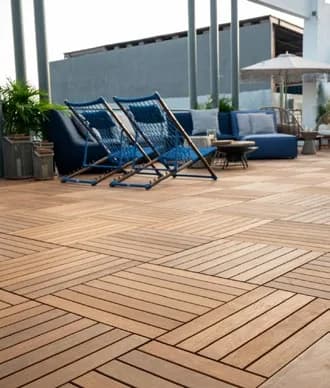
Assess Your Project Site for Delivery and Access
The first step in planning material logistics is a thorough assessment of your project site. Consider the street access for large delivery vehicles, potential parking restrictions, and the path from the curb to the final staging area. For ground-level projects, this might be straightforward, but for elevated spaces like balconies or rooftops, vertical transportation (elevators, cranes, stairwells) becomes a key factor.
Measure the dimensions of any gates, doorways, or elevator openings that the deck tile pallets or boxes will need to pass through. Identify any obstacles such as narrow corridors, tight turns, or uneven terrain. Documenting these details will help you communicate effectively with the delivery team and anticipate any challenges.
For larger projects, confirm if there are specific hours for deliveries or material handling within the building or complex. Urban environments often have strict rules regarding street closures or loading dock usage. Neglecting these details can lead to costly redelivery charges or project delays.
Understanding Ipe Deck Tile Packaging and Weight
Ipe deck tiles are typically bundled or crated to protect them during transit. While specific packaging varies, expect each tile to contribute significant weight due to Ipe's density. For example, a 24 x 24 inch Ipe deck tile covers 4 square feet. A pallet containing multiple tiles can be very heavy, requiring mechanical assistance for unloading and movement.
Obtain specific packaging dimensions and approximate weights from your supplier before delivery. This information is crucial for determining if a forklift, pallet jack, or other specialized equipment will be necessary. For manual handling, ensure you have enough personnel and appropriate safety gear. Never attempt to lift overly heavy packages alone.
Knowing the package dimensions also helps in planning storage space and calculating how many bundles can fit into an elevator or through a doorway in a single trip. This prevents bottlenecks during the staging process.
Planning for Temporary On-Site Storage
Once delivered, Ipe deck tiles need a secure, protected temporary storage location. This area should be flat, dry, and away from direct sunlight and extreme weather. Exposure to moisture before installation can cause the wood to expand or warp, while direct sun can lead to premature fading or checking.
If storing outdoors, cover the tiles with a waterproof tarp, ensuring adequate airflow to prevent condensation. Elevate pallets off the ground using blocks or dunnage to protect against ground moisture. The storage area should also be secure to prevent theft or damage from foot traffic or other construction activities.
Consider the duration of storage. For longer periods, a more robust, climate-controlled environment might be advisable, particularly in regions with high humidity or significant temperature fluctuations. Always store tiles flat to maintain their shape.
Coordinating with Your Delivery Service
Effective communication with the delivery service is paramount. Share all relevant site access information, including any restrictions on vehicle size, delivery hours, or required equipment for unloading. Confirm the expected delivery date and time window, and ensure someone is available on-site to receive and inspect the materials.
Upon arrival, carefully inspect all packages for any signs of damage before signing the delivery receipt. Document any visible damage with photographs and note it clearly on the delivery manifest. This step is critical for filing any claims for damaged goods.
Discuss with the delivery driver the exact drop-off location. If the truck cannot access the desired staging area, be prepared with a plan for moving the materials from the curb or nearest accessible point. This might involve a 'white glove' delivery service or having your own team and equipment ready.
Worked Example: Rooftop Terrace Logistics for Ipe Deck Tiles
Consider a hypothetical rooftop terrace project measuring 20 feet by 15 feet. The project requires 24 x 24 inch Ipe deck tiles. Each tile covers 4 square feet, so the total area of 300 square feet (20 x 15) requires 75 tiles (300 / 4). Allowing for cuts and waste, let's assume 80 tiles are ordered.
These 80 tiles might be packaged in 8 bundles of 10 tiles each. If each bundle measures approximately 25 inches by 25 inches by 15 inches high and weighs 150 lbs, the total weight is 1200 lbs. The building has a service elevator with a maximum capacity of 1000 lbs and internal dimensions of 36 inches wide by 48 inches deep by 84 inches high.
The bundles are too large to fit two side-by-side in the elevator's depth, and the total weight exceeds the elevator's capacity if all 8 bundles are moved at once. The plan must therefore involve moving a maximum of 6 bundles (900 lbs) per elevator trip, requiring two trips. Each bundle must be carefully oriented to fit through the elevator doors and inside the cabin. A dolly or hand truck will be needed to move bundles from the delivery truck to the elevator, and then from the elevator to the rooftop staging area, which should be protected by a tarp and elevated on dunnage.
Before you order
- Have I assessed all site access points for delivery vehicles and material movement?
- Do I know the specific dimensions and weight of the Ipe deck tile packaging?
- Is the planned temporary storage area dry, level, secure, and protected from elements?
- Have I confirmed any building or city restrictions on delivery times or equipment?
- Is there a clear plan for moving materials from the delivery truck to the final staging area?
- Have I communicated all site access and handling requirements to the delivery service?
- Do I have a plan for inspecting materials upon arrival and documenting any damage?
- Are there enough people and the right equipment available on-site to handle the materials safely?
- Have I considered the need for elevation (dunnage) and covering (tarp) for stored materials?
Confirm installation details, approved uses and warranty terms in the current instructions for the exact product and profile. Your installer should verify the substrate, structure and applicable project requirements.
Questions to help you decide
What should I do if my Ipe deck tiles arrive damaged?
Upon delivery, carefully inspect all packages for damage before signing the delivery receipt. If you observe any damage, photograph it immediately and clearly note the damage on the delivery manifest. Contact your supplier (Lumber Plus) as soon as possible with this documentation to report the issue and discuss next steps. Do not discard any packaging or damaged materials until instructed.
Can I store Ipe deck tiles outdoors before installation?
Yes, Ipe deck tiles can be stored outdoors temporarily, but they must be properly protected. Choose a flat, dry area away from direct sunlight and standing water. Elevate the bundles off the ground using dunnage or blocks to prevent moisture absorption. Cover the entire stack with a waterproof tarp, ensuring sufficient airflow to prevent condensation. Avoid prolonged outdoor storage, especially in areas with significant temperature swings or high humidity, as this can affect the wood.
How do I calculate how many Ipe deck tile bundles I will receive?
To estimate the number of bundles, first calculate the total square footage of your project and add a percentage for waste (typically 5-10%). Then, divide this total square footage by the area covered by a single tile (e.g., 1 sq ft for 12x12, 4 sq ft for 24x24) to get the number of tiles. Finally, divide the total number of tiles by the number of tiles per bundle (which your supplier can provide) to estimate the number of bundles. Always confirm exact packaging details with your supplier (Lumber Plus) before delivery.
Request a Quote for Ipe Deck Tiles
Ready to plan your outdoor project? Request a material quote for Ipe deck tiles. Provide your project dimensions, desired profile (12x12 or 24x24), and ZIP code to confirm current availability and service options. Our team can help you with material estimates and logistics planning.
Request a material quote →