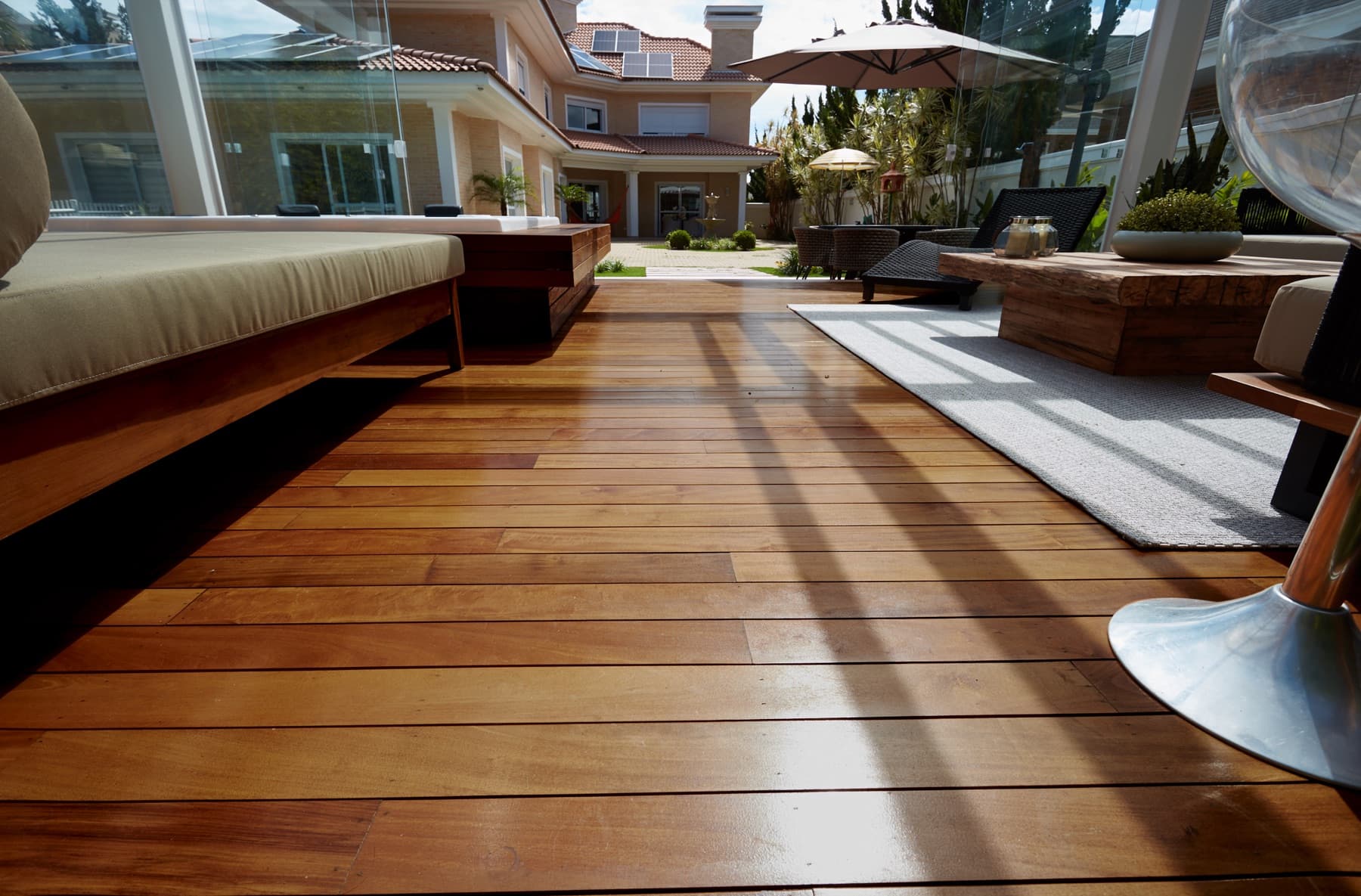
Understanding Hardwood Decking Dimensions and Units
Hardwood decking is typically sold by the linear foot (LF) or board foot (BF). While the board foot accounts for volume (length x width x thickness / 144), many decking projects are planned using linear feet, especially for standard board widths and thicknesses. It's crucial to confirm how your chosen product is sold and how your supplier quotes it. For instance, Ipe and Cumaru decking are available in various profiles and lengths, such as 1"x2" through 6"x6" dimensions and lengths from 3 to 24 feet. Always verify current profiles and lengths with your supplier.
When measuring, consider the nominal versus actual dimensions. While a board might be called "1x6," its actual milled dimensions will be slightly smaller. For decking, the key is the coverage width. For example, a nominal 1x6 board might cover 5.5 inches once installed. Always use the actual coverage width for your calculations, not the nominal size.
Measuring Your Deck Area
Start by measuring the total area of your deck frame. Use a tape measure to determine the length and width of each section of your deck. If your deck has an irregular shape, break it down into simpler rectangles or squares, measure each section individually, and then sum the areas. For a rectangular deck, simply multiply the length by the width to get the total square footage.
Precision is key. Measure twice to minimize errors. Document all measurements clearly, perhaps with a simple sketch of your deck layout, marking lengths and widths. This visual aid can be invaluable when planning board placement and calculating cuts.
Planning Board Layout and Direction
The direction in which you lay your decking boards significantly impacts your material needs. Boards laid parallel to the longest dimension of the deck often result in fewer cuts and less waste. However, aesthetic preferences, such as a diagonal pattern or a picture-frame border, will increase the complexity of cuts and often require a higher waste factor.
Consider the available lengths of hardwood decking. Ipe and Cumaru, for example, are available in lengths up to 24 feet. Planning your layout to utilize full board lengths as much as possible will reduce offcuts. If your deck is 16 feet long, using 16-foot boards minimizes waste compared to using 10-foot boards that require multiple cuts and seams.
Calculating Linear Feet for a Simple Rectangular Deck: A Worked Example
Let's assume you're building a rectangular deck that is 12 feet wide by 20 feet long. You plan to use Ipe decking boards, which are 5.5 inches wide (actual coverage) and available in various lengths.
1. **Calculate the total area:** 12 feet * 20 feet = 240 square feet.
2. **Convert board width to feet:** 5.5 inches / 12 inches/foot = 0.4583 feet.
3. **Determine the number of boards needed across the width:** If boards are laid along the 20-foot length, you'll need boards to cover the 12-foot width. Number of boards = 12 feet / 0.4583 feet/board = 26.18 boards. Round up to 27 boards to ensure full coverage.
4. **Calculate total linear feet (before waste):** Each of the 27 boards needs to be 20 feet long. Total linear feet = 27 boards * 20 feet/board = 540 linear feet.
The 5.5-inch coverage width implicitly includes the board material itself, and the calculation for the number of boards needed across the width typically accounts for this by using the board's effective coverage.
6. **Add for Waste:** This is a crucial step. For a straightforward rectangular deck with minimal cuts, a 5-10% waste factor is often recommended. For more complex layouts (diagonal patterns, multiple angles, picture framing), you might need to account for 15-20% or even more. Let's use a 10% waste factor for this simple deck. Waste = 540 LF * 0.10 = 54 LF.
7. **Total Linear Feet to Order:** 540 LF (base) + 54 LF (waste) = 594 linear feet. Round up to the nearest full board length increment if your supplier sells in specific lengths (e.g., if only 20-foot boards are available, you'd need 30 boards for 600 LF).
8. **Consider specific board lengths:** If you can order 20-foot boards, you'd order 30 of them. This gives you 600 linear feet, providing slightly more than the 594 LF calculated, which is a safe margin.
Accounting for Waste and Offcuts
Waste is an inevitable part of any construction project, especially with decking that requires precise cuts around obstacles, for ends, and for transitions. The waste factor depends on several elements:
**Deck Shape and Layout:** Simple rectangular decks with straight board runs have less waste. Diagonal layouts, curves, and intricate patterns will increase waste significantly.
**Board Length Availability:** If your deck length doesn't align well with available board lengths, you'll have more offcuts. For example, a 13-foot deck using 16-foot boards will result in 3 feet of offcut per board, which may or may not be reusable.
**Obstacles and Features:** Posts, railings, built-in benches, and other deck features require boards to be cut around them, leading to additional waste.
**Skill Level:** Less experienced installers may generate more waste due to miscuts. Always factor in a slightly higher percentage if you are new to decking installation.
A typical waste factor for a basic rectangular deck is 5-10%. For more complex designs, consider 15-20%. It's always better to over-order slightly than to run short and face delays or color matching issues with a new batch of material. Unused full boards can often be returned, but cut pieces cannot.
Additional Materials to Consider
Beyond the decking boards themselves, remember to account for other essential materials:
**Fascia and Trim Boards:** These finish the edges of your deck, often using the same hardwood species but in different profiles. For Ipe, these are often available in similar dimensions to decking.
**Fasteners:** Whether you choose hidden fasteners or face fasteners, ensure you have the correct type and quantity for your project. Ipe's density often requires specialized tools and techniques for installation.
**Support Structure:** While not part of the decking takeoff, ensure your joists and beams are correctly spaced and adequately sized to support the hardwood decking and anticipated loads.
**Sealants or Oils:** If you wish to maintain the original reddish-brown to olive-brown color of species like Ipe or Cumaru, you'll need a UV-blocking sealer. If left untreated, these hardwoods will weather to a silvery-gray patina.
**Ventilation:** Proper under-deck ventilation is critical for the longevity of hardwood decking. Ensure your design allows for adequate airflow.
Before you order
- Have I measured the total length and width of each deck section accurately?
- Have I converted all measurements to a consistent unit (e.g., feet or inches)?
- Do I know the actual coverage width of the specific hardwood decking boards I plan to use?
- Have I decided on the board layout (straight, diagonal, picture frame)?
- Have I checked the available lengths of my chosen hardwood species (e.g., Ipe, Cumaru) and planned my cuts to minimize waste?
- Have I accounted for board spacing in my calculations?
- What waste factor have I applied (5-20% depending on complexity)?
- Have I included fascia, trim, and other finishing materials in my material list?
- Are the correct fasteners specified and quantified?
- Have I considered sealants or oils if I want to maintain the wood's original color?
- Have I confirmed current profiles, lengths, and service options with Lumber Plus?
- Is my under-deck ventilation plan adequate for hardwood decking?
Confirm installation details, approved uses and warranty terms in the current instructions for the exact product and profile. Your installer should verify the substrate, structure and applicable project requirements.
Questions to help you decide
What is the difference between linear feet and board feet for decking?
Linear feet (LF) measure the length of a board, regardless of its width or thickness. Board feet (BF) measure the volume of lumber (length x width x thickness / 144 cubic inches). For decking, which typically uses standard widths and thicknesses, linear feet are often used for ordering. However, some suppliers may price by board foot, so always confirm the unit of measure.
How much waste should I factor into my hardwood decking order?
A general rule of thumb for a simple rectangular deck is 5-10% waste. For more complex designs, such as diagonal layouts, decks with many angles, or those requiring extensive cuts around obstacles, a waste factor of 15-20% or even higher is recommended. It's better to have a small amount of extra material than to run short.
Does board spacing affect the quantity of decking I need?
Yes, board spacing affects the total coverage of your deck. While our example calculates the number of boards based on their actual width, the small gaps between boards mean you'll need slightly fewer boards to cover a given area than if they were installed edge-to-edge. However, for practical ordering, calculating based on the board's effective coverage (including its width and a nominal portion of the gap it displaces) and then adding a waste factor is a common and effective approach. Always refer to the manufacturer's specific spacing recommendations.
Ready to Plan Your Hardwood Decking Project?
Request a material quote with your project dimensions, exact profile preferences, and ZIP code. Our team can help confirm current availability, service options, and provide a tailored quote for your hardwood decking needs. Explore our selection of Ipe, Cumaru, and other premium hardwoods.
Request a material quote →