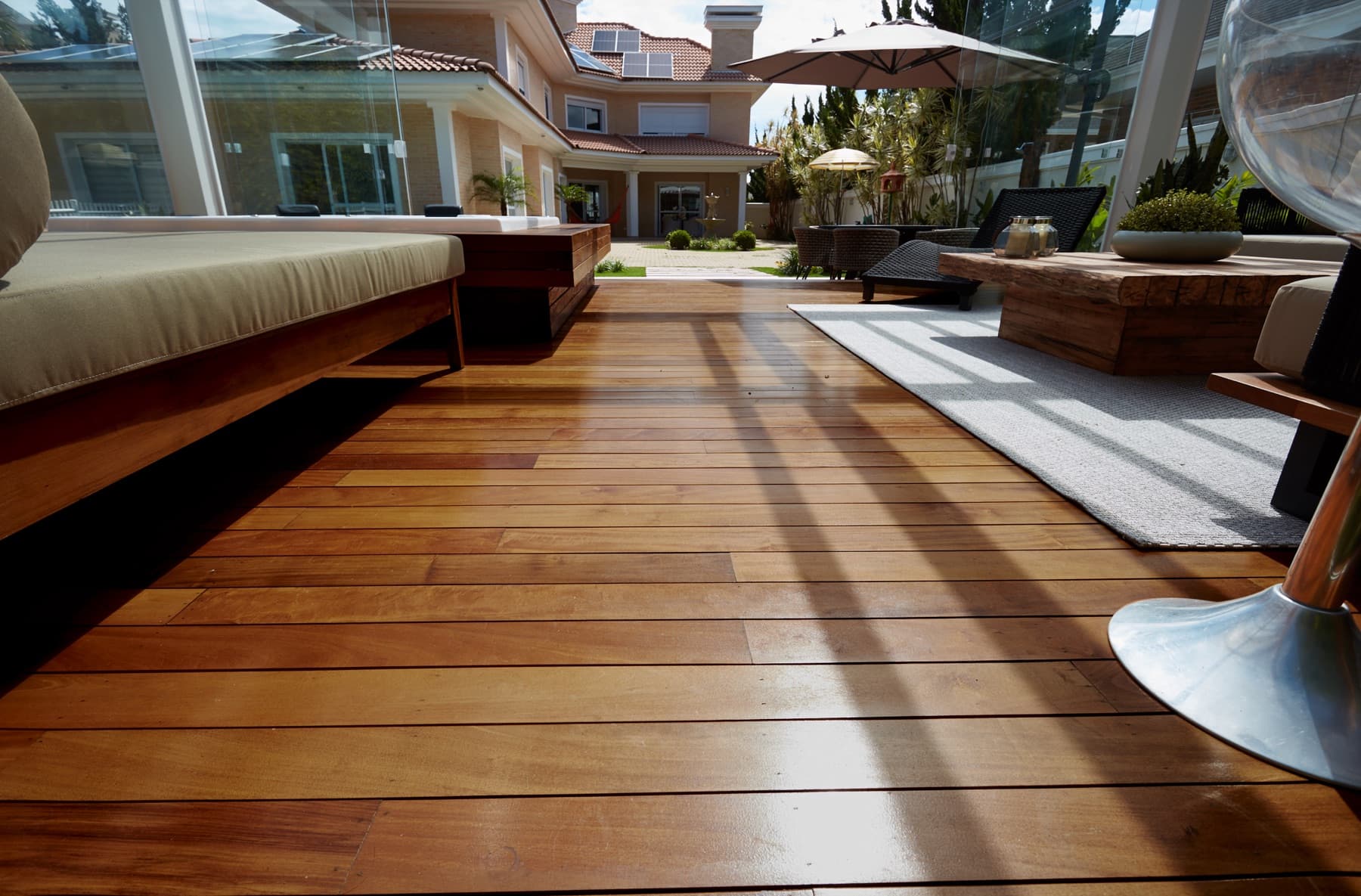
Assess Your Existing Deck Frame and Structure
Before selecting any new decking material, a thorough inspection of your existing deck frame is essential. The structural integrity of your joists, beams, and support posts will dictate what kind of new decking can be installed and whether any repairs or upgrades are necessary. Look for signs of rot, insect damage, or excessive deflection in the joists. Hardwood decking species like Ipe and Cumaru are dense and heavier than many common decking materials, so a robust, well-maintained frame is crucial.
Consider the spacing of your existing joists. If your current joist spacing is wider, or if the frame shows significant wear, you may need to reinforce the structure or add additional joists to adequately support the new, denser decking. This initial assessment can save significant time and cost down the line.
Measuring Your Deck for Hardwood Decking
Accurate measurements are critical for ordering the correct quantity of hardwood decking. Begin by measuring the total length and width of your deck surface. If your deck has irregular shapes, multiple levels, or integrated features like benches or planters, break the area down into simpler geometric sections and measure each individually. Always measure twice to ensure accuracy.
For a renovation, also consider the existing board layout. Will you be replacing boards in the same orientation, or are you planning a new pattern like a diagonal layout or a picture-frame border? These design choices can influence the required board lengths and the amount of material needed, including potential waste from cuts. Documenting your measurements with a sketch of the deck layout can be highly beneficial when requesting a quote.
Choosing Hardwood Species: Ipe vs. Cumaru for Boston's Climate
When renovating a deck in a climate like Boston's, which experiences distinct seasons and varying moisture levels, selecting a durable hardwood is key. Two popular choices for their resilience and appearance are Ipe and Cumaru.
Ipe, also known as Brazilian walnut, is renowned for its exceptional durability and longevity. Ipe typically ranges from reddish-brown to olive-brown and can last for decades with proper care. It's a premium choice that offers significant long-term value. If left untreated, Ipe will weather to a silvery-gray patina; applying a UV-blocking sealer can help maintain its original color.
It is also resistant to termites and weather changes, making it a dependable option for outdoor applications. Cumaru often presents a slightly lighter, reddish-brown to golden-brown hue and shares many of Ipe's robust qualities. It is a strong alternative that can provide similar performance.
Both species are suitable for areas with salt air and spray, which might be a consideration for coastal Boston properties, as they are commonly used in marine-grade applications like boardwalks. They require minimal maintenance, typically a yearly wash, and an optional annual oiling to preserve their original color.
Consider the aesthetic you desire for your renovated deck. Ipe's deeper tones often convey a sense of luxury, while Cumaru offers a warm, inviting appearance. Both will perform well structurally in varying weather conditions.
Hardwood Decking Profiles and Board Dimensions
Hardwood decking is available in various profiles and dimensions. Common profiles include standard rectangular boards with eased edges. The typical dimensions for hardwood decking range from 1x2 inches up to 6x6 inches, with lengths often available from 3 to 24 feet. The exact profiles and lengths available can vary, so confirming current stock is important.
When planning your renovation, consider the width of the boards. Wider boards can create a more contemporary look and may mean fewer visible seams. Narrower boards can offer a more traditional aesthetic. The thickness of the boards should also be considered in relation to your existing frame and any height transitions to adjacent structures or doorways.
If your project requires specific dimensions or custom milling, it is advisable to discuss this early in the planning process. While hardwood decking is extremely dense, it can be cut to fit, but specialized tools are often recommended for installation due to its hardness.
Worked Example: Renovating a 10x15 Foot Deck in Boston
Let's consider a hypothetical deck renovation project in Boston for a rectangular deck measuring 10 feet by 15 feet. The homeowner wants to replace existing decking with Ipe.
The total area of the deck is 10 ft x 15 ft = 150 square feet. Assuming a standard Ipe decking board of 5.5 inches wide (nominal 1x6) and a common length of 12 feet:
First, calculate the number of 12-foot long boards needed to cover the 10-foot width. 10 feet = 120 inches. A 5.5-inch board means 120 / 5.5 = approximately 21.8 boards. Since you need full boards, you would plan for 22 boards across the width.
Next, calculate how many 12-foot lengths are needed for the 15-foot length. This is straightforward: 15 feet requires one 12-foot board and a 3-foot cut. However, to minimize waste and ensure consistent appearance, it's often more practical to use longer lengths where possible, or plan for staggered seams. For this example, if only 12-foot boards are used, each 12-foot board will cover 12 feet of the 15-foot length, leaving 3 feet. This means for every run, you'd need one 12-foot board and one 3-foot section. You would purchase 22 boards for the width, and then for the 15-foot length, you would need to plan for two 12-foot boards per run to minimize cuts and waste. This would be 22 boards * 2 = 44 boards.
If you can source 16-foot or longer boards, the calculation simplifies. This would be 22 boards x 16 feet/board = 352 linear feet. Always add 10-15% for cuts, waste, and future repairs. So, 352 linear feet * 1.15 = approximately 405 linear feet. This translates to roughly 34 boards of 12 feet each if only 12-foot lengths were purchased, or 26 boards of 16 feet each.
This example highlights the importance of matching available lengths to your project dimensions and accounting for cuts. Always consult with a supplier to optimize board lengths and minimize waste for your specific layout.
Before you order
- Inspect existing deck frame for rot, insect damage, and structural integrity.
- Verify existing joist spacing and plan for any necessary reinforcements.
- Measure total deck area, accounting for irregular shapes and features.
- Determine desired board orientation and layout (e.g., straight, diagonal, border).
- Compare Ipe and Cumaru based on desired appearance, durability, and budget.
- Confirm available profiles and lengths of selected hardwood species.
- Calculate estimated material quantity, including waste factor.
- Consider fastening methods (hidden vs. face-fastened) and their impact on installation and appearance.
- Plan for proper ventilation beneath the deck, especially in Boston's climate.
- Factor in maintenance preferences (weathering to gray vs. maintaining original color with sealer).
Confirm installation details, approved uses and warranty terms in the current instructions for the exact product and profile. Your installer should verify the substrate, structure and applicable project requirements.
This is a planning guide for projects in Boston, MA. Ask our team to confirm availability, delivery to your ZIP code and which branch can support your order.
Questions to help you decide
How long does hardwood decking last in Boston's climate?
With proper installation and minimal maintenance, hardwoods like Ipe can last up to 75 years, and Cumaru over 25 years. Their natural density and resistance to rot and insects help them withstand Boston's seasonal weather changes, including winter conditions and varying moisture levels.
Can I install hardwood decking over my existing deck frame?
You may be able to, but a thorough inspection of your existing frame is crucial. The frame must be in excellent structural condition, free from rot or significant damage, and adequately spaced to support the weight and density of new hardwood decking. Any compromised joists or beams should be repaired or replaced before installation.
What maintenance does hardwood decking require in Boston?
Hardwood decking is relatively low maintenance. A yearly wash is generally sufficient. If you prefer to maintain the wood's original color, an annual application of a UV-blocking sealer is recommended. If left untreated, the wood will naturally weather to a silvery-gray patina, which does not affect its structural integrity.
Ready to Renovate Your Boston Deck with Hardwood?
Request a material quote today. Provide your project dimensions, desired hardwood profile, and your ZIP code to confirm current availability and service options for your Boston, MA project.
Request a material quote →