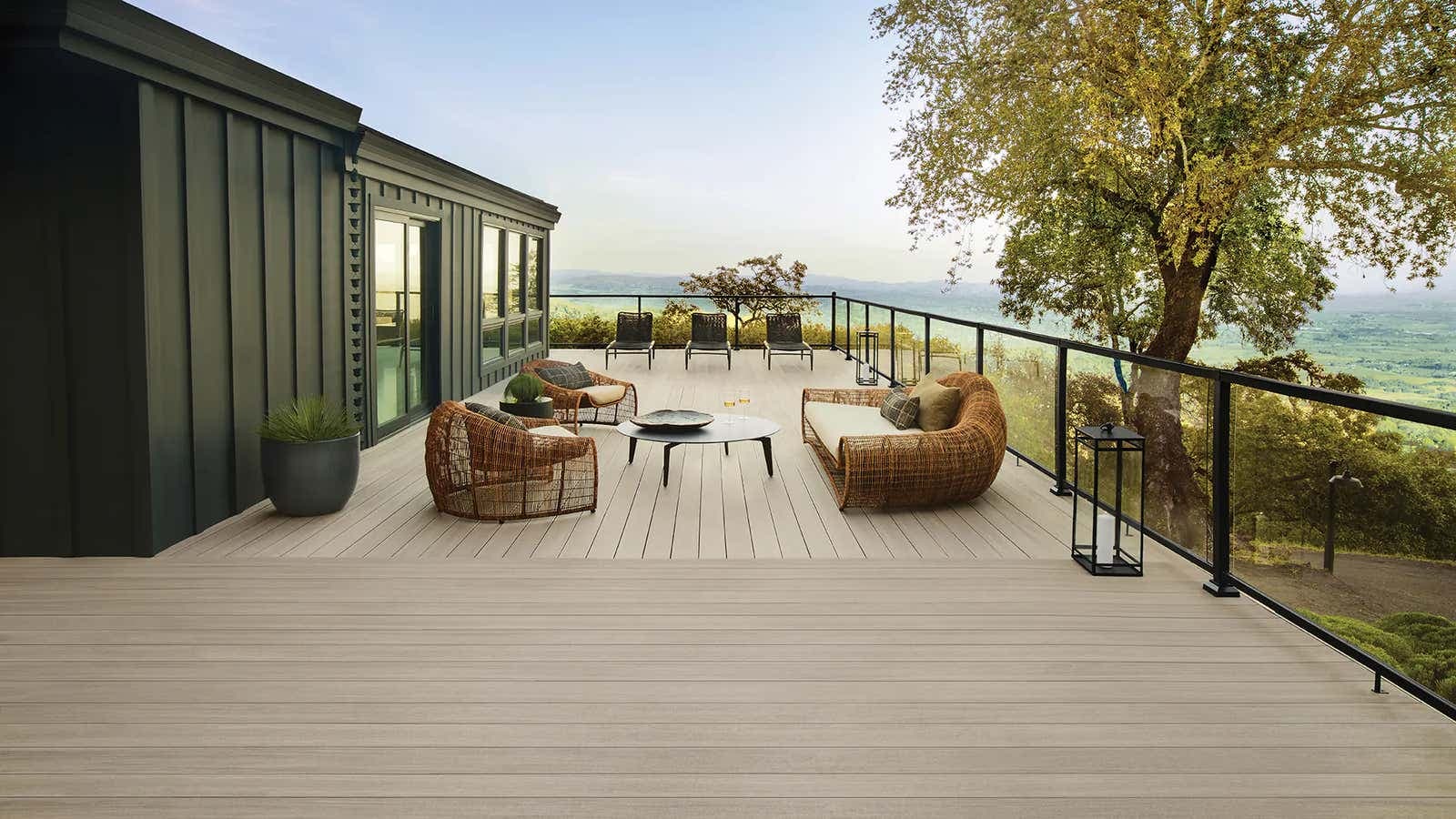
Understanding the Unique Demands of Compact Spaces
Compact outdoor spaces in urban settings present unique challenges. Limited access for material delivery, tight working areas, and the need to maximize every inch for usability are common. The material chosen must be durable, easy to maintain, and contribute positively to the overall aesthetic without overwhelming the space. Noise considerations during installation, debris management, and minimizing future maintenance disruptions are also key.
For a small Boston balcony or patio, the decking material should ideally be quick to install to reduce disruption, offer a consistent appearance, and require minimal ongoing care. This allows residents to enjoy their space rather than spending time on upkeep.
Why Composite Decking Suits Small Footprints
Composite decking is a blend of recycled plastic and wood fibers, engineered to offer the look of wood without extensive maintenance. This makes it a strong contender for compact outdoor areas where convenience and durability are paramount.
Key benefits for small spaces include:
Low Maintenance: Composite decking requires only an annual soap-and-water wash. There's no need for oiling, sanding, or staining, which saves time and avoids the mess of maintenance tasks in a confined area. This is a significant advantage in urban settings where storage for maintenance supplies might be limited.
Durability: Brands like Trex, TimberTech, and Fiberon offer composite products designed to withstand various weather conditions without splintering, rotting, or warping. Many lines feature capped shells for enhanced resistance to fading and staining, which is beneficial for decks exposed to sun or moisture.
Consistency: Each board offers consistent color and grain, ensuring a uniform appearance across your compact deck. This predictability simplifies planning and ensures the finished space looks as intended, even in a small area where visual details are more prominent.
Sustainability: Some composite decking, such as Trex, can contain up to 95% recycled content, including sawdust and plastic film. This offers an environmentally conscious choice for urban projects.
Choosing the Right Composite Decking Collection and Profile
Different composite decking collections offer varying aesthetics, board profiles, and performance features. For a compact space, consider:
Board Widths: Standard board widths are common, but some manufacturers offer narrower or wider profiles. In a small area, narrower boards can sometimes make the space feel larger by creating more visual lines, while wider boards might offer a cleaner, more contemporary look. Consider how the board width will interact with the overall dimensions of your space.
Edge Profiles: Look for boards with finished edges or options for fascia boards that provide a clean, polished look around the perimeter of your deck. This attention to detail is crucial in small spaces where edges are highly visible.
Color and Finish: Lighter colors can make a small space feel more open and reflect sunlight, potentially keeping the surface cooler. Darker colors can create a sophisticated, intimate atmosphere. Consider how the color will interact with surrounding building materials and the amount of natural light your space receives. Many manufacturers offer 'cooler-underfoot' options for sun-exposed areas.
Decking from Trex, TimberTech, and Fiberon provides various options to match different design preferences and performance needs. Reviewing specific product lines will help identify the best fit for your project's aesthetic and functional requirements.
Planning Your Compact Deck Layout: An Example
Consider a hypothetical Boston balcony measuring 6 feet wide by 10 feet long. This 60 square foot area requires careful planning to maximize usability and minimize material waste.
Assumptions:
Decking boards are 12 feet long and 5.5 inches wide (nominal).
A hidden fastening system is used, requiring a consistent gap between boards.
The deck will have a picture-frame border on all four sides.
Calculation Steps:
1. Determine the Number of Field Boards: The interior field area will be slightly smaller due to the border. If the border uses two board widths (one for each side of the 6-foot dimension), the field width becomes approximately 6 feet - (2 * 5.5 inches) = 6 feet - 11 inches = 4 feet 1 inch. The field length would be 10 feet - (2 * 5.5 inches) = 10 feet - 11 inches = 9 feet 1 inch.
To cover a 4-foot 1-inch width with 5.5-inch boards (which is 49 inches), you would need 49 / 5.5 = 8.9 boards. Since you can't use partial boards in the field, you'd plan for 9 boards. These boards would run parallel to the 10-foot dimension, so you'd use 10-foot lengths or cut down 12-foot boards.
2. Calculate Border Boards: The perimeter of the 6x10 foot deck is 2*(6+10) = 32 linear feet. If using 12-foot boards for the border, you would need 32 / 12 = 2.67 boards. Round up to 3 boards for the border, accounting for cuts and waste.
3. Total Boards: 9 field boards (cut from 10-foot stock or 12-foot stock with minimal waste) + 3 border boards (12-foot stock). This is a simplified calculation; a detailed cut plan would optimize for specific board lengths and account for end cuts.
This example illustrates how board dimensions and layout impact material needs, even in a small space. Always verify manufacturer-recommended spacing and fastening methods.
Installation and Access Considerations for Urban Projects
Installing decking in Boston's urban environment often means navigating narrow stairwells, elevators, and busy streets. Material delivery, storage, and the actual installation process need careful consideration.
Material Delivery: Discuss delivery logistics with your supplier. Can materials be delivered directly to the project site, or will they need to be transferred from a street-level drop-off? Consider the weight and length of composite boards and how they will be moved through tight spaces.
Jobsite Access: Ensure there is clear access to the installation area. For balcony or rooftop projects, this might involve coordinating elevator use or hoisting materials. Minimizing the number of cuts on-site can also reduce noise and debris, which is often appreciated in densely populated areas.
Substructure: Verify the existing substructure can support the weight of composite decking. For balconies or rooftops, structural integrity is paramount. Ensure proper ventilation is planned beneath the deck surface, as recommended by manufacturers, to prevent moisture buildup.
Permitting: Always confirm local building codes and permitting requirements for deck construction or renovation in Boston. Even small projects may require permits, especially if they involve structural changes or are on multi-unit buildings.
Maintenance and Longevity in a Boston Climate
Boston experiences a range of weather conditions, from hot, humid summers to cold, snowy winters. Composite decking is designed to perform well in these varying climates.
Winter Exposure: Composite decking is resilient to freezing and thawing cycles. Snow and ice can be cleared using plastic shovels, avoiding metal tools that could potentially scratch the surface. Ensure proper drainage to prevent standing water, which can lead to ice formation.
Coastal Considerations: For properties near the coast, composite decking's resistance to salt air is a benefit. Unlike some wood species, composite materials are not prone to degradation from saline exposure.
Routine Cleaning: A simple annual wash with soap and water is typically all that's needed to keep composite decking looking its best. This low-maintenance requirement is particularly advantageous for compact spaces, freeing up time for enjoyment rather than upkeep. Always check the manufacturer's specific cleaning recommendations for your chosen product line.
Before you order
- Assess the structural capacity of your compact outdoor space (balcony, patio, rooftop) for new decking.
- Measure the exact dimensions of your area, accounting for any irregularities or existing structures.
- Consider access for material delivery and installation in your urban setting.
- Choose a composite decking collection (Trex, TimberTech, Fiberon) that aligns with your aesthetic and performance needs.
- Select a board profile (width, edge finish) suitable for a compact space.
- Decide on a color and finish that complements your building and personal style, considering sun exposure.
- Plan your decking layout, including any border designs, to minimize waste.
- Identify compatible fastening systems (hidden or face-fastened) for your chosen boards.
- Research local building codes and permitting requirements in Boston for deck projects.
- Confirm maintenance requirements and product longevity in Boston's climate.
Confirm installation details, approved uses and warranty terms in the current instructions for the exact product and profile. Your installer should verify the substrate, structure and applicable project requirements.
This is a planning guide for projects in Boston, MA. Ask our team to confirm availability, delivery to your ZIP code and which branch can support your order.
Questions to help you decide
Can composite decking be installed over an existing concrete patio or balcony?
Yes, composite decking can often be installed over an existing concrete slab, provided the concrete is in good condition, offers adequate drainage, and the necessary substructure (joists or sleepers) can be properly secured and ventilated. It's crucial to ensure proper air circulation beneath the deck to prevent moisture issues. Always consult the specific manufacturer's installation guidelines and local building codes for best practices.
How do I choose the right color for my composite deck in a small space?
For small spaces, lighter colors can often make the area feel larger and more open by reflecting light. They can also be cooler underfoot in direct sun. Darker colors can create a sophisticated, cozy feel but may absorb more heat. Consider the overall color palette of your building's exterior and any existing outdoor furniture. Requesting samples to see them in your specific lighting conditions is highly recommended.
What is the typical lifespan of composite decking in the Boston climate?
Composite decking is engineered for durability and longevity. Brands like Trex, TimberTech, and Fiberon offer products designed to resist fading, staining, and material degradation for many years, often backed by substantial warranties. With proper installation and minimal annual cleaning, composite decking can provide decades of service in varying climates, including Boston's seasonal changes. The exact lifespan can depend on the specific product line and exposure conditions.
Ready to Plan Your Composite Decking Project?
Contact Lumber Plus for a material quote. Provide your project dimensions, desired composite decking profile, and project ZIP code to confirm current availability and service options. Explore our full range of composite decking options at /decking/composite, or consider alternatives like /decking/hardwood or /decking/pvc.
Request a material quote →