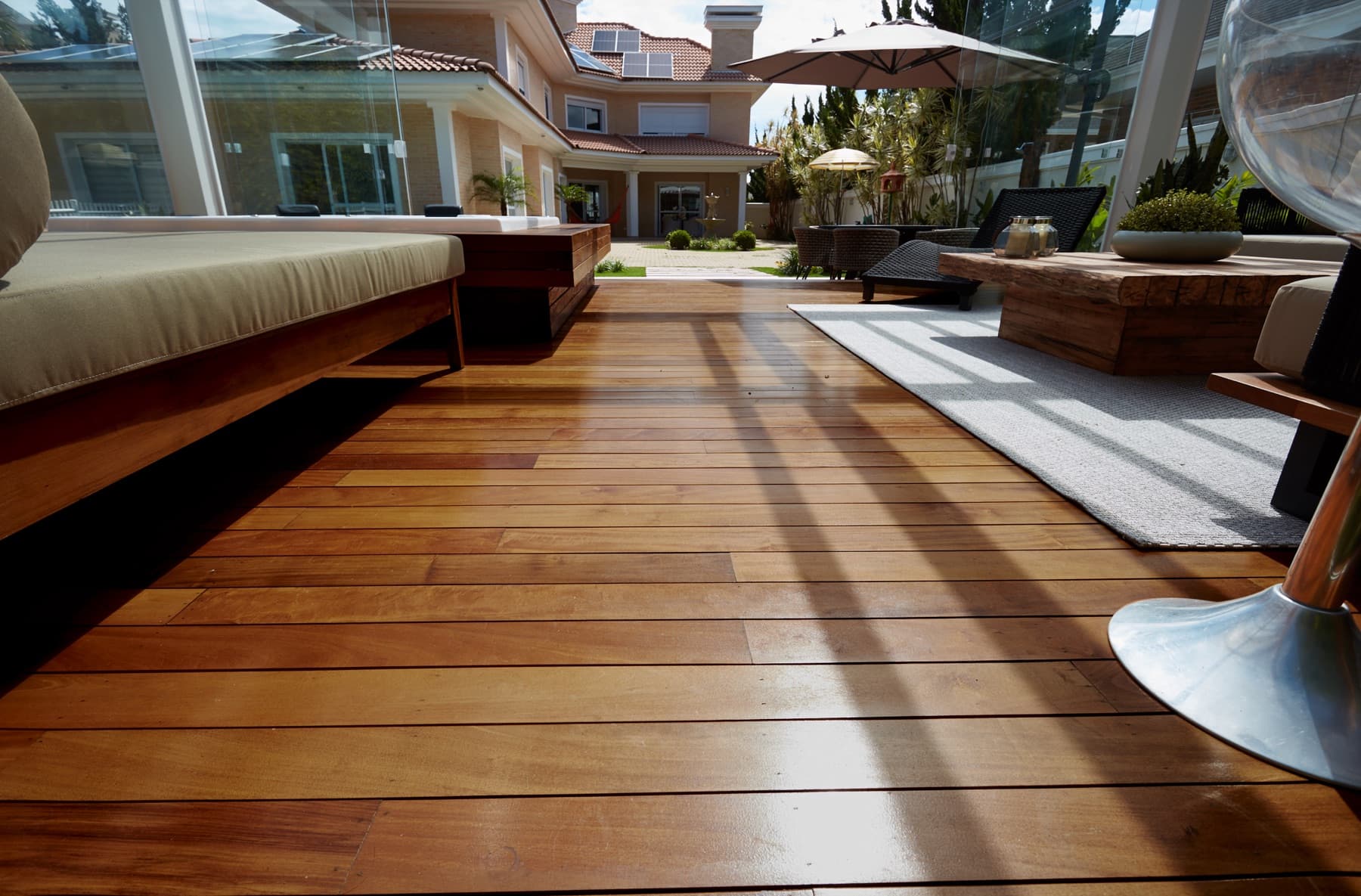
Understanding Hardwood Decking Board Availability
Hardwood decking, such as Ipe and Cumaru, is typically supplied in a range of nominal lengths. These lengths are often standardized but can vary by supplier and species. For instance, Ipe and Cumaru are commonly available in lengths ranging from 3 feet to 24 feet, in various profiles.
It's important to confirm the exact available lengths from your supplier before finalizing your deck design. This information will directly influence your cut plan and help avoid unexpected material shortages or excessive waste. Longer boards can reduce the number of seams, contributing to a cleaner aesthetic, but may also come with a higher per-linear-foot cost or require special handling during delivery and installation.
The Importance of Staggered Seams
A fundamental principle in decking layout is staggering the board seams (butt joints). This means that no two board ends should align on adjacent rows. Staggering seams provides several benefits:
First, it enhances structural integrity. By distributing the points where boards meet, you create a more robust deck surface that is less prone to localized weakness. Second, it improves aesthetics. A randomized, staggered pattern looks more natural and intentional than a grid of aligned seams, which can draw unwanted attention to the joints.
Third, it helps to manage expansion and contraction. While hardwoods like Ipe and Cumaru exhibit minimal movement post-installation, distributing seams helps to accommodate any subtle dimensional changes over time without creating visible stress points.
Planning Seam Locations and Joist Spacing
Every board end must be fully supported by a joist. This is non-negotiable for structural stability.
To achieve a strong, stable joint, it's often recommended to use a double joist or a blocking piece at each seam location. This provides ample surface area for fastening both board ends securely. Ensure your fasteners are appropriate for hardwood and installed according to manufacturer guidelines.
Consider the overall length of your deck. If your deck is longer than the longest available board, you will need seams. Plan these seams strategically to create a visually balanced pattern. Avoid having all seams concentrated in one area.
Worked Example: Designing a 16-foot by 10-foot Ipe Deck
Let's consider a hypothetical 16-foot by 10-foot deck using 1x6 Ipe decking boards. For this example, we'll assume Ipe boards are available in 8-foot, 10-foot, 12-foot, 14-foot, and 16-foot lengths.
We'll need 22 rows of decking.
**Step 2: Plan the first row.** For the 16-foot length, we can use a single 16-foot board. This eliminates a seam in the first row.
**Step 3: Plan subsequent rows with staggered seams.** For the second row, we want to avoid aligning the seam with the first. We could use two 8-foot boards, placing the seam at the 8-foot mark. For the third row, we might use a 10-foot board and a 6-foot board (cut from a 12-foot or 14-foot length), staggering the seam at 10 feet.
**Step 4: Create a cut list and optimize waste.** Continue this process for all 22 rows, trying to use full lengths where possible and cutting longer boards to create the necessary shorter lengths. Keep track of offcuts.
**Consideration for Ipe:** Ipe is a dense hardwood. Cutting requires sharp, carbide-tipped blades. Pre-drilling is often necessary for fasteners, even with self-tapping screws, to prevent splitting. Ensure all cut ends are sealed with an end-grain sealer to minimize moisture absorption.
Minimizing Waste and Cost
Strategic planning of board lengths directly impacts material waste. By carefully mapping out cuts and utilizing shorter offcuts for smaller sections or subsequent rows, you can reduce the amount of unused material. Always order approximately 5-10% extra material to account for miscuts, knot placement, or minor board imperfections.
When purchasing, consider the price per linear foot for different lengths. Sometimes, purchasing slightly longer boards and cutting them might be more cost-effective than buying many short, specific lengths, especially if the offcuts can be utilized. Discuss your cut plan with your supplier; they might offer advice on optimizing your order based on their current stock and typical board dimensions.
For complex deck shapes or diagonal layouts, waste factors can increase significantly. In such cases, a detailed drawing with every board laid out can be invaluable for accurate material estimation.
Fasteners and End Sealing for Hardwood Decking
Regardless of your board length choices, proper fastening and end sealing are critical for hardwood decking. For species like Ipe and Cumaru, specialized fasteners are recommended. Hidden fastening systems can provide a clean, screw-free surface, while face-fastening offers robust hold.
All freshly cut ends of hardwood decking boards should be sealed with a high-quality end-grain sealer. This minimizes moisture absorption through the exposed end grain, which is the most vulnerable part of the board, helping to prevent checking and splitting. This step is particularly important in climates with significant temperature and humidity fluctuations.
Consult the specific installation guidelines for your chosen hardwood species and fastening system to ensure longevity and performance. Proper installation techniques are as important as the material itself in achieving a durable deck.
Before you order
- Confirm actual available board lengths for your chosen hardwood species.
- Measure your deck dimensions precisely (length and width).
- Identify joist spacing for all deck areas.
- Sketch your deck layout, indicating joist locations.
- Plan for staggered seams; avoid aligning butt joints on adjacent rows.
- Ensure every board end rests fully on a joist; consider double joists or blocking at seams.
- Create a detailed cut list, accounting for board widths and spacing gaps.
- Calculate material needs, including a 5-10% waste factor.
- Plan for end-grain sealing on all cut ends.
- Select appropriate fasteners compatible with hardwood decking.
Confirm installation details, approved uses and warranty terms in the current instructions for the exact product and profile. Your installer should verify the substrate, structure and applicable project requirements.
Questions to help you decide
Why can't I just buy boards that are exactly the length of my deck?
While ideal, hardwood decking is milled from natural timber and comes in a range of standard lengths. It's rare to find boards that perfectly match every dimension of your project. Planning with available lengths and strategic cutting helps manage this reality and reduces waste.
What is the best way to cut hardwood decking boards?
Due to the density of hardwoods like Ipe and Cumaru, a miter saw with a sharp, carbide-tipped blade is recommended for clean, precise cuts. Always wear appropriate safety gear. It's also important to seal all cut ends immediately after cutting to prevent moisture absorption.
Do shorter boards mean a less durable deck?
Not necessarily. The durability of your deck depends more on proper installation, adequate joist support at all seams, and the quality of the material itself. A deck with many well-executed, staggered seams can be just as durable as one with fewer seams, provided each joint is properly supported and fastened.
Ready to Plan Your Hardwood Decking Project?
Contact us to request a material quote. Provide your project dimensions, desired hardwood profile, and ZIP code, and we'll help confirm current availability and service options for your decking needs. We can assist in optimizing your board length selection for a beautiful and efficient build.
Request a material quote →