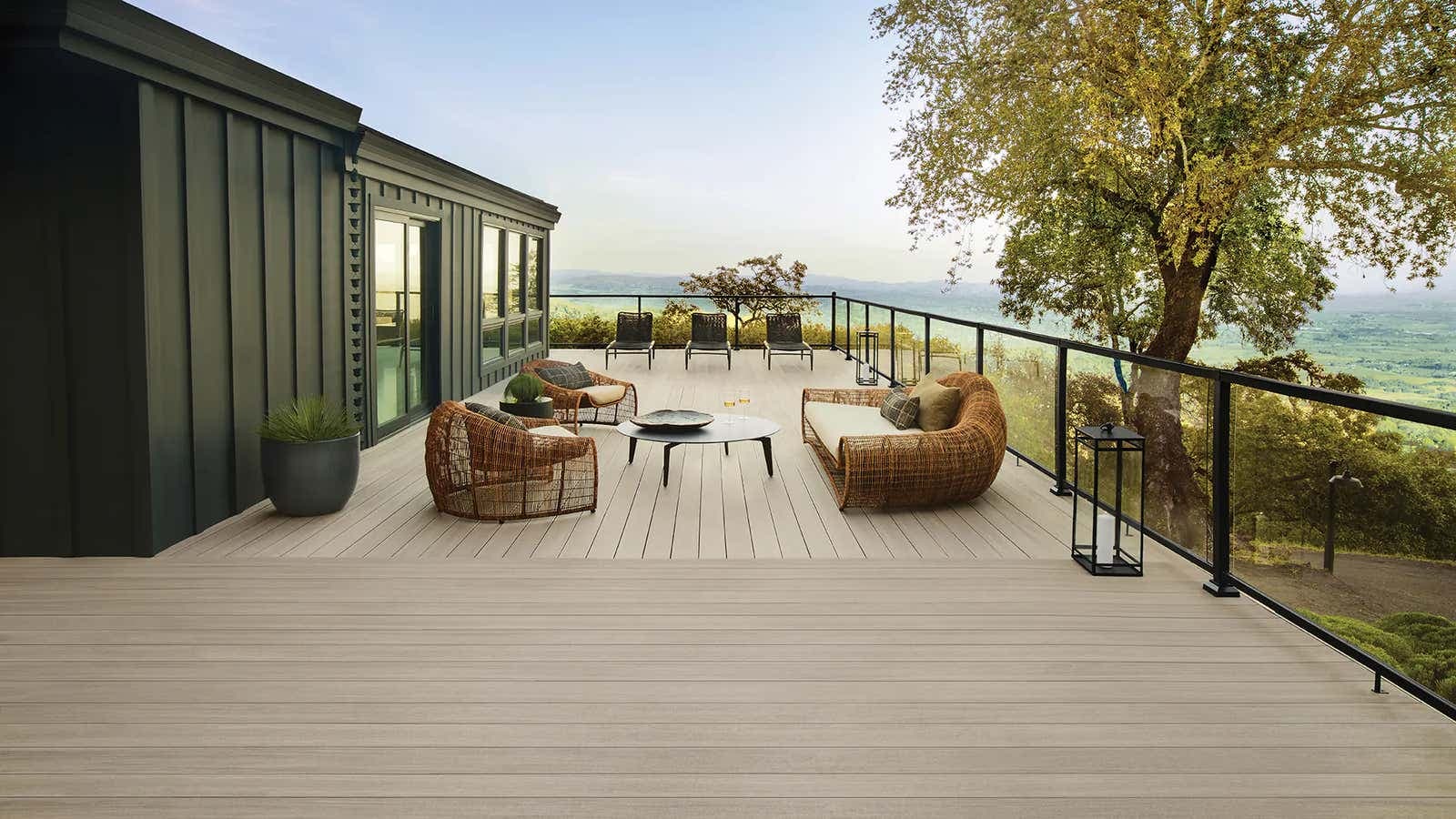
Understanding Composite Decking Options
Composite decking is engineered from a blend of wood fibers and recycled plastics, offering a consistent appearance and often featuring capped shells for enhanced resistance to fading and staining. Brands like Trex, TimberTech, and Fiberon each offer various lines, colors, and profiles.
Unlike natural wood, composite decking does not require regular oiling, sanding, or staining. Many products offer written fade and stain warranties, which can range significantly depending on the manufacturer and specific product line. It is important to compare these features as you select your material. Some composite options are also designed to be cooler underfoot or to perform well in specific environments like coastal areas.
Essential Project Information for Your Quote
To get a precise quote, you will need to provide specific details about your project. This includes not just the dimensions of your deck, but also information about the type of composite decking you've chosen, the quantity required, and logistical considerations.
The more detail you can provide upfront, the more accurate your quote will be. Consider whether your project involves a simple rectangular deck or a more complex design with multiple levels, stairs, or picture-frame borders.
Step 1: Project Dimensions and Layout
Start by measuring the total area of your deck. For a rectangular deck, this is straightforward: length multiplied by width. For more complex shapes, break down the area into simpler geometric figures (rectangles, triangles) and sum them.
Beyond the flat deck surface, consider any stairs, landings, or fascia boards. Stairs require specific board lengths and often involve risers and treads. Fascia boards, used to cover the rim joists, also need to be accounted for in length. If you plan a picture-frame border, this will affect the board lengths and quantities for both the border and the infill.
A simple sketch of your deck layout, even if not to scale, can be incredibly helpful. Indicate board direction, any seams, and the placement of stairs or other features. This visual aid can clarify your material needs and assist the supplier in understanding your project.
Step 2: Selecting Your Composite Decking Profile
Composite decking comes in various profiles and board widths. Common profiles include solid, scalloped, or grooved edge boards. Grooved edge boards are typically used with hidden fastening systems, while solid edge boards or square edge boards are often used for perimeter boards or stairs where face fastening may be preferred.
Your chosen profile will directly impact the type of fasteners you can use and the overall appearance. For example, a hidden fastener system often requires grooved boards, ensuring a clean, screw-free surface. Be sure to specify the exact profile, as well as the desired width and length of the boards.
Manufacturers offer different board lengths. Planning your layout to minimize waste by utilizing standard lengths where possible can be cost-effective. However, some projects may benefit from longer boards to reduce the number of seams.
Step 3: Calculating Quantity and Accounting for Waste
Calculating the exact quantity of boards needed involves converting your deck area into linear feet based on your chosen board width. Always add an allowance for cuts, mistakes, and future repairs. A common recommendation is to add 5-10% to your calculated linear footage.
Consider this hypothetical example: you are building a 10-foot by 12-foot rectangular deck. The total area is 120 square feet. If you choose 6-inch wide composite boards (0.5 feet), and plan to run them along the 12-foot length, you would need 20 boards (10 feet / 0.5 feet = 20 boards). Each board would be 12 feet long. So, you would initially need 20 boards x 12 feet/board = 240 linear feet.
Adding a 10% waste factor, you would request 240 linear feet * 1.10 = 264 linear feet. This might mean purchasing 22 boards (264 / 12 = 22 boards) if 12-foot lengths are available. Remember to also account for any specialized trim, fascia, or stair components separately.
For hidden fasteners, estimate the number of clips needed based on your joist spacing and board lengths. Most fastener systems specify coverage per square foot or per linear foot of board.
Step 4: Project ZIP Code and Logistics
Your project's ZIP code is crucial for an accurate quote. It allows the supplier to calculate potential delivery costs, confirm service availability in your area, and check current stock levels at the nearest distribution point.
Also, consider access to your job site. Can a large delivery truck easily reach the area? Is there space for materials to be dropped off and stored without obstruction? Mentioning any access challenges upfront can help the supplier plan accordingly.
Finally, provide your desired project timeline. While not always directly impacting the material price, it helps the supplier confirm availability and delivery timing, especially for specialized profiles or colors.
Before you order
- Confirmed total deck surface area (square footage).
- Measured all stair treads and risers (linear feet and quantity).
- Measured all fascia and trim boards (linear feet).
- Chosen specific composite decking brand, line, and color.
- Selected desired board profile (grooved, solid, square edge).
- Determined preferred board width and length(s).
- Calculated total linear footage for all decking, stairs, and trim, including a 5-10% waste factor.
- Identified preferred fastening system (hidden or face-fastened) and estimated quantity if applicable.
- Provided project ZIP code.
- Noted any specific job site access considerations.
- Indicated desired project start and completion timeline.
Confirm installation details, approved uses and warranty terms in the current instructions for the exact product and profile. Your installer should verify the substrate, structure and applicable project requirements.
Questions to help you decide
Why is the project ZIP code necessary for a quote?
The project ZIP code is essential for calculating accurate delivery costs, confirming product availability from the nearest branch, and verifying if service options extend to your location. It ensures the quote reflects all relevant logistical factors.
Do I need to know the exact quantity of fasteners for my quote?
While the supplier can often estimate fasteners based on your deck dimensions and chosen decking type, providing your preferred fastening system (e.g., hidden clips, face screws) is helpful. Some systems specify coverage per square foot or linear foot, which can assist in a more precise estimate. If you have a specific fastener in mind, mention it.
What if I'm unsure about the best composite decking profile for my project?
If you are uncertain, describe your intended use and desired aesthetic. For example, mention if you prefer a smooth, screw-free surface (suggesting grooved boards for hidden fasteners) or if you need solid edge boards for stairs or perimeter detailing. The supplier can then guide you on suitable options based on your project needs and the available product lines.
Ready to Request Your Composite Decking Quote?
Gather your project dimensions, desired composite decking profile, and project ZIP code. Contact us to confirm current availability and service options. We're here to help you get the materials you need for your outdoor space.
Request a material quote →