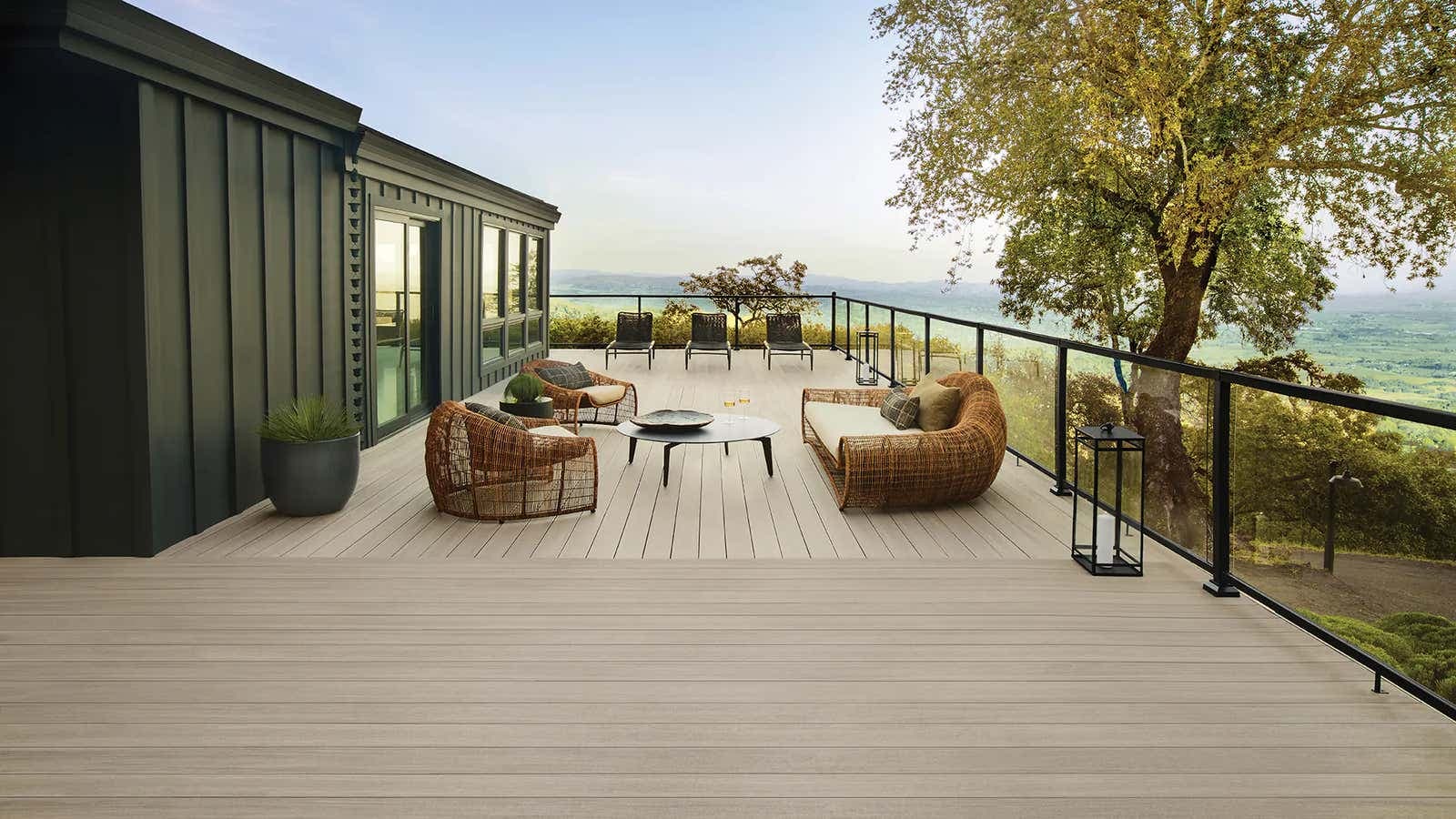
Understanding Composite Decking Board Dimensions
Composite decking boards are typically available in standard lengths and widths. While widths can vary (e.g., 5.5 inches, 7.25 inches), common lengths often include 12-foot, 16-foot, and 20-foot options. It's essential to confirm the exact dimensions of the specific composite decking product you intend to use, as these will directly influence your quantity calculations.
For example, Trex, TimberTech, and Fiberon, commonly available composite decking brands, offer various collections with distinct board dimensions. Always refer to the manufacturer's specifications for the chosen line and profile to ensure accuracy. These details are critical for planning efficient cuts and minimizing waste.
Measuring Your Deck Area
Begin by drawing a detailed sketch of your deck area, including all dimensions. For a simple rectangular or square deck, measure the length and width. For more complex shapes, break the area down into smaller, manageable rectangles or squares, measure each section, and then sum them up.
Consider any features that will impact your decking layout, such as stair openings, planters, or built-in benches. These areas will either require precise cuts or reduce the total decking surface, which needs to be accounted for in your plan.
Accuracy is key. Measure twice to confirm all dimensions. Even small discrepancies can lead to significant material shortages or surpluses on larger projects.
Calculating Board Coverage and Initial Quantity
Once you have your total deck area, you'll need to determine how many boards are required. This involves considering both the board width and the recommended spacing between boards. Manufacturer guidelines for composite decking often specify a small gap for drainage and thermal expansion.
For a straight deck layout, divide the total deck width (or length, depending on board orientation) by the effective width of a single board (board width plus gap). This gives you the number of boards needed across that dimension. Then, divide the total deck length (or width) by the chosen board length. Multiply these two figures to get an initial estimate of boards.
Remember that boards come in fixed lengths. If your deck length is 18 feet and you're using 16-foot boards, you'll need to use two boards per run, creating a seam. Planning seams strategically is important for both aesthetics and material efficiency.
Worked Example: Calculating Composite Decking for a Rectangular Deck
Let's assume a hypothetical rectangular deck measuring 12 feet wide by 20 feet long. We plan to use composite decking boards that are 5.5 inches wide and available in 12-foot and 20-foot lengths.
First, convert all measurements to a consistent unit, such as inches. Deck width = 12 feet * 12 inches/foot = 144 inches. Deck length = 20 feet * 12 inches/foot = 240 inches. Board width = 5.5 inches. Effective board width = 5.5 + 0.125 = 5.625 inches.
If running boards along the 20-foot length (parallel to the 20-foot dimension):
Number of boards needed across the 12-foot width: 144 inches / 5.625 inches/board = 25.6 boards. Round up to 26 boards.
Since our deck length is 20 feet and 20-foot boards are available, we can use one 20-foot board per run.
Total 20-foot boards needed: 26 boards * 1 = 26 boards. This is the initial quantity before accounting for waste or specific cuts.
If running boards along the 12-foot length (parallel to the 12-foot dimension):
Number of boards needed across the 20-foot length: 240 inches / 5.625 inches/board = 42.66 boards. Round up to 43 boards.
Since our deck width is 12 feet and 12-foot boards are available, we can use one 12-foot board per run.
Total 12-foot boards needed: 43 boards * 1 = 43 boards. This is the initial quantity before accounting for waste or specific cuts.
For this example, using 20-foot boards along the 20-foot dimension is more efficient due to fewer boards and potentially less waste from cuts.
Accounting for Cuts, Waste, and Special Features
Even with careful planning, some material will be lost to cuts, mistakes, or damaged boards. It's standard practice to add a waste factor to your initial quantity. A common waste factor for straight-lay composite decking projects is 5-10%. For diagonal layouts, complex designs, or projects with many cuts (e.g., around posts, stairs), a waste factor of 10-15% or even more may be appropriate.
For our 12x20-foot deck using 20-foot boards, if we apply a 10% waste factor to the 26 boards: 26 boards * 1.10 = 28.6 boards. We would round up to 29 boards to ensure enough material.
Consider other elements: fascia boards for the deck perimeter, stair treads, risers, and any decorative borders (picture framing). These often require separate calculations based on lineal footage. For a picture frame border, you'll need to measure the perimeter of the deck and add a waste factor for those specific trim pieces.
For a 12x20-foot deck, the perimeter is (12+20)*2 = 64 lineal feet. If using 12-foot fascia boards, you'd need 64 / 12 = 5.33, or 6 boards. Add a waste factor for cuts, perhaps 10%, bringing it to 6 * 1.1 = 6.6, or 7 fascia boards.
Final Review and Ordering
Before placing your order, review your calculations. Double-check your measurements, confirm the exact board dimensions from your chosen product line (e.g., from Trex, TimberTech, or Fiberon), and ensure your waste factor is appropriate for your project's complexity.
It's often helpful to sketch out your board layout on paper, especially for projects with seams or intricate cuts. This visual plan can help identify potential efficiencies and confirm your quantity needs. Remember to consider any specific requirements for fasteners (hidden or face-fastened) and any complementary trim pieces.
When you're ready to order, provide your project dimensions, desired composite decking profile, color, and your project ZIP code to receive an accurate quote. This ensures you get the correct materials and helps confirm current availability and service options.
Before you order
- Confirm exact dimensions (length, width, thickness) of chosen composite decking boards.
- Measure total deck area accurately, breaking down complex shapes.
- Decide on board orientation (parallel to long or short dimension) for efficiency.
- Calculate the number of boards needed based on effective board width (board + gap).
- Determine optimal board lengths to minimize seams and offcuts.
- Apply an appropriate waste factor (5-15% depending on complexity).
- Calculate lineal footage for fascia, stair components, and other trim separately.
- Sketch out the board layout to visualize cuts and confirm quantities.
- Verify all calculations before finalizing the order.
Confirm installation details, approved uses and warranty terms in the current instructions for the exact product and profile. Your installer should verify the substrate, structure and applicable project requirements.
Questions to help you decide
What is a typical waste factor for composite decking?
A typical waste factor for straight-lay composite decking projects is 5-10%. For more complex layouts, diagonal patterns, or projects with numerous cuts around obstacles, a waste factor of 10-15% or more is often recommended to account for offcuts and potential miscuts.
Should I account for board spacing when calculating quantity?
Yes, absolutely. Most composite decking manufacturers specify a small gap between boards for drainage and thermal expansion. Failing to include this will result in ordering too few boards.
What if my deck dimensions don't match standard board lengths?
When your deck dimensions don't perfectly align with standard board lengths (e.g., a 14-foot deck using 12-foot or 16-foot boards), you'll need to plan for seams. Using a longer board and cutting it to size often results in a usable offcut for another part of the deck. If using shorter boards, you'll need multiple boards per run, creating seams that should be staggered for structural integrity and aesthetics. Always aim to minimize seams where possible or plan them strategically.
Ready to Plan Your Composite Decking Project?
Provide your project dimensions, desired composite decking profile, and project ZIP code to request a material quote. We can help you confirm current availability and service options for brands like Trex, TimberTech, and Fiberon.
Request a material quote →