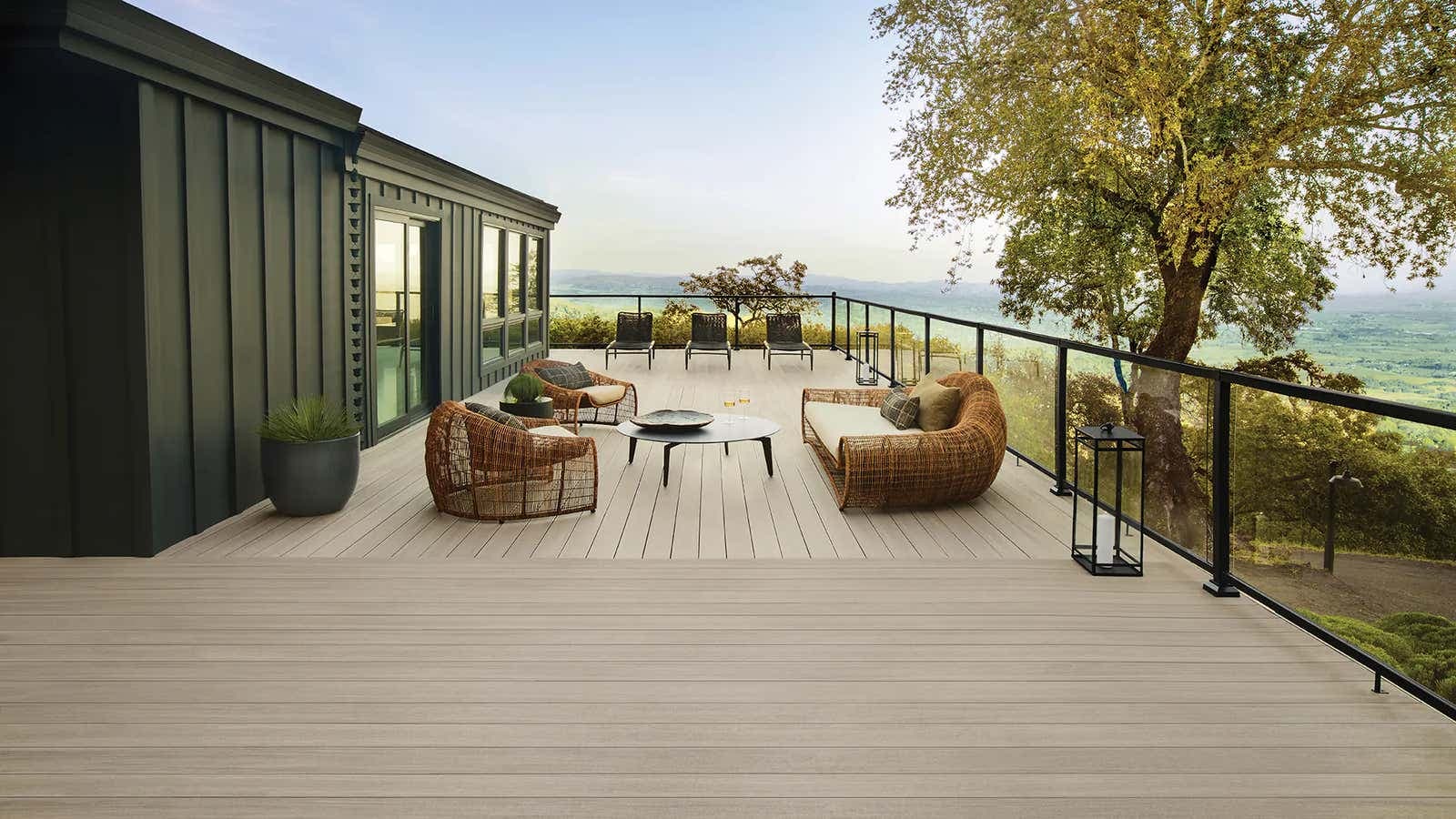
Understanding Available Composite Decking Board Lengths
Composite decking from manufacturers like Trex, TimberTech, and Fiberon is typically available in a range of standard lengths. Common lengths often include 12, 16, and 20 feet. Some lines may offer additional lengths, such as 10 or 24 feet, for specific applications or larger projects. These consistent lengths are a key advantage of composite materials, as they allow for more predictable planning and less variability than some natural wood products.
It is important to confirm the exact lengths available for the specific composite decking line and color you intend to purchase. Availability can vary by manufacturer, product series, and even regional supply. Checking this information early in your planning process will ensure your design aligns with what can be sourced.
Why Board Length Planning Matters
Strategic board length planning offers several benefits. Firstly, it can significantly reduce material waste. By designing your deck dimensions to align with available board lengths, you can minimize the number of short offcuts that cannot be reused. Secondly, proper planning leads to fewer seams, which generally results in a more cohesive and less visually interrupted deck surface.
Thirdly, well-planned board lengths contribute to structural integrity. While composite decking is designed to be stable, minimizing seams, particularly in high-traffic areas, can enhance the overall robustness of the deck. Finally, efficient use of board lengths can simplify the installation process, potentially reducing labor time and complexity.
Planning Seam Placement for Composite Decking
Seams, or butt joints, are unavoidable on larger decks or when spanning distances longer than a single board. The goal is to make these seams as inconspicuous and structurally sound as possible. Here are key considerations for seam placement:
Staggering Seams: Avoid lining up seams on adjacent boards in a straight line across the deck. Instead, stagger them randomly or in a repeating pattern. This distributes the visual interruption and prevents a single, prominent seam line.
Locating Seams over Joists: All butt joints in composite decking must be fully supported by a joist. Never allow a seam to float between joists. This is crucial for stability and to prevent deflection or sagging at the joint. Ensure your joist spacing accommodates this requirement.
End-to-End Jointing: Some manufacturers offer specific fastening systems or recommendations for end-to-end joints to ensure proper spacing and alignment. Consult the manufacturer's installation guide for precise instructions.
Minimizing Seams in High-Visibility Areas: If possible, try to avoid placing seams directly in front of main entry points or in the primary focal areas of your deck. Directing seams to less prominent zones can improve the overall aesthetic.
Worked Example: Deck Board Layout Calculation
Let's consider a hypothetical rectangular deck measuring 18 feet by 12 feet. We plan to use composite decking boards available in 12-foot and 20-foot lengths. The deck boards will run along the 18-foot dimension.
Option 1: Using 12-foot boards. To cover 18 feet, each run of boards will require one 12-foot board and one 6-foot board. The 6-foot section would need to be cut from another 12-foot board, resulting in a 6-foot offcut per run. To minimize waste, you could plan to use these 6-foot offcuts for other sections, but this requires careful cutting and layout. For each 18-foot run, you would purchase two 12-foot boards, yielding 6 feet of waste per run if not reused.
Option 2: Using 20-foot boards. To cover 18 feet, each run would require one 20-foot board cut down to 18 feet. This would leave a 2-foot offcut per run. While this generates less waste per run than Option 1, the 2-foot offcuts are less likely to be reusable for typical deck board applications.
Option 3: Mixed lengths and staggered seams. For an 18-foot run, you could use one 12-foot board and one 6-foot board. If you have multiple runs, you can stagger the seams. For example, on one row, place the 12-foot board first, then the 6-foot piece. On the next row, you might start with a 6-foot piece (cut from a 12-foot board), then a 12-foot board, and then another 6-foot piece, ensuring the seams are offset. This approach requires careful planning to utilize offcuts effectively. If you have an adjacent 12-foot wide section, you could use full 12-foot boards without any seams across that dimension.
For our 18x12 foot deck, if boards run along the 18-foot length, and the deck is 12 feet wide, you would need enough boards to cover 12 feet of width. If each board is 6 inches wide (0.5 feet), you would need 12 feet / 0.5 feet = 24 boards for the width. If using 12-foot boards for the 18-foot length (Option 1), you'd need 2 boards per run x 24 runs = 48 boards. This calculation assumes no waste for cuts and optimal reuse of offcuts. In practice, you would purchase full boards and account for cuts and a waste factor, typically 5-10%.
Considering the Impact of Thermal Expansion
Composite decking materials, like most building materials, will expand and contract with changes in temperature. Manufacturers provide specific guidelines for gapping between board ends (butt joints) and between board edges to accommodate this movement. It is crucial to follow these recommendations precisely.
Failing to leave adequate expansion gaps can lead to buckling, warping, or other damage to your deck. The required gap size can vary based on the specific composite product, the ambient temperature during installation, and the expected temperature range in your climate. Always refer to the manufacturer's installation guide for the exact gapping requirements for your chosen product.
Hidden fastening systems often incorporate built-in spacing, but end-to-end gaps must still be carefully managed.
Complementary Products for Your Composite Deck
Beyond the primary decking boards, consider these related products to complete your project:
Fascia and Rim Joist Covers: These trim pieces are designed to finish the edges of your deck, concealing the substructure and providing a clean, cohesive look. Often available in matching colors and finishes to your decking boards.
Stair Components: If your deck includes stairs, look for compatible composite stair treads, risers, and stringer covers that complement your main deck surface.
Hidden Fastening Systems: Many composite decking lines are designed for use with hidden fasteners, which create a smooth, blemish-free surface by securing boards from the side or underneath. Confirm compatibility with your chosen decking.
Deck Railing Systems: Integrate your composite deck with a compatible railing system, whether composite, aluminum, or a combination of materials, to ensure safety and enhance the overall design.
Before you order
- Confirm the exact available lengths for your chosen composite decking product line and color.
- Measure your deck dimensions accurately, noting any irregular shapes or features.
- Sketch out a layout plan, indicating board directions and potential seam locations.
- Prioritize staggering seams to avoid continuous lines across the deck surface.
- Ensure all butt joints will be fully supported by a joist in your substructure.
- Consult the manufacturer's installation guide for specific end-to-end gapping requirements to account for thermal expansion.
- Calculate the total number of boards needed, factoring in cuts, waste, and any necessary trim pieces.
- Consider how offcuts can be reused for shorter sections or other parts of the project to minimize waste.
- Plan for fascia, stair components, and railing systems that complement your chosen decking.
Confirm installation details, approved uses and warranty terms in the current instructions for the exact product and profile. Your installer should verify the substrate, structure and applicable project requirements.
Questions to help you decide
Can I mix different lengths of composite decking boards?
Yes, you can mix different lengths of composite decking boards to optimize your layout and minimize waste. For example, if your deck is 24 feet long and boards are available in 12-foot and 20-foot lengths, you could use two 12-foot boards for one run, and a 20-foot board with a 4-foot cut for another, carefully staggering the seams.
How do I calculate how many boards I need for my deck?
First, determine the total square footage of your deck. Then, calculate the square footage of a single board (width x length). Divide the total deck area by the area of one board to get an approximate number of boards. However, for accurate planning, it's best to sketch your layout, accounting for specific board lengths, cuts, and a waste factor (typically 5-10%) to ensure you purchase enough full boards.
Do all composite decking manufacturers offer the same board lengths?
No, board lengths can vary by manufacturer and even by specific product line within a manufacturer's offerings. It is essential to check the product specifications for the exact composite decking you are considering to confirm the available lengths before finalizing your design and ordering materials.
Ready to Plan Your Composite Decking Project?
Request a material quote with your project dimensions, desired composite decking profile, and project ZIP code. Our team can help confirm current availability and service options for your specific needs. Explore our full selection of composite decking options at Lumber Plus.
Request a material quote →