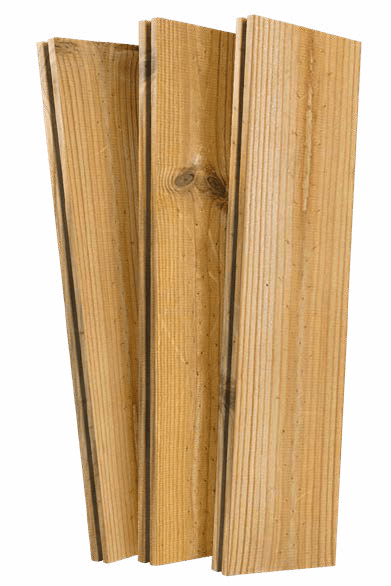
Identifying Bulletwood Decking Profiles
Bulletwood decking is available in various profiles, each designed for specific installation methods and aesthetic outcomes. The term 'profile' refers to the shape of the board's edges and faces. Common profiles include standard square edge, tongue-and-groove, and pre-grooved for hidden fasteners. Square edge boards are typically face-fastened, while pre-grooved boards are designed to accept hidden fastening clips, creating a cleaner, fastener-free surface.
When reviewing product specifications, pay close attention to the profile description. For instance, a square-edge board might be specified as 'S4S E4E' (surfaced four sides, eased four edges), indicating a smooth finish with slightly rounded edges. A pre-grooved profile will explicitly state its compatibility with specific hidden fastening systems. Confirming the exact profile is essential, especially if you have a particular fastening method in mind for your project.
Understanding Board Dimensions: Width, Thickness, and Lengths
Bulletwood decking boards come in standard and sometimes custom dimensions. The thickness and width are critical for structural integrity and visual scale, while available lengths impact layout efficiency and waste. Common thicknesses for residential decking might include 3/4 inch or 1 inch, with widths ranging from 4 inches to 6 inches, or wider.
Length availability can vary significantly. Some suppliers offer fixed lengths, while others provide random lengths or specific lengths upon request. For larger projects, understanding the available length increments can help optimize your material take-off and minimize cuts. Always specify your required dimensions precisely when requesting a quote, as these details directly influence both cost and installation time.
For example, a project requiring an 18-foot-long deck section would ideally benefit from 18-foot boards to avoid seams, but if only 8-foot and 10-foot boards are available, a seam plan becomes necessary. This detail should be part of your initial material review.
Approved Applications and Environmental Suitability
Bulletwood is recognized for its density and durability, making it suitable for a range of exterior applications. Product specifications will often list the approved uses, such as decking, exterior stairs, and other outdoor structures. It's important to cross-reference your project's intended use with these listed applications.
Consider the environmental conditions your deck will face. Bulletwood is a dense hardwood, often chosen for its robust nature in various climates. However, specific product documentation may offer guidance on installation in areas with extreme temperature fluctuations, high humidity, or coastal exposure. While Bulletwood is generally known for its resilience, understanding any specific recommendations for your project's environment can help ensure long-term performance.
Worked Example: Calculating Material for a Multi-Level Deck
Let’s consider a hypothetical multi-level deck project. The upper deck is 10 feet by 12 feet, and the lower deck is 8 feet by 15 feet. We plan to use Bulletwood decking with a standard square edge profile, specified as 1 inch thick by 6 inches wide (nominal dimensions). The project also includes a 12-inch wide picture-frame border around both deck levels, using the same material.
First, calculate the main deck areas: Upper deck is 10 ft * 12 ft = 120 sq ft. Lower deck is 8 ft * 15 ft = 120 sq ft. Total main deck area = 240 sq ft.
Next, calculate the border material. The perimeter of the upper deck is 2 * (10 + 12) = 44 linear feet. The perimeter of the lower deck is 2 * (8 + 15) = 46 linear feet. Total linear feet for the border = 90 linear feet. Since the border is 12 inches (1 foot) wide, this translates to 90 linear feet * 1 foot width = 90 sq ft of border material.
Total square footage of decking needed (before waste factor) = 240 sq ft (main) + 90 sq ft (border) = 330 sq ft. Assuming a 5% waste factor for cuts and unforeseen issues, the total material to order would be 330 sq ft * 1.05 = 346.5 sq ft.
To convert this to linear feet of 1x6 (0.5 sq ft/linear foot), we need 346.5 sq ft / 0.5 sq ft/linear foot = 693 linear feet of 1x6 boards. If boards are primarily available in 10-foot and 12-foot lengths, a detailed cut plan would be needed to optimize ordering and minimize waste, ensuring sufficient material for all sections, including the specific lengths required for the picture frame.
Complementary Products and Fastening Systems
When planning your Bulletwood decking project, remember to consider complementary products. This includes appropriate fasteners, whether face screws or hidden clips, which must be compatible with the Bulletwood's density and the chosen profile. For instance, if you select pre-grooved Bulletwood, you'll need a compatible hidden fastening system designed for hardwood.
Other considerations include suitable lumber for the substructure (if not already in place), appropriate sealers or finishes if you plan to alter the wood's natural aging process, and any specialized tools required for installation. Always refer to the manufacturer's recommendations for compatible products to ensure system integrity and performance. Lumber Plus offers a range of decking accessories and fasteners to complement your Bulletwood purchase.
Explore compatible decking options: Decking, Hardwood Decking, Ipe Decking, Composite Decking, PVC Decking.
Before you order
- Confirm desired Bulletwood decking profile (e.g., square edge, pre-grooved).
- Verify available board thicknesses and widths.
- Check specific length availability for your project dimensions.
- Review approved applications to match your project's intended use.
- Consider environmental suitability for your project location.
- Identify compatible fastening systems (face screws or hidden clips).
- Plan for any complementary products like sealers or substructure materials.
- Calculate total material quantity, including a waste factor.
Confirm installation details, approved uses and warranty terms in the current instructions for the exact product and profile. Your installer should verify the substrate, structure and applicable project requirements.
Questions to help you decide
What does 'profile' mean for Bulletwood decking?
For Bulletwood decking, 'profile' refers to the shape of the board's edges and faces. This determines how the boards are installed and their finished appearance. Common profiles include square edge for face-fastening and pre-grooved for hidden fastener systems.
Why are board dimensions so important when ordering?
Board dimensions (thickness, width, and length) are critical for several reasons. They impact the structural integrity of your deck, influence the overall aesthetic, and directly affect material yield and waste during installation. Matching dimensions to your project plan helps ensure efficiency and accurate cost estimation.
Does Bulletwood require special fasteners?
Bulletwood's density often requires specific fasteners designed for hardwood applications. If using a face-fastened approach, specialized screws may be recommended to prevent splitting and ensure secure attachment. For pre-grooved profiles, compatible hidden fastening clips are necessary. Always check product specifications for recommended fastener types.
Ready to Plan Your Bulletwood Decking Project?
Request a material quote with your project dimensions, exact profile, and ZIP code. We can confirm current availability and service options for your needs.
Request a material quote →