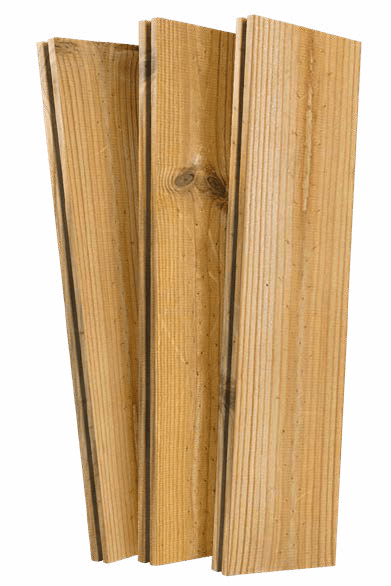
Bulletwood Decking: Available Profiles
Bulletwood is a dense, durable hardwood often chosen for decking and other exterior applications. When selecting Bulletwood for your project, you'll typically find it available in several standard board widths. These profiles are designed to accommodate a range of project scales and design preferences.
Commonly available nominal widths for Bulletwood decking include 1x4 and 1x6. It's important to note that actual finished dimensions will be slightly smaller than the nominal size. For example, a nominal 1x4 board typically measures around 3/4 inch thick by 3 1/2 inches wide, while a nominal 1x6 board is often 3/4 inch thick by 5 1/2 inches wide. Always confirm the exact finished dimensions with your supplier, as these can impact your layout and calculations.
Visual Impact of Board Widths
The width of your decking boards plays a significant role in the overall visual impression of your deck. Narrower boards, such as the 1x4 profile, can create a sense of intricacy and detail. They tend to make a smaller deck appear larger and can lend a more traditional or classic aesthetic. The increased number of board lines can also add visual texture.
Wider boards, like the 1x6 profile, often convey a more contemporary or expansive feel. They can make a large deck appear even grander, with fewer lines creating a cleaner, more streamlined surface. Wider boards can also be effective in visually simplifying a complex deck shape or highlighting the natural grain patterns of the Bulletwood more prominently.
Considering Deck Size and Layout
The size and shape of your deck are key factors in determining the most suitable board width. For smaller decks, balconies, or intricate designs with many angles or curves, narrower boards can be easier to work with and may result in less material waste from cuts. The smaller width allows for more flexibility in fitting boards into tighter spaces.
For larger, more open deck areas, wider boards can reduce installation time due to fewer boards needing to be laid. They can also create a more cohesive look across a broad expanse. If your design includes features like picture-frame borders or diagonal layouts, consider how the chosen board width will visually integrate with these elements. Sometimes, a combination of widths can be used for specific design effects, such as a narrow border around a field of wider boards, but this requires careful planning to ensure consistent fastening and support.
Worked Example: Calculating Board Quantity for a 10x12 Foot Deck
Let's consider a hypothetical 10-foot by 12-foot rectangular deck. We will compare using nominal 1x4 (actual 3.5 inches wide) versus nominal 1x6 (actual 5.5 inches wide) Bulletwood decking.
First, determine the effective width per board, including the spacing.
Next, calculate the number of boards needed to cover the 10-foot (120-inch) width of the deck. For 1x4 boards: 120 inches / 3.625 inches/board = approximately 33.1 boards. Since you cannot purchase fractions of boards, you would need 34 boards. For 1x6 boards: 120 inches / 5.625 inches/board = approximately 21.3 boards. You would need 22 boards.
Finally, calculate the total linear footage. Each board will be 12 feet long. For 1x4 boards: 34 boards * 12 feet/board = 408 linear feet. For 1x6 boards: 22 boards * 12 feet/board = 264 linear feet.
This example illustrates that while wider boards mean fewer individual pieces, the total linear footage needed will depend on the exact dimensions and spacing. Always add a percentage for waste (typically 5-10%) to your final linear footage calculation, especially for cuts, mistakes, or future repairs. This example assumes no offcuts are reusable, which may not always be the case depending on the layout and board lengths purchased.
Planning for Winter or Coastal Exposure
For projects in areas with significant winter temperature fluctuations or coastal environments, the choice of board width can have practical implications. While Bulletwood is a stable hardwood, all wood will experience some degree of expansion and contraction with changes in moisture and temperature. Wider boards, having more material, may exhibit these movements more noticeably than narrower boards, although proper installation and spacing are key for both.
In these environments, ensuring adequate ventilation beneath the deck is especially important, regardless of board width, to manage moisture and prevent issues. Always adhere to manufacturer-recommended spacing to allow for natural movement and drainage, which is critical in mitigating potential problems in challenging climates.
Before you order
- Consider the overall size and shape of your deck: Is it a compact balcony or an expansive entertaining area?
- Visualize the aesthetic: Do you prefer the detailed look of narrower boards or the expansive feel of wider boards?
- Review available Bulletwood profiles: Confirm exact finished dimensions with your supplier.
- Calculate material needs: Use the board width and desired spacing to estimate linear footage.
- Account for waste: Add 5-10% to your material order for cuts and potential errors.
- Evaluate installation complexity: Narrower boards might be easier for intricate designs, while wider boards can speed up larger areas.
- Consider environmental factors: Ensure proper spacing and ventilation for stability in all climates.
Confirm installation details, approved uses and warranty terms in the current instructions for the exact product and profile. Your installer should verify the substrate, structure and applicable project requirements.
Questions to help you decide
Can I mix different Bulletwood board widths on one deck?
While it is technically possible to mix board widths, it requires meticulous planning to ensure consistent structural support and a cohesive appearance. Fastener types and spacing might need adjustment. It's generally recommended for experienced builders or specific design features like borders or inlays. Consult with your contractor and material supplier for advice on such custom designs.
Does board width affect the durability of Bulletwood decking?
The inherent durability of Bulletwood as a species is not directly dependent on the board width. Both narrower and wider boards will possess the same natural resistance to decay and insects characteristic of Bulletwood. However, wider boards may show natural movement (expansion/contraction) more prominently than narrower boards due to their larger surface area. Proper installation, including correct spacing and ventilation, is crucial for the performance of any width.
Are wider Bulletwood boards more expensive per linear foot?
Pricing for decking materials can vary based on several factors, including species, grade, and specific dimensions. Often, wider boards may have a higher price per linear foot than narrower boards of the same species and grade, reflecting the larger volume of material. However, because wider boards cover more area, you might need fewer of them for a given project, which could balance the overall material cost. Always request a detailed quote for both options to compare total project material costs.
Ready to Plan Your Bulletwood Decking Project?
Request a material quote with your project dimensions, desired Bulletwood profile, and ZIP code to confirm current availability and service options. We're here to help you select the right materials for your outdoor space. Explore our full range of Bulletwood decking and related products at our product page: [Bulletwood Decking](/decking/hardwood/bulletwood). Consider complementary products such as [Decking](/decking) in general, other [Hardwood Decking](/decking/hardwood) options like [IPE Decking](/decking/hardwood/ipe), or even alternative materials like [Composite Decking](/decking/composite) or [PVC Decking](/decking/pvc).
Request a material quote →