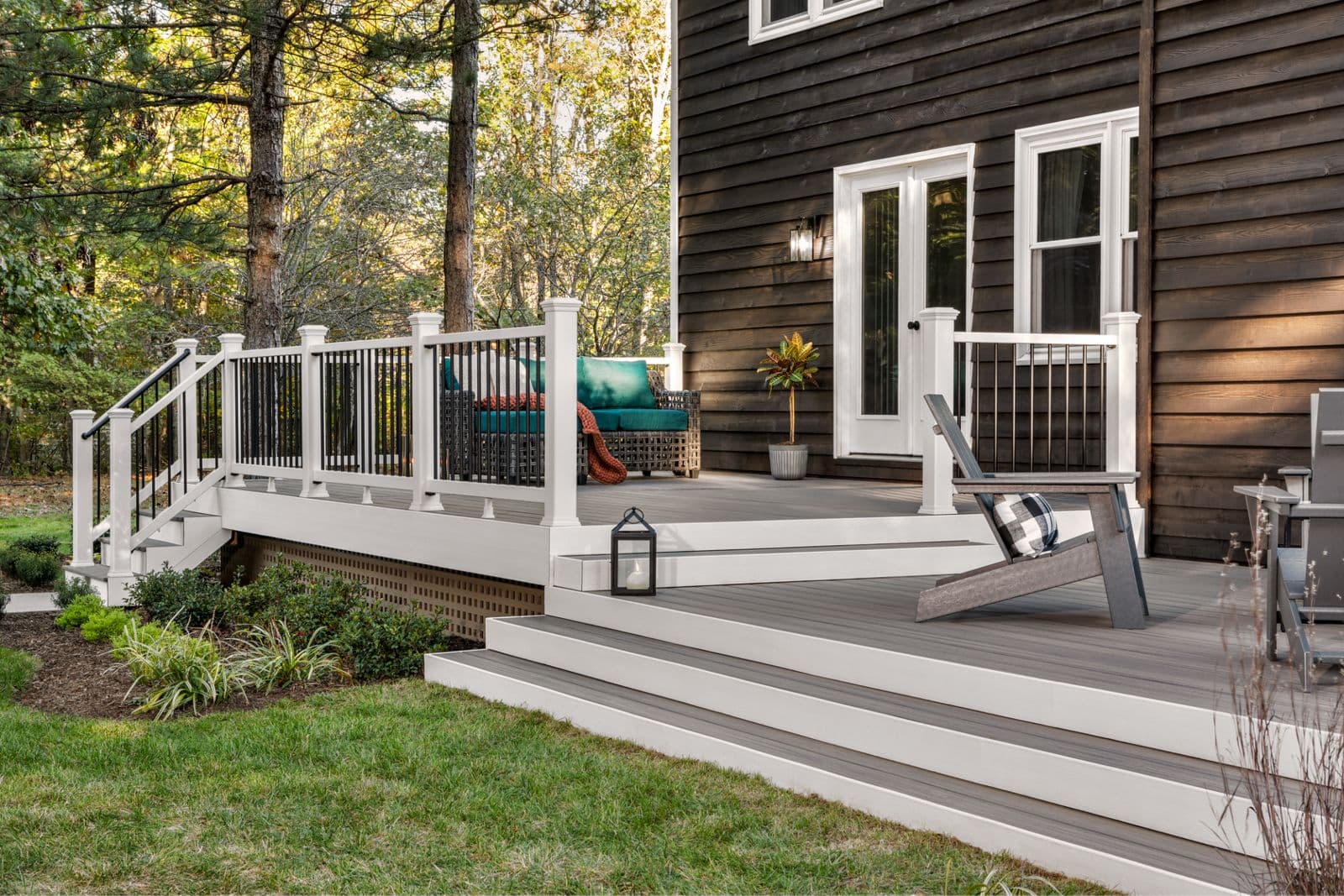
Understanding Trex Deck Board Profiles for Stairs
Trex offers a range of deck board profiles, typically 1 inch by 5.5 inches, available in both grooved and square-edge formats. For stair treads, square-edge boards are generally preferred as they provide a solid, finished edge that can be securely face-fastened. Grooved boards are primarily designed for hidden fastening systems on the main deck surface and may require additional blocking or specific fastening techniques if used for treads, often involving face screws near the edges for stability.
Consider the specific Trex line you are using for your deck, such as Enhance, Select, or Transcend. While all lines share a common recycled core and capped surface, the finish depth and color range vary. Maintaining consistency between your deck and stair treads ensures a unified look. Ensure that the chosen board profile is approved for stair tread application by consulting the latest manufacturer's guidelines.
For risers, which are the vertical elements between treads, square-edge boards or dedicated fascia boards can be used. Fascia boards are often thinner and designed for vertical applications, offering a clean finish to the stair structure. The choice between a standard deck board or a fascia board for risers depends on the desired aesthetic and structural requirements for the riser component.
Structural Support for Trex Deck Stairs
The underlying structure of your stairs is critical for safety and longevity. Trex decking, like any decking material, requires a robust sub-structure. Stair stringers, typically made from pressure-treated lumber, form the backbone of the staircase, supporting the treads and risers. The spacing of these stringers must align with the manufacturer's recommendations for Trex decking, which often specifies a maximum span for treads to prevent deflection.
Local building codes will dictate the minimum dimensions and spacing for stringers, as well as the maximum rise and minimum run for individual steps. Always confirm these requirements with your local building department before beginning construction. Adequate support ensures that the Trex boards perform as intended, resisting movement and maintaining their appearance over time. Insufficient support can lead to premature wear or safety hazards.
When designing the stair structure, account for the dimensions of the Trex boards. The depth of the tread material will influence the cut of the stringers to achieve the correct rise and run. Proper blocking and bracing between stringers may also be necessary, especially for wider staircases, to enhance stability and provide solid attachment points for the decking.
Designing Safe and Compliant Stair Treads
Stair treads are the most critical component for safety. For Trex decking, the standard practice is to use full-width square-edge boards. The number of boards per tread depends on the desired tread depth, which is also regulated by building codes. Many codes specify a minimum tread depth, often around 10 to 11 inches.
If a single Trex 5.5-inch board is used, the tread depth would be approximately 5.5 inches, which is generally insufficient for code compliance. Therefore, most Trex stair treads will require two boards. These two boards must be securely fastened to the stringers. Face screws are typically recommended for treads, ensuring a strong connection that resists uplift and movement. Ensure that the screws are compatible with composite decking and installed according to manufacturer instructions.
When using two boards for a tread, consider how the seam will be handled. A small, consistent gap between the boards is usually recommended for drainage and expansion. The exact gap size should follow Trex installation guidelines. The leading edge of the tread should also have a slight overhang (nosing) over the riser below, as specified by building codes, typically between 3/4 inch and 1 1/4 inches. This nosing helps with foot placement and visibility.
Worked Example: Two-Board Trex Stair Tread
Let's consider a hypothetical project requiring a stair tread depth of 11 inches to meet local code. We will use standard Trex square-edge boards, which are approximately 5.5 inches wide. To achieve an 11-inch tread depth, we would need two Trex boards side-by-side.
For each tread, we would purchase two Trex square-edge boards. This configuration provides a stable and code-compliant tread surface.
Each of these two boards would be face-fastened into the supporting stringers below. For instance, if the stringers are spaced 12 inches on center, each 5.5-inch board would be securely attached to multiple stringers, preventing any rocking or deflection. This approach ensures both structural integrity and visual continuity with the main deck.
For a staircase with 5 steps, you would need 10 individual Trex boards for the treads (2 boards per step x 5 steps). If each board is cut from a 12-foot length, and each step is 36 inches wide, you would get 4 treads from one 12-foot board (144 inches / 36 inches = 4). Therefore, for 10 treads, you would need 3 full 12-foot boards (10 treads / 4 treads per board = 2.5, rounded up to 3). This calculation assumes efficient cutting and minimal waste.
Risers and Fascia for a Finished Look
Risers are the vertical pieces that close the gap between treads. While not always structurally essential, they contribute to the finished appearance and can prevent debris from accumulating under the stairs. Trex fascia boards, designed to match the decking, are an excellent choice for risers due to their thinner profile and finished edges. Standard Trex deck boards can also be ripped down to size for risers, but this may expose the uncapped core, which could affect long-term appearance.
When installing risers, ensure they are securely fastened to the stringers and the underside of the treads. Proper alignment with the treads is crucial for a clean, professional look. The color of the risers should ideally match or complement your chosen Trex decking and fascia for a cohesive design.
Consider the overall aesthetic: do you want open risers for a lighter, more modern feel, or closed risers for a more traditional, solid appearance? Local codes may also have requirements regarding open risers, especially concerning the maximum opening size to prevent falls. Always verify these details with your project team and local authorities.
Before you order
- Confirm local building codes for stair rise, run, tread depth, and nosing.
- Verify stringer material and spacing requirements for Trex decking.
- Select a Trex decking line and color that matches or complements your main deck.
- Determine if square-edge Trex boards are available for your chosen line.
- Calculate the number of Trex boards needed for treads, considering two boards per tread for most code-compliant depths.
- Decide on open or closed risers, and select appropriate Trex fascia or deck boards.
- Choose compatible face fasteners for treads and risers.
- Plan for drainage and expansion gaps between tread boards.
- Review manufacturer installation guides for specific Trex products being used.
Confirm installation details, approved uses and warranty terms in the current instructions for the exact product and profile. Your installer should verify the substrate, structure and applicable project requirements.
Questions to help you decide
Can I use grooved Trex boards for stair treads?
While grooved boards are primarily for hidden fastening on the main deck, they can sometimes be used for stair treads if face-fastened near the edges. However, square-edge boards are generally recommended for treads as they offer a solid edge and are easier to secure with face screws, providing a more robust and code-compliant solution. Always consult Trex's latest installation guides for approved applications.
What is the recommended spacing for stringers when building Trex stairs?
The recommended spacing for stair stringers depends on the specific Trex decking product and local building codes. Always refer to the most current Trex installation instructions and local building codes to ensure proper support and compliance.
Do Trex stairs require special maintenance?
Trex decking, including stair components, is designed for low maintenance. A simple soap-and-water wash is typically sufficient to keep it clean and maintain its appearance. Unlike wood, Trex does not require staining, sealing, or painting. Regular cleaning helps prevent the buildup of dirt, mold, or mildew. Always follow Trex's specific cleaning recommendations to ensure the longevity of your stairs and maintain your warranty.
Ready to Plan Your Trex Deck Stairs?
Request a material quote for Trex decking, including exact profiles and lengths for your project. Provide your project dimensions and ZIP code to confirm current availability and service options.
Request a material quote →