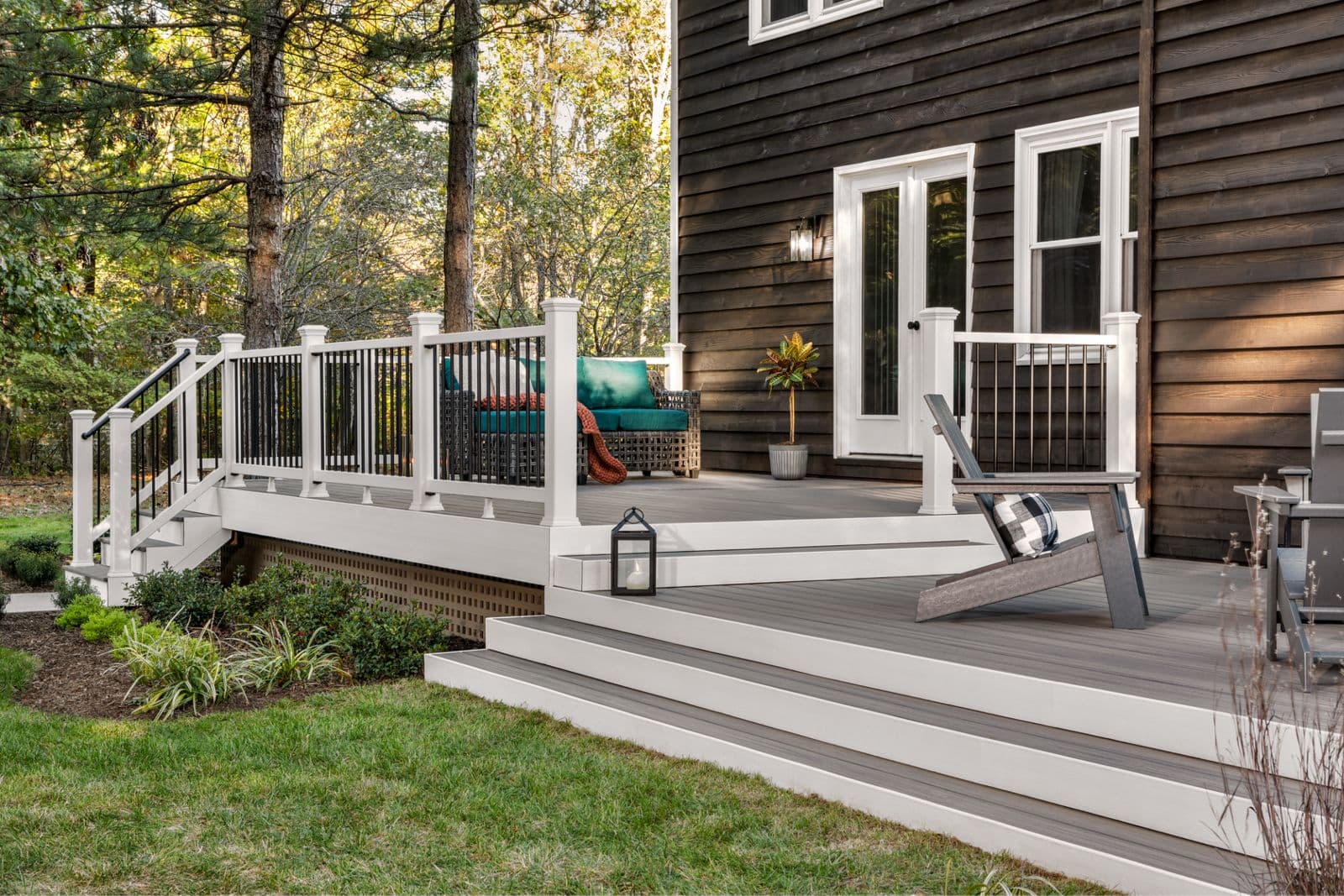
Understanding Trex Decking Lines and Material Costs
Trex composite decking is available in several lines, each offering different aesthetics and price points.
The Trex Enhance® Basics and Enhance® Naturals lines are considered entry-level, offering traditional or authentic wood-grain appearances. The Select® Earth Tones line represents a mid-range option with high-performance shell technology. For flagship aesthetics and performance, consider the Transcend® Earth Tones and Transcend® Tropical lines. Your choice of line will directly influence the primary material cost.
Trex boards are typically available in 12, 16, and 20-foot lengths, with a standard profile of 1 inch by 5.5 inches. Both grooved and square-edge boards are available. Grooved boards are designed for hidden fastening systems, while square-edge boards are typically used for face-fastening or as perimeter boards, fascia, and risers. Accurate measurement of your deck area and layout plan is essential to determine the required board lengths and minimize waste.
Essential Trex Decking Accessories
Beyond the decking boards, several accessories are integral to a successful Trex installation and must be factored into your budget.
Hidden Fasteners: Trex offers compatible hidden clip systems for grooved boards, which create a clean, screw-free deck surface. These clips ensure consistent board spacing and are a significant component of the material cost. Face screws are an alternative, often used for perimeter boards or stairs, and require specific composite-compatible fasteners.
Fascia Boards: These are used to finish the exposed edges of your deck, creating a polished appearance. Trex offers matching fascia boards that coordinate with their decking lines. The quantity needed depends on the perimeter length of your deck.
Stair Components: If your project includes stairs, you will need additional boards for treads and risers, along with appropriate fastening solutions and potentially specialized stair clips or brackets.
Railing Systems: While not always part of the decking material itself, a railing system is often a necessary safety and aesthetic component of a deck project. Trex offers compatible railing systems, or you may choose a different material. Budget for posts, balusters, top and bottom rails, and any required hardware.
Substructure Materials: Though not a Trex product, the substructure (joists, beams, posts) is fundamental. This typically involves pressure-treated lumber or steel. Ensure your substructure is sound and correctly spaced according to Trex installation guidelines for proper support and warranty validation.
Worked Example: Budgeting for a 12x10 Foot Trex Deck
This example focuses on materials only.
Deck Area: 12 ft x 10 ft = 120 square feet.
Decking Boards: For a 12x10 foot deck, laid parallel to the 10-foot width, you'd need boards that are 12 feet long. Each Trex board is 5.5 inches wide (0.458 feet). To cover 10 feet of width, you'd need approximately 10 ft / 0.458 ft per board = 21.8 boards. Since you can only purchase full boards, you would need 22 boards at 12 feet long. Total lineal footage for boards: 22 boards * 12 ft/board = 264 lineal feet.
So, 22 boards * 9 clips/board = 198 hidden clips.
Fascia Boards: The perimeter is (12 ft + 10 ft) * 2 = 44 lineal feet. You'd typically use 12-foot or 20-foot fascia boards. For 44 feet, you'd need three 20-foot boards (60 feet total, with some offcut remaining).
Substructure (Lumber Plus does not supply): This example assumes an existing, sound substructure or a separate budget for pressure-treated lumber for joists, beams, and posts. This can easily add several hundred to over a thousand dollars depending on the design.
Railing System (Optional, Lumber Plus does not supply): If a railing is required, budget for posts, top and bottom rails, balusters, and hardware for a 44-foot perimeter. This is a significant additional cost.
This example provides a material quantity estimate. Actual costs will depend on the chosen Trex line, current pricing, and specific accessory quantities.
Labor and Installation Considerations
Unless you are undertaking a DIY project, labor costs will be a substantial part of your budget. Labor rates vary significantly based on location, contractor experience, and project complexity. Obtain multiple bids from qualified contractors to understand the prevailing rates in your area.
Factors influencing labor costs include: demolition of an existing deck, site preparation, substructure construction or modification, decking installation (hidden fasteners generally take longer than face-fastening), railing installation, and any custom features like built-in benches or lighting. Always ensure your contractor is familiar with Trex installation guidelines to ensure proper assembly and warranty adherence.
The Importance of a Contingency Fund
No matter how meticulously you plan, unforeseen circumstances can arise during any construction project. A contingency fund, typically 10-15% of the total project cost, is highly recommended. This fund can cover unexpected material needs (e.g., miscuts, damaged boards), minor design changes, or unforeseen labor challenges.
Having a contingency budget helps prevent project delays and financial stress, allowing you to address issues without derailing your overall plan. It's a prudent financial practice for any home improvement project.
Before you order
- Determine your desired Trex decking line (Enhance Basics, Enhance Naturals, Select Earth Tones, Transcend Earth Tones, or Transcend Tropical).
- Measure your deck area accurately to calculate the required lineal footage of decking boards.
- Decide on grooved boards (for hidden fasteners) or square-edge boards (for face-fastening or perimeter).
- Calculate the quantity of hidden fasteners or face screws needed based on joist spacing and deck size.
- Measure the perimeter for fascia boards and determine required lengths.
- Account for any stair treads, risers, and specific stair hardware.
- Plan for a railing system, including posts, rails, balusters, and hardware, if applicable.
- Budget for substructure materials (lumber, concrete, hardware) if building new or modifying existing.
- Obtain labor quotes from multiple contractors if not DIY.
- Allocate a contingency fund (10-15% of total estimated cost) for unforeseen expenses.
Confirm installation details, approved uses and warranty terms in the current instructions for the exact product and profile. Your installer should verify the substrate, structure and applicable project requirements.
Questions to help you decide
What is the primary difference between Trex decking lines?
The primary differences between Trex decking lines are the finish depth, the range of available colors, and the warranty terms. All Trex lines are made from 95% recycled materials and feature a low-maintenance, three-sided cap, but the aesthetic and performance characteristics evolve from the entry-level Enhance lines to the flagship Transcend lines. For instance, Transcend Tropical offers vibrant, multi-tonal finishes inspired by exotic hardwoods.
Do I need special fasteners for Trex decking?
Yes, Trex decking requires specific fastening systems. For grooved-edge boards, a compatible hidden fastening system is recommended to create a clean, seamless surface. For square-edge boards, or when face-fastening is preferred for perimeter boards or stairs, specialized composite-compatible face screws are necessary. Always refer to the manufacturer's installation guidelines for the correct fasteners for your chosen Trex product.
Does Trex decking come with a warranty?
This warranty is transferable. It's important to review the specific warranty document for the Trex line you select, as terms and conditions, including proper installation and maintenance requirements, apply. Always confirm current warranty details at the time of purchase.
Ready to Plan Your Trex Decking Project?
Request a material quote today. Provide your project dimensions, desired Trex profile, and ZIP code, and we'll help you confirm current availability and service options for your decking materials.
Request a material quote →