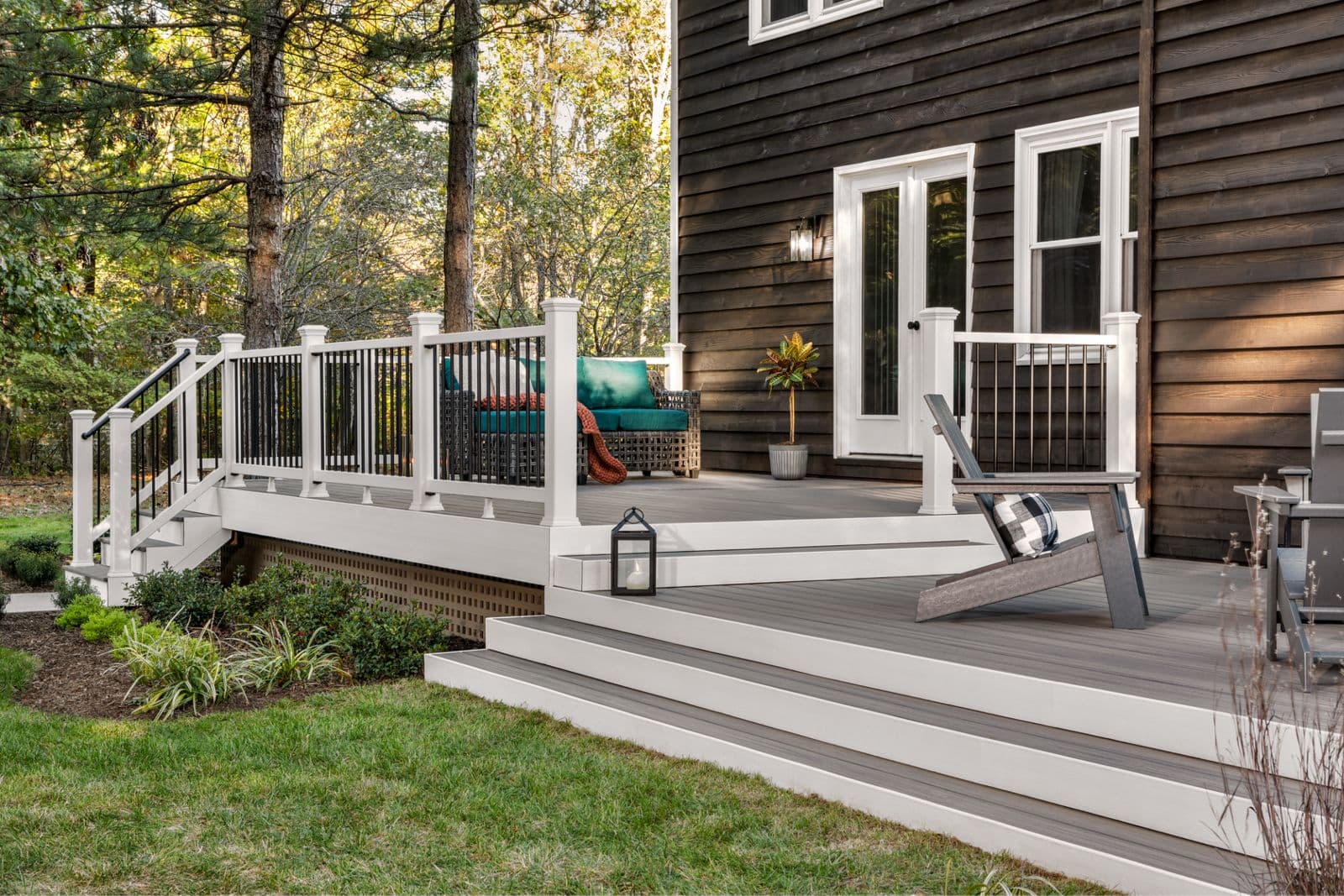
Understanding Trex Decking Board Dimensions
Trex composite decking is manufactured with consistent dimensions, which simplifies the planning process. Standard board profiles are typically 1 inch by 5.5 inches, available in both grooved and square-edge options. These boards come in specific lengths: 12 feet, 16 feet, and 20 feet. Knowing these standard lengths is crucial for minimizing cuts and maximizing material use in your project.
The choice between grooved and square-edge boards depends on your fastening method. Grooved boards are designed to be used with hidden fastening systems, which create a clean, fastener-free deck surface. Square-edge boards are typically used for face-fastening, or for border boards, stair treads, and fascia where the edges are visible and a flush finish is desired. Always confirm the specific board profile required for each part of your deck plan.
Measuring Your Deck Area
Begin by accurately measuring the total surface area of your deck. For rectangular or square decks, simply multiply the length by the width. If your deck has an irregular shape, divide it into smaller, manageable rectangles or squares, calculate the area of each section, and then add them together.
For example, a deck that is 10 feet wide and 15 feet long has a surface area of 150 square feet. Make sure to take measurements from the outermost points of your deck frame, accounting for any overhangs or picture-frame borders you plan to install. Double-check all measurements to avoid errors in your calculations.
Calculating Main Decking Board Quantity
Once you have your total deck area, you can estimate the number of boards needed. Trex boards are 5.5 inches wide. To convert this to feet, divide 5.5 by 12, which equals approximately 0.458 feet. To cover one linear foot of deck width, you need to know how many boards fit across that width.
A common method is to calculate the linear feet of decking required. For a deck 10 feet wide, you would need 10 feet / 0.458 feet/board = approximately 21.8 boards across the width. If your deck is 15 feet long, the total linear footage needed would be 21.8 boards * 15 feet/board = approximately 327 linear feet of Trex board. This is a simplified calculation and does not account for spacing between boards or waste.
Accounting for Board Spacing and Waste
Trex decking requires specific spacing between boards for proper drainage and thermal expansion. Consult the manufacturer's installation guide for the exact recommended gap. This spacing will slightly increase the number of boards you need compared to a simple area calculation. A general rule of thumb for straight layouts is to add a waste factor of 5-10% to your total linear footage to account for cuts, miscuts, and potential board defects.
For diagonal layouts, the waste factor can be significantly higher, often 15-20% or more, due to the increased number of angled cuts. Always round up to the nearest full board length when purchasing. For example, if you need 17 feet of a board and the available lengths are 12, 16, and 20 feet, you would purchase a 20-foot board. Offcuts shorter than 2 feet are generally considered waste unless they can be used for blocking or very short sections.
Worked Example: 12x18 Foot Deck with Straight Layout
Let's assume a rectangular deck measuring 12 feet wide by 18 feet long, with a straight decking layout. We will use Trex boards that are 5.5 inches wide and available in 12, 16, and 20-foot lengths.
1. **Deck Area:** 12 feet * 18 feet = 216 square feet.
2. **Number of boards across width (12 ft):** Since boards are 5.5 inches (0.458 ft) wide, 12 feet / 0.458 ft/board = approximately 26.2 boards.
3. **Linear footage per board run:** Each board runs the 18-foot length of the deck. Since 18 feet is available as a standard length (a 20-foot board would be cut down), we can optimize by purchasing 20-foot boards, allowing for a small trim.
4. **Total linear footage needed:** 27 boards * 18 feet/board = 486 linear feet.
5. **Applying Waste Factor:** For a straight layout, let's apply a 7% waste factor: 486 linear feet * 1.07 = 519.02 linear feet.
6. **Converting to full boards:** To cover 519.02 linear feet using 20-foot boards: 519.02 / 20 = 25.95 boards. Round up to 26 boards. If we used 16-foot boards, 519.02 / 16 = 32.43 boards, rounded up to 33 boards. In this case, 26 of the 20-foot boards are more efficient for the 18-foot runs, as they minimize cuts and leave a smaller offcut per board. This results in 26 boards of 20-foot length. This leaves a 2-foot offcut per board, which may be usable for blocking or other small sections, reducing effective waste.
7. **Summary:** For a 12x18 foot deck, you would need to order 26 Trex boards, each 20 feet long, for the main decking surface.
Consider Fascia, Trim, and Stairs
Beyond the main deck surface, remember to calculate materials for fascia boards, trim, and any stairs. Trex offers matching fascia boards that provide a finished look to the perimeter of your deck. Measure the linear perimeter of your deck where fascia will be applied, and calculate the number of fascia boards needed, again adding a waste factor.
For stairs, measure the length of each tread and riser. Multiply by the number of stairs to get the total linear footage for each component. Stair projects can have more complex cuts and angles, so a higher waste factor may be appropriate for these sections. Always consider coordinating these elements with your main decking choice.
Explore complementary products like other composite decking options at our main decking page, or consider other materials like Ipe hardwood decking or PVC decking for different project requirements.
Before you order
- Confirm total deck surface area (length x width).
- Identify preferred Trex board width (typically 5.5 inches).
- Determine the primary board layout (straight or diagonal).
- Select optimal Trex board lengths (12, 16, or 20 ft) to minimize cuts and waste.
- Calculate linear footage for main deck boards, accounting for spacing.
- Apply appropriate waste factor (5-10% for straight, 15-20%+ for diagonal).
- Calculate linear footage for fascia, trim, and stair components.
- Round up to the nearest full board for all purchases.
- Consider the use of offcuts for smaller sections or blocking.
Confirm installation details, approved uses and warranty terms in the current instructions for the exact product and profile. Your installer should verify the substrate, structure and applicable project requirements.
Questions to help you decide
What is the standard width of Trex decking boards?
Trex decking boards typically have a standard width of 5.5 inches. This consistent dimension helps in planning and calculating the number of boards needed for your project.
How much waste should I factor in for Trex decking?
For a straight decking layout, a waste factor of 5-10% is generally recommended. For diagonal layouts or more complex designs with many cuts, you should consider a higher waste factor, often in the range of 15-20% or more, to account for angled cuts and potential miscuts.
Can I use Trex boards for both the deck surface and fascia?
Yes, Trex offers matching fascia boards specifically designed to complement their decking lines. These are typically used to finish the perimeter of the deck, providing a consistent aesthetic. Square-edge deck boards can also be used for fascia or stair treads.
Ready to Plan Your Trex Decking Project?
Request a material quote today. Provide your project dimensions, desired Trex profile (e.g., Enhance Basics, Transcend Tropical), and your ZIP code to confirm current availability and service options. Our team can assist you with your quantity take-off.
Request a material quote →