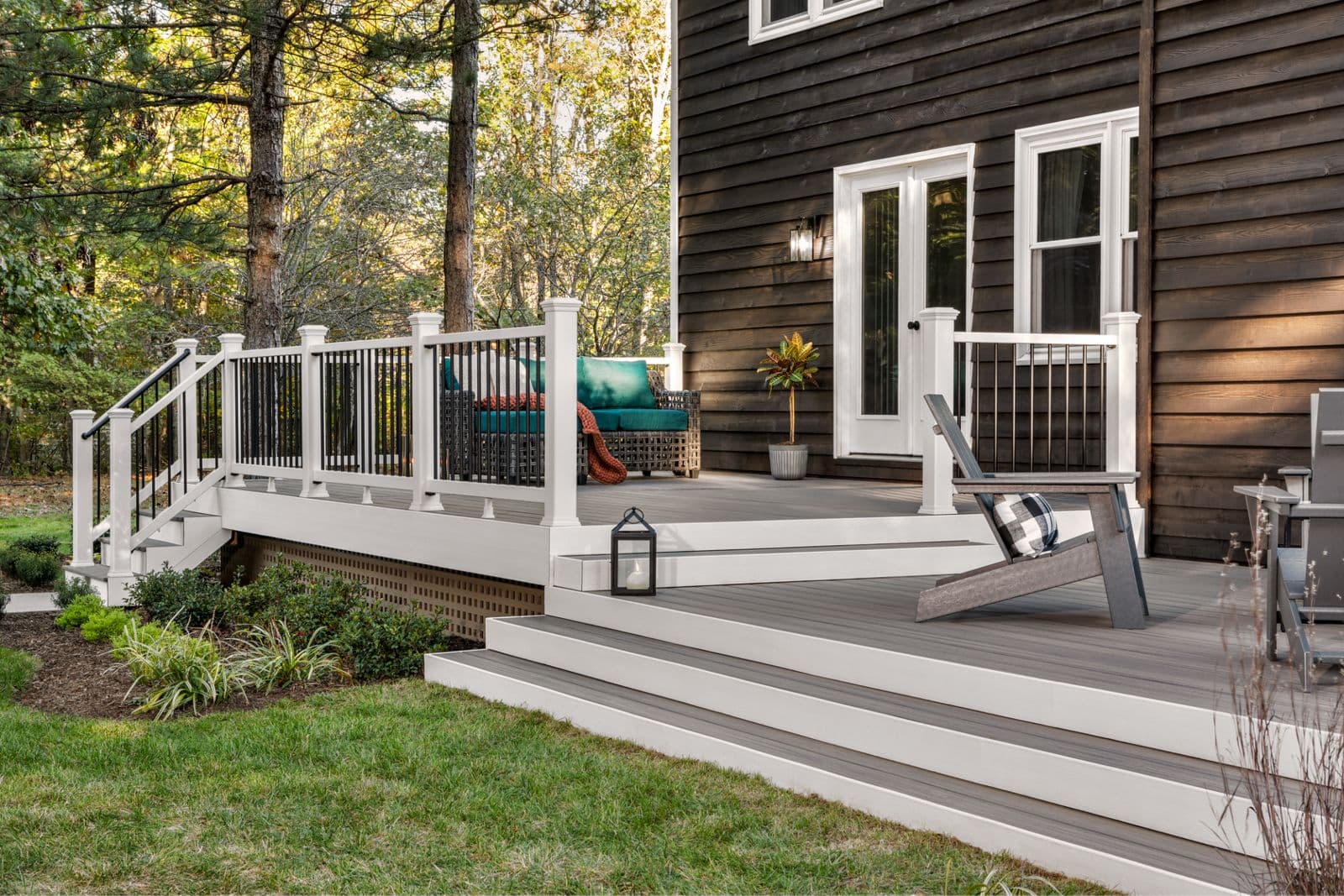
Understanding Trex Decking Lines and Their Characteristics
Trex offers several decking lines, each designed with specific aesthetics and performance attributes. For instance, the Enhance® lines are considered entry-level, offering traditional colors or authentic wood-grain appearances. The Select® line features hallmark high-performance shell technology, while the Transcend® lines represent the flagship options with elevated aesthetics and robust protection.
Knowing which line you are considering is the first step in understanding its specific product details. Each line, such as Enhance® Basics, Enhance® Naturals, Select® Earth Tones, Transcend® Earth Tones, and Transcend® Tropical, has its own set of available colors and sometimes subtle variations in board characteristics. Always refer to the specific line's documentation for accurate information.
While all Trex decking is made from wood-plastic composite and is capped on three sides, checking the specific line helps confirm its intended use and any particular installation guidelines. For example, a homeowner might initially choose a color from the Enhance® Basics line but later decide they prefer the multi-tonal appearance of Enhance® Naturals. This change could impact available lengths or lead to a review of other design elements if not confirmed early.
Board Dimensions and Profiles: Grooved vs. Square Edge
Trex decking boards are consistently manufactured with a nominal profile of 1 inch by 5.5 inches. However, a crucial distinction lies in the board edge profile: grooved or square. Grooved boards are designed to be used with hidden fastening systems, which clip into the grooves along the board's sides, creating a smooth, fastener-free deck surface. Square-edge boards, on the other hand, are typically used for the perimeter of the deck, stair treads, or where face-fastening is preferred or required.
For a typical deck project, you will likely need a combination of both profiles. Grooved boards form the main deck surface, while square-edge boards provide a clean finish for edges and stairs. It is important to specify the correct quantity of each profile when ordering. For instance, a deck designed with a picture-frame border will require square-edge boards for that border, while the interior field will use grooved boards.
Failure to accurately count the required grooved and square-edge boards can lead to ordering too much of one type and not enough of the other. This can cause project delays or necessitate additional orders and shipping costs. Always double-check your deck plan to determine the exact number of linear feet needed for each profile.
Available Board Lengths and Planning for Waste
Trex decking boards are commonly available in lengths of 12, 16, and 20 feet. Choosing the optimal board length can significantly impact material efficiency and reduce waste. Longer boards can minimize the number of seams on your deck surface, creating a more continuous appearance. However, longer boards can also be more challenging to transport and handle, especially for DIY installers or in tight job site conditions.
When planning your layout, consider the dimensions of your deck and how board lengths will align. For example, if your deck is 15 feet deep, a 16-foot board would be suitable, leaving a 1-foot offcut. If the deck is 11 feet deep, a 12-foot board might be chosen, resulting in a 1-foot offcut. These offcuts may be usable for other parts of the deck, such as stair risers or smaller infill pieces, but this requires careful planning. If they are not usable, they become waste.
A common mistake is ordering based solely on total square footage without accounting for linear feet and cuts. For a deck requiring 15-foot boards, ordering 16-foot lengths will generate unavoidable waste if the offcuts cannot be repurposed. Always calculate the linear footage for each section and then select the most efficient board lengths to minimize waste and cost.
Fastening Systems: Hidden Clips and Face Screws
Trex decking offers flexibility in fastening methods: hidden clips for grooved boards and face screws for square-edge boards. Hidden fasteners provide a clean aesthetic by securing boards from the side, making them invisible from the deck surface. These clips are specifically designed to work with the grooved profile of Trex boards and ensure consistent spacing between boards.
Face-fastening involves screwing directly through the face of the board into the joists below. This method is typically used for square-edge boards, particularly for the perimeter of the deck, stair treads, or when a more visible fastener is acceptable. When face-fastening, it's important to use compatible screws that are designed for composite decking to prevent mushrooming or cracking and to ensure proper hold.
Always confirm the type of fastening system you intend to use and ensure you order the corresponding hardware. Hidden clips are sold separately and are specific to composite decking. If you plan to face-fasten any part of your deck, ensure you have the correct screws and understand the manufacturer's recommendations for pilot holes and torque settings to avoid damaging the boards.
Worked Example: Calculating Trex Board Requirements
Let's consider a hypothetical deck project: a rectangular deck measuring 12 feet by 18 feet. The homeowner wants a picture-frame border of 6 inches and will use grooved boards for the main deck surface. All boards will run parallel to the 12-foot dimension.
First, calculate the border. The outer perimeter is (12 ft + 18 ft) * 2 = 60 linear feet. With a 6-inch (0.5 ft) border, you'll need two 18-foot boards and two 12-foot boards for the outer frame using square-edge boards. This is 60 linear feet of square-edge boards. Since Trex boards come in 12, 16, and 20 ft lengths, you'd purchase two 18-foot equivalent (two 20-foot) and two 12-foot boards for the outer frame. This means 40 linear feet of 20-foot and 24 linear feet of 12-foot square-edge boards.
Next, calculate the inner field. The inner dimensions are (12 ft - 2 * 0.5 ft) = 11 ft wide, and (18 ft - 2 * 0.5 ft) = 17 ft long. The boards will run parallel to the 11-foot dimension. Each grooved board is 5.5 inches (0.458 ft) wide. So, 17 ft / 0.458 ft per board = approximately 37.1 boards. Round up to 38 boards. Each board needs to be 11 feet long. Since Trex offers 12-foot lengths, you would order 38 grooved boards, each 12 feet long. This totals 38 * 12 = 456 linear feet of grooved boards. The offcuts of 1 foot per board could be used for other small sections if applicable, or become waste.
Before you order
- Confirm the specific Trex decking line (e.g., Enhance, Select, Transcend) you intend to purchase.
- Determine the required quantities of grooved boards for the main deck surface.
- Determine the required quantities of square-edge boards for borders, stairs, and other visible edges.
- Select optimal board lengths (12, 16, or 20 ft) to minimize waste for each section of your deck.
- Specify the type and quantity of hidden fasteners needed for grooved boards.
- Identify any face-fastening requirements and select appropriate screws for square-edge boards.
- Review the warranty terms associated with your chosen Trex line.
- Account for any matching fascia or trim boards required for the project perimeter.
Confirm installation details, approved uses and warranty terms in the current instructions for the exact product and profile. Your installer should verify the substrate, structure and applicable project requirements.
Questions to help you decide
What is the difference between grooved and square-edge Trex boards?
Grooved boards have a channel along their sides designed to accept hidden fastening clips, creating a smooth deck surface without visible screws. Square-edge boards have flat sides and are typically used for the perimeter of the deck, stair treads, or when face-fastening is preferred.
Can I mix different Trex decking lines on the same project?
While it is physically possible to mix different Trex lines, it is generally not recommended due to potential variations in finish, color, and texture. For a cohesive appearance and consistent performance, it is best to stick to one Trex line for your primary decking surface. Always consult with a professional if you are considering combining different lines.
How do I calculate how many Trex boards I need for my deck?
To calculate the number of boards, first determine the total linear footage required for both your main deck surface (using grooved boards) and any borders or stairs (using square-edge boards). Then, divide the linear footage by the available board lengths (12, 16, or 20 feet) to find the most efficient combination that minimizes waste. Remember to account for board width and spacing.
Ready to Order Your Trex Decking?
Request a material quote with your project dimensions, exact Trex profile, and ZIP code to confirm current availability and service options.
Request a material quote →