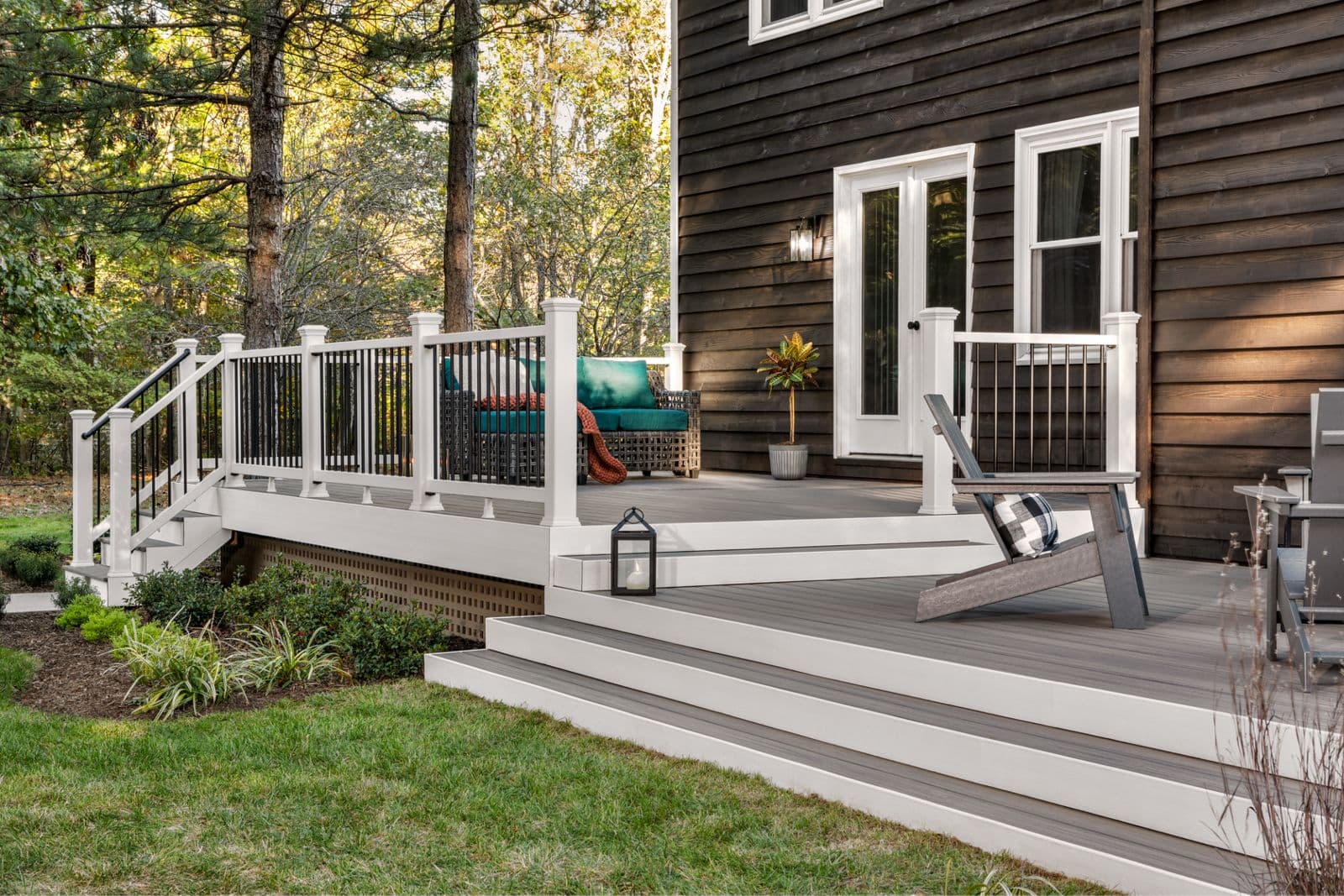
Visual Impact and Design Considerations
The primary reason to choose a diagonal layout for Trex decking is its distinct visual appeal. Boards laid at a 45-degree angle to the house or main structure create a unique pattern that can add sophistication and a custom feel to your deck. This angle can visually expand a space, making it feel less confined than parallel board arrangements. The direction of the diagonal can also be used to guide foot traffic or emphasize a particular view.
When planning, consider how the diagonal lines will interact with the surrounding landscape, the architecture of your home, and any other outdoor features. A diagonal pattern can complement modern designs or add a contemporary twist to more traditional settings. It's also worth noting that patterns can be combined; a diagonal field can be framed by perpendicular picture-frame borders for an even more custom look. Consider the color and grain of your chosen Trex line, such as the multi-tonal options in Trex Enhance® Naturals or the rich hues of Trex Transcend® Tropical, as these will be highlighted by the diagonal orientation.
Remember that while diagonal layouts are visually striking, they can also make small imperfections more noticeable if not installed meticulously. Precision in cuts and spacing is paramount to achieve the desired effect.
Increased Material Waste and Board Lengths
One of the most significant practical implications of a diagonal decking layout is the increase in material waste. When boards are cut at an angle to fit the perimeter of the deck, triangular offcuts are often generated that may not be reusable. This means you will need to purchase more Trex decking boards than you would for a traditional perpendicular layout.
For a typical rectangular deck, a diagonal installation can increase material waste by 15-20% or more, depending on the deck's dimensions and the efficiency of your cutting plan. Longer board lengths, such as the 16-foot or 20-foot Trex options, can help minimize waste by allowing for more efficient angle cuts and reducing the number of seams. However, even with careful planning, expect to factor in extra material. Always calculate your needs with a buffer to account for cuts, potential errors, and future repairs.
It's essential to plan your cuts to maximize the use of each board. For example, if you make a 45-degree cut at one end of a board for one side of the deck, the resulting offcut might be used for the opposing corner on the other side. A detailed drawing or digital layout tool can help optimize board usage and estimate waste more accurately.
Adjusted Joist Spacing and Framing Requirements
Unlike perpendicular installations where decking boards typically run across the joists, a diagonal layout means the boards cross the joists at an angle. This changes the effective span of the decking material and often requires closer joist spacing to maintain structural integrity and prevent deflection.
Trex decking, like other composite boards, requires specific support. This reduction provides the necessary support for the boards and helps ensure the deck remains stable and flat over time. Failing to adjust joist spacing can lead to bouncy areas, sagging, or premature wear of the decking.
Before finalizing your framing plan, always consult the most current Trex installation guide for the specific product line you are using (e.g., Trex Enhance, Select, or Transcend). These guides provide precise recommendations for joist spacing based on the orientation of the decking boards. Adequate framing is critical for the long-term performance and warranty validity of your Trex deck.
Fastening Systems for Diagonal Trex Decking
Trex decking offers both hidden fastening systems and face-fastening options. For diagonal layouts, hidden fasteners, which clip into the grooved edges of the boards, are generally recommended as they provide a cleaner look and maintain the smooth, splinter-free surface characteristic of Trex. These clips also ensure consistent spacing between boards, which is particularly important for maintaining the visual integrity of a diagonal pattern.
When using hidden fasteners, ensure that each board is securely fastened to every joist it crosses. The clips are designed to accommodate the slight movement of composite decking. If face-fastening is chosen, ensure screws are installed at the correct angle and depth to avoid splitting the board and to maintain a secure hold. Pre-drilling may be necessary, especially near board ends or edges.
Regardless of the fastening method, proper board spacing is essential for drainage and thermal expansion/contraction. Refer to the Trex installation instructions for specific gap requirements, as these can vary slightly based on temperature at the time of installation and the product line. Consistent gaps are vital for the visual appeal of a diagonal pattern.
Worked Example: Calculating Trex Boards for a Diagonal Layout
Let's consider a hypothetical rectangular deck measuring 10 feet by 12 feet. For a traditional perpendicular layout, you might estimate 120 square feet of decking. However, for a diagonal layout, we need to account for increased waste and ensure adequate board length.
Assume you are using Trex boards that are 1 inch thick and 5.5 inches wide, available in 12, 16, and 20-foot lengths. The diagonal length across a 10x12-foot rectangle is approximately 15.6 feet (using the Pythagorean theorem). This means that to run full boards diagonally without seams, you would ideally need boards longer than 15.6 feet. A 16-foot board would allow for this, but with very little room for error or angle cuts at the ends. A 20-foot board would provide more flexibility.
For a 10x12 deck (120 sq ft), a perpendicular layout might require approximately 26 of the 16-foot boards (120 sq ft / (5.5 inches / 12 ft/inch * 16 ft) = 16.36 boards * 1.6 factor for waste and cuts). For a diagonal layout, you should add at least 15-20% to the total square footage to account for waste. So, 120 sq ft * 1.20 = 144 sq ft. Using 20-foot boards (5.5 inches wide), each board covers approximately 9.17 square feet (5.5/12 * 20). Therefore, you would need roughly 144 sq ft / 9.17 sq ft/board = 15.7 boards. Rounding up and adding a buffer for errors, you might consider purchasing 18-20 of the 20-foot boards. This example highlights the need for longer boards and a higher quantity.
This means more joist material and additional labor for framing.
Before you order
- Confirm the desired aesthetic: Does a diagonal layout truly enhance your deck's design and complement your home?
- Calculate material quantities: Have you factored in at least 15-20% extra Trex decking for waste due to diagonal cuts?
- Verify board lengths: Can you source Trex boards long enough to minimize seams along the diagonal, or have you planned for discrete butt joints?
- Select fastening method: Are you using appropriate hidden fasteners or face screws, ensuring secure attachment at every joist intersection?
- Check manufacturer guidelines: Have you consulted the latest Trex installation guide for your specific product line regarding diagonal layouts, spacing, and fastening?
- Consider labor costs: Are you prepared for potentially increased labor time due to more complex cuts and framing modifications?
- Plan for edge finishing: How will the diagonal boards meet fascia or picture-frame borders? This requires precise angle cuts.
Confirm installation details, approved uses and warranty terms in the current instructions for the exact product and profile. Your installer should verify the substrate, structure and applicable project requirements.
Questions to help you decide
Can all Trex decking lines be installed diagonally?
Yes, all Trex decking lines, including Enhance, Select, and Transcend, can be installed diagonally. The key is to follow the specific installation guidelines provided by Trex for each product, particularly regarding joist spacing and fastening methods, which are critical for any diagonal application. Always check the current manufacturer instructions for your chosen Trex product.
Does a diagonal layout affect the Trex warranty?
The Trex limited warranty is contingent upon proper installation according to the manufacturer's guidelines. Always retain proof of purchase and installation documentation.
How do I calculate the amount of extra material needed for a diagonal deck?
A common rule of thumb is to add 15-20% to your total square footage calculation for a diagonal layout compared to a perpendicular one. This accounts for the waste generated by angle cuts along the perimeter. For example, if your deck is 100 square feet, plan to purchase enough material for 115-120 square feet. It's always best to create a detailed layout plan to minimize waste and get a more precise estimate, and to consult with your material supplier.
Ready to Plan Your Trex Decking Project?
Request a material quote with your project dimensions, exact Trex profile, and ZIP code. We can help confirm current availability and service options for your diagonal decking layout.
Request a material quote →