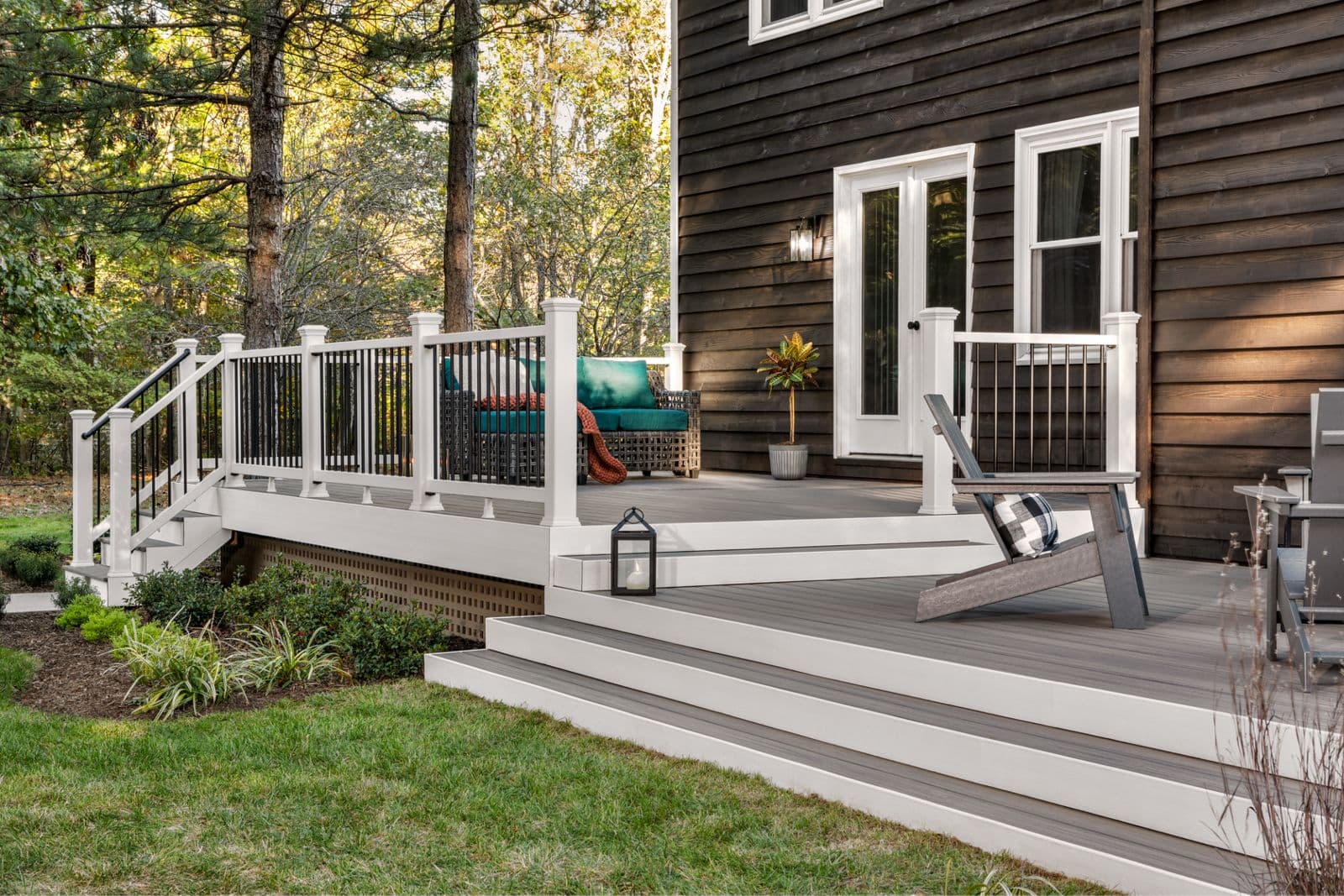
Confirming Your Trex Decking Product Line and Color
Before any order is placed, finalize the specific Trex decking line and color you intend to use. Trex offers several collections, including Enhance® Basics, Enhance® Naturals, Select® Earth Tones, Transcend® Earth Tones, and Transcend® Tropical. Each line has unique characteristics in terms of appearance, finish depth, and available colors.
For example, if you're aiming for a classic, low-maintenance look, Trex Enhance® Basics in Clam Shell or Saddle might be suitable. If you prefer a multi-tonal, wood-grain appearance, Enhance® Naturals offers options like Foggy Wharf or Toasted Sand. For a premium aesthetic with elevated performance, Transcend® Tropical offers vibrant colors such as Havana Gold or Island Mist. Digital swatches can provide a starting point, but always confirm your final selection with physical samples, if available, to accurately assess the color and texture in your project's specific lighting conditions.
Your contractor should be aware of your chosen line and color as different lines may have subtle variations in board profiles or recommended fastening systems, which can impact the installation plan and associated hardware.
Verifying Deck Dimensions and Board Quantities
Accurate project dimensions are fundamental to ordering the correct quantity of Trex decking. Provide your contractor with the detailed deck plans, including overall length, width, and any unique features like angled sections, stairs, or picture-frame borders. Your contractor will use these dimensions to perform a material takeoff.
Trex decking boards are typically available in 12, 16, and 20-foot lengths, and a standard board profile of 1 inch by 5.5 inches, available in both grooved and square-edge options. The choice between grooved and square-edge boards depends on the fastening method; grooved boards are designed for hidden clip fastening systems, while square-edge boards are used for face screws or for perimeter and stair applications.
Consider a hypothetical example: a rectangular deck measuring 10 feet by 16 feet. Assuming a standard layout parallel to the 10-foot dimension, you would need enough 16-foot boards to cover the 10-foot width. With 5.5-inch wide boards, approximately 22 boards (10 feet * 12 inches/foot / 5.5 inches/board = 21.8 boards) would be needed. This calculation is a starting point; your contractor will refine it to account for waste, cuts, and specific layout requirements, such as staggering seams or incorporating pattern elements. Always add a small percentage for waste or unforeseen cuts, typically 5-10%.
Planning Fascia, Risers, and Trim
Beyond the main decking surface, Trex offers matching fascia and riser boards to create a finished look for the deck perimeter and stairs. Fascia boards are used to conceal the deck's substructure, while risers are installed on staircases. These components are crucial for aesthetic continuity and protection.
Discuss with your contractor the specific requirements for fascia and risers. Will the deck have a single fascia board height, or will there be multiple layers for a more robust appearance? For a deck with stairs, ensure the number and dimensions of riser boards are included in the material list. These often come in complementary colors or the exact match to your chosen decking, so specify your preference.
For example, if your 10-foot by 16-foot deck requires fascia around three sides (two 16-foot sides and one 10-foot side), you would need 42 linear feet of fascia. If stairs are involved, count the number of risers and specify their dimensions. Coordinating these details upfront ensures a complete and cohesive order.
Selecting Fasteners and Hardware
The choice of fastening system significantly impacts both the appearance and installation of your Trex deck. Trex decking is compatible with hidden fastening systems, which create a smooth, fastener-free surface, or traditional face screws. Hidden clips are designed to fit into the grooved edges of boards, providing consistent spacing and a clean look.
If you opt for hidden fasteners, confirm with your contractor the specific type and quantity required. These systems typically include clips, screws, and installation tools. For square-edge boards, or for the first and last board of a deck using grooved boards, face screws are often necessary. Ensure these screws are specifically designed for composite decking to prevent splitting and ensure proper hold.
Your contractor will advise on the most suitable fastening system based on the deck design and local building practices. Be sure to include all necessary hardware, such as starter clips, breaker board clips, and any specialized tools, in the material order.
Considering Complementary Products and Accessories
A complete Trex decking project often involves more than just boards and fasteners. Think about railing systems, lighting, and other accessories that enhance the deck's functionality and aesthetic. Trex offers a range of railing options that complement their decking lines, allowing for a unified design.
If you plan to include a railing system, discuss the style (e.g., traditional balusters, glass panels, or cable railing) and color with your contractor. Consider adding integrated deck lighting, which can be incorporated into posts, risers, or under railings, to extend the usability of your deck into the evening. These components require specific ordering and installation considerations.
While not directly part of the Trex decking material order, elements like under-deck drainage systems, pergolas, or built-in benches should also be discussed with your contractor. These items may influence the substructure or require specific clearances, making early coordination beneficial.
Before you order
- Have you finalized your specific Trex decking line and color?
- Are the overall deck dimensions (length, width, height) accurately documented?
- Have all unique deck features (e.g., angles, curves, multi-level sections) been accounted for?
- Is the quantity of main decking boards calculated, including a waste factor?
- Are the required lengths (12, 16, 20 ft) specified for optimal cutting and minimal waste?
- Have you chosen between grooved and square-edge boards based on fastening method?
- Is the quantity and type of fascia boards (and risers, if applicable) determined?
- Have you selected the fastening system (hidden clips, face screws) and calculated quantities?
- Are any complementary Trex railing components, posts, or infill specified?
- Have you considered and specified any integrated lighting or other Trex accessories?
- Has your contractor reviewed and approved the complete material list before ordering?
- Are there any specific manufacturer installation guidelines or spacing requirements that need to be followed?
- Have you confirmed current availability of selected products with your supplier?
Confirm installation details, approved uses and warranty terms in the current instructions for the exact product and profile. Your installer should verify the substrate, structure and applicable project requirements.
Questions to help you decide
What is the difference between Trex grooved and square-edge boards?
Trex grooved boards feature a channel along the side designed to accept hidden fastening clips, resulting in a smooth, fastener-free deck surface. Square-edge boards have no such channel and are typically used for face-fastening with screws, or for perimeter boards and stair treads where a finished edge is desired or required for structural attachment. The choice depends on the desired aesthetic and fastening method.
How do I calculate the amount of Trex fascia I need?
To calculate fascia, measure the total linear feet of the deck's perimeter and any exposed stair stringers where fascia will be applied. Divide this total by the available lengths of Trex fascia boards (typically 12, 16, or 20 feet) and round up to the nearest whole board. Always add a small percentage (e.g., 5-10%) for cuts and potential waste.
Can I mix different Trex decking lines or colors on one deck?
Yes, you can mix different Trex decking lines or colors to create unique patterns or zones on your deck. For example, you might use a darker color for a picture-frame border and a lighter color for the main field. However, ensure that the board profiles and fastening requirements are compatible across the chosen lines. Always confirm with your contractor that your design vision is feasible with the chosen products and that all necessary components are ordered correctly.
Ready to Order Your Trex Decking?
Provide your project dimensions, desired Trex profile, and ZIP code to request a material quote. Our team can confirm current availability and service options to help you finalize your order with confidence. We can also assist in coordinating with your contractor for a seamless material planning process.
Request a material quote →