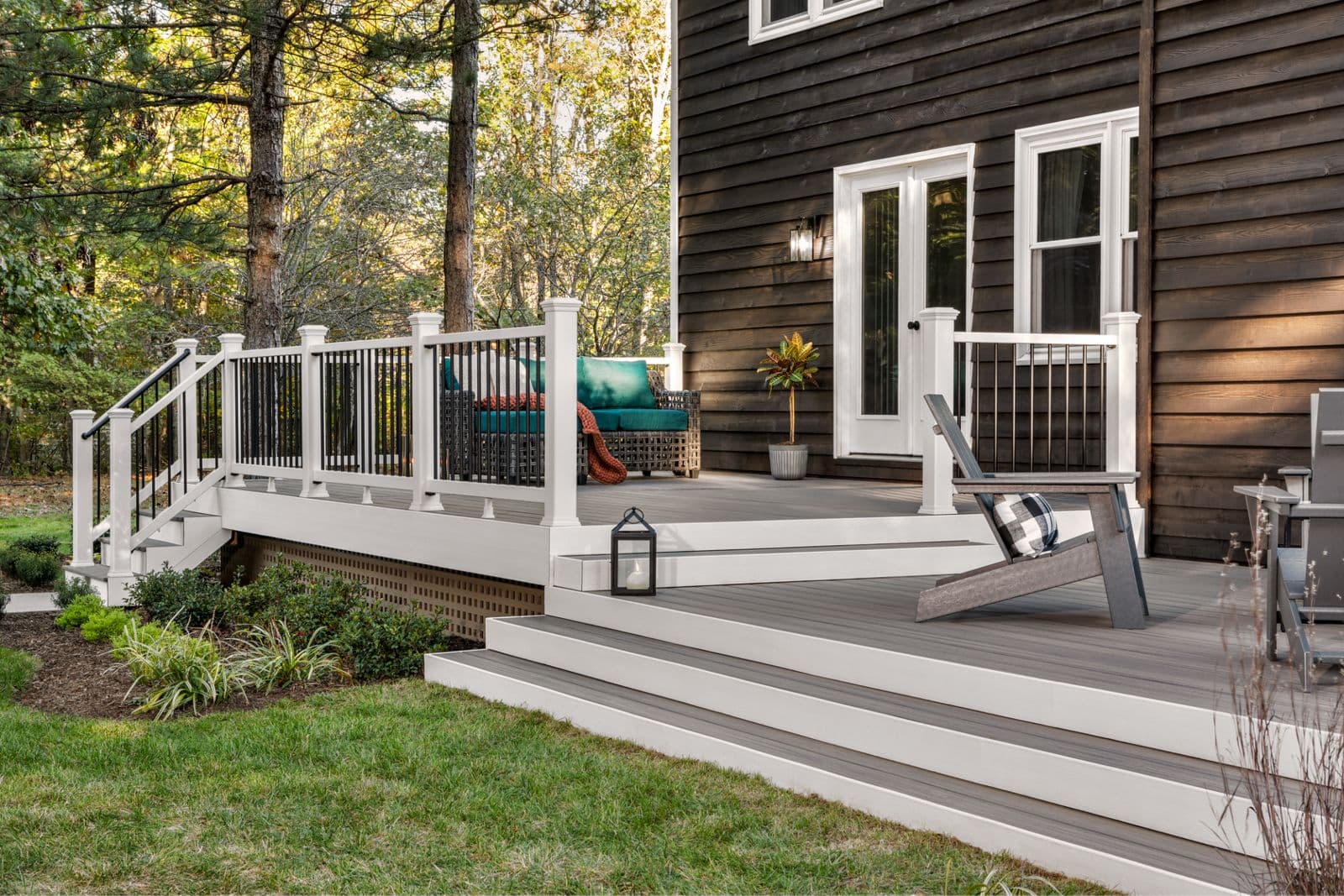
Choosing Your Trex Decking Collection
Trex offers several decking collections, each with distinct aesthetics and features. For a backyard gathering space, consider the visual impact and durability of each line. The Enhance Basics collection, with colors like Clam Shell, Beach Dune, and Saddle, provides a traditional look that is lightweight and easy to work with. Enhance Naturals offers an authentic wood-grain appearance in multi-tonal colors such as Foggy Wharf and Rocky Harbor, ideal for a more natural aesthetic.
For a mid-range option, Trex Select Earth Tones provides a high-performance shell technology in nature-inspired colors like Pebble Grey and Woodland Brown. If you are looking for an elevated aesthetic and the highest level of performance, the Transcend collection is available in Earth Tones (Gravel Path, Rope Swing) and Tropical colors (Havana Gold, Island Mist, Tiki Torch). These collections feature vibrant colors and a luxurious finish with three-side shell protection. Your choice will influence the overall look and feel of your gathering area, so consider how it complements your home and landscaping.
Each Trex line shares a core of 95% recycled material and a low-maintenance shell. The primary differences lie in the finish depth, color range, and warranty terms. All lines are designed for no oiling, staining, or sealing, requiring only a soap-and-water wash for maintenance. This characteristic makes Trex a practical choice for busy gathering spaces where continuous upkeep is not desired.
Planning Deck Dimensions and Layout
Accurate measurements are crucial for a successful Trex deck project. Start by defining the exact footprint of your gathering space. Consider how many people you typically entertain, what furniture you plan to include, and any specific activity zones like dining, lounging, or grilling. A common board profile for Trex decking is 1 inch by 5.5 inches, available in lengths of 12, 16, and 20 feet.
When planning your layout, determine the direction of your deck boards. Running boards parallel to the house can make a space feel longer, while a diagonal layout can add visual interest. Factor in the need for picture-frame borders or breaker boards if your deck exceeds the maximum board length or if you desire a distinct aesthetic. Remember that larger gatherings may benefit from open, unobstructed areas, while smaller, more intimate spaces might incorporate built-in seating or distinct zones defined by railing or planters. Ensure your dimensions allow for proper spacing around any permanent fixtures like exterior doors or garden beds.
Consider how the deck will integrate with existing landscaping or hardscaping. Will it be flush with a patio, or will there be steps? These decisions impact the overall accessibility and flow of your gathering space. For a hypothetical 16-foot by 12-foot deck, you might plan for 16-foot boards running parallel to the 12-foot side, requiring fewer cuts and minimizing waste. Always account for board spacing as specified in the manufacturer's guidelines, as this is critical for proper drainage and expansion/contraction.
Selecting Fascia and Edge Finishes
Fascia boards provide a finished look to the perimeter of your deck, concealing the substructure. Trex offers matching fascia for all its decking lines, ensuring a cohesive appearance. These typically come in a thinner profile designed to cover the rim joists. The choice of fascia color should either match your deck boards for a seamless look or provide a contrasting accent, depending on your design preference.
Edge finishing is another important consideration. Trex boards are available in both grooved and square-edge profiles. Grooved boards are designed for hidden fastening systems, which create a smooth, fastener-free deck surface. Square-edge boards are typically used for the perimeter, stair treads, or for face-fastening applications. For a gathering space, a smooth, splinter-free surface achieved with hidden fasteners is often preferred for comfort and safety.
Carefully coordinating your order to include the correct quantity of fascia boards and the appropriate edge profiles for your deck design will ensure a polished final result. An overlooked detail in fascia or edge selection can detract from an otherwise well-planned deck.
Fastening Systems for Trex Decking
The choice of fastening system significantly impacts both the appearance and structural integrity of your Trex deck. Trex composite decking can be installed using either hidden clips or face screws. Hidden fastening systems are popular for gathering spaces as they create a clean, uninterrupted deck surface, enhancing safety and aesthetics. These clips fit into the grooved edges of the deck boards and attach to the substructure, providing consistent spacing between boards.
Face-fastening involves screwing directly through the top surface of the deck boards into the joists. While still secure, this method leaves visible screw heads. If face-fastening is chosen for certain areas, such as perimeter boards or stair treads, ensure that screws are compatible with composite decking and installed according to manufacturer recommendations to prevent mushrooming or cracking. Always confirm the specific fastening requirements for the Trex collection you select, as proper installation is key to maintaining the warranty and performance of the deck.
It is important to use compatible hidden fastening systems or screws specifically designed for composite decking to avoid issues like improper spacing, board movement, or damage to the material. Following the manufacturer's guidance on fastener type, spacing, and installation technique is essential for a durable and aesthetically pleasing deck.
Maintenance for Your Trex Gathering Space
One of the primary advantages of Trex decking for a backyard gathering space is its low maintenance. Unlike traditional wood decks that require regular sanding, staining, or sealing, Trex composite decking is designed to be maintained with a simple soap-and-water wash. This minimal maintenance regimen helps to keep the warranty valid and the deck looking its best.
The protective shell of Trex boards is engineered to lock pigment in, meaning the color you install should remain consistent over time, resisting fade and stain. This feature is particularly beneficial for high-traffic gathering areas where spills and heavy use are common. While Trex is designed for durability, regular cleaning helps prevent the buildup of dirt, pollen, and other debris that can accumulate in outdoor environments.
For specific cleaning instructions or to address tougher stains, always refer to the official Trex cleaning guidelines. Avoid using harsh chemicals or abrasive cleaners that could damage the composite material. Proactive cleaning will ensure your deck remains a beautiful and inviting space for years of gatherings without demanding extensive upkeep.
Worked Example: A 200 sq ft Gathering Deck
Let's plan a hypothetical 200 square foot rectangular deck for a Boise backyard gathering space, measuring 20 feet by 10 feet. We'll choose Trex Transcend Tropical decking in Island Mist for its vibrant color and high performance. We aim for a clean look with hidden fasteners and a picture-frame border.
For the main deck surface, we will use 20-foot grooved boards running parallel to the 10-foot side. This means we will need 10 boards to cover the 10-foot width (10 feet / 5.5 inches board width ≈ 21.8 boards, but we need full 20-foot lengths across the 10-foot dimension, so 10 boards * 120 inches / 5.5 inches board width = 21.8 boards. For a cleaner calculation, 10 feet / (5.5 inches / 12 inches/foot) = 21.8 boards. So, 10 feet * 12 inches/foot / 5.5 inches/board = 21.8 boards. We will round this up to 22 boards to ensure full coverage and account for potential cuts. So, 22 boards of 20-foot length are needed for the main field.
For the picture-frame border, we will use square-edge boards. We need two 20-foot boards for the long sides and two 10-foot boards for the short sides. Since Trex boards come in 12, 16, and 20-foot lengths, we will order two 20-foot square-edge boards and two 12-foot square-edge boards (cutting two feet off each for the 10-foot sections).
For fastening, we will need hidden clips for the grooved boards. So, 22 boards * 16 clips/board = 352 clips. For the square-edge border boards, face screws will be used.
This example simplifies the calculation; actual projects require detailed substructure planning, waste factors, and specific manufacturer guidelines for board spacing and fastening. Always consult the latest installation guides and consider professional assistance for precise material takeoffs.
Before you order
- Select a Trex collection (Enhance, Select, or Transcend) that matches your aesthetic and performance needs.
- Determine the exact dimensions and shape of your gathering space, considering furniture and traffic flow.
- Decide on board direction (parallel, perpendicular, or diagonal) and plan for any picture-frame borders or breaker boards.
- Choose between grooved boards for hidden fasteners and square-edge boards for face-fastening or perimeter use.
- Select matching fascia boards to finish the deck perimeter.
- Plan for the appropriate fastening system (hidden clips or face screws) based on board profile and desired appearance.
- Confirm local building codes and substructure requirements for your specific project.
- Consider any steps, railings, or other accessories needed to complete your gathering space.
- Understand the simple soap-and-water cleaning regimen for ongoing maintenance.
Confirm installation details, approved uses and warranty terms in the current instructions for the exact product and profile. Your installer should verify the substrate, structure and applicable project requirements.
This is a planning guide for projects in Boise, ID. Ask our team to confirm availability, delivery to your ZIP code and which branch can support your order.
Questions to help you decide
What are the main differences between Trex decking collections?
Trex decking collections like Enhance, Select, and Transcend share a 95% recycled core and a low-maintenance shell. The main differences lie in their finish depth, color ranges, and aesthetic details. Enhance offers traditional and natural wood-grain looks. Select provides hallmark high-performance shell technology with nature-inspired colors. Transcend, the flagship line, offers elevated aesthetics and the highest level of performance with a wider range of vibrant Earth Tone and Tropical colors, all with three-side capping.
Can I use Trex decking for a ground-level patio in Boise?
Trex decking can be used for ground-level applications, provided there is adequate ventilation and proper substructure support. It's crucial to ensure sufficient airflow beneath the deck to prevent moisture buildup, which can affect the substructure. Consult Trex installation guidelines for specific requirements regarding ground clearance and ventilation for your chosen collection to ensure proper performance and warranty validity.
How do I calculate the amount of Trex decking I need?
To calculate the amount of Trex decking, measure the total square footage of your deck. Then, consider the board width (typically 5.5 inches) and available lengths (12, 16, 20 feet). Divide the total length of your deck by the effective coverage width of a board (including manufacturer-specified spacing) to determine the number of boards needed across the width. Multiply this by the length of your deck to get the total linear footage, then divide by the available board lengths. Always add a percentage for waste and account for any specific cuts, diagonal layouts, or picture-frame borders. It's recommended to consult a professional or use a decking calculator for precise material takeoffs.
Ready to Plan Your Trex Decking Project?
Request a material quote with your project dimensions, desired Trex profile, and ZIP code. We can help confirm current availability and service options for your Boise, ID backyard gathering space.
Request a material quote →