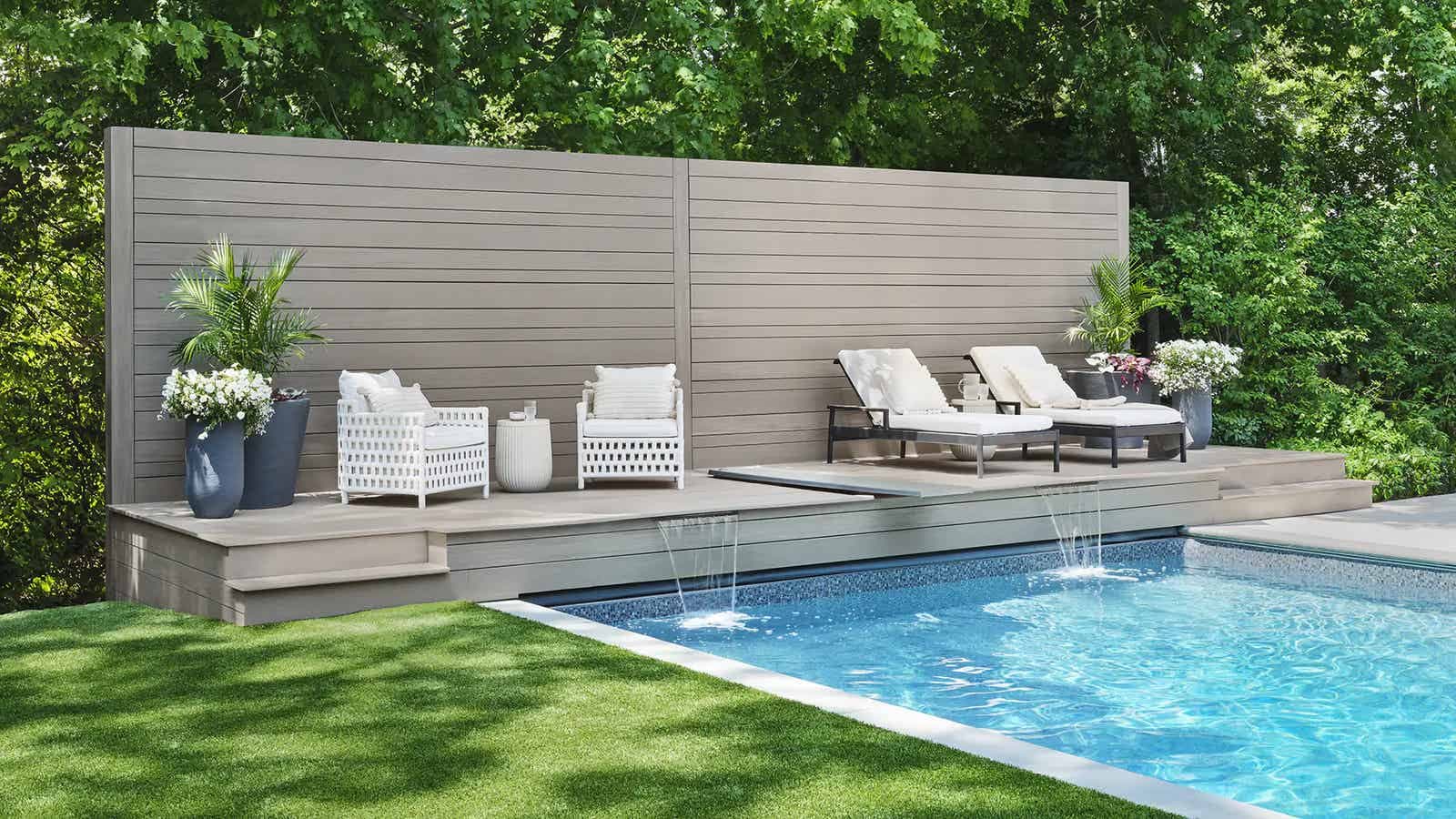
Why PVC Decking for Pool Terraces?
PVC decking is a 100% synthetic material, meaning it contains no wood fiber. This composition is crucial for pool terraces because it makes the boards waterproof to the core.
This inherent water resistance makes PVC decking a default specification where boards are consistently wet, such as around pools, on docks, or for covered porches that experience weather from multiple angles. Its synthetic nature also contributes to its low-maintenance profile, as it sheds grease and wine, wiping clean with soap and water.
Appearance and Design Options
Modern PVC decking offers a range of aesthetic choices, including collections with deep wood looks. This allows homeowners to achieve the visual appeal of natural wood without the associated maintenance concerns in a wet environment. Manufacturers like TimberTech Azek provide lines such as the Vintage, Landmark, and Harvest collections, which feature advanced capping for enhanced durability and appearance.
The availability of various colors and finishes, including heat-mitigating options, allows for customization to complement your home's exterior and landscaping. These design choices ensure that your pool terrace is not only functional but also a visually appealing extension of your outdoor living space.
Installation and Weight Considerations
PVC decking generally weighs less than both hardwood and composite decking. This lighter weight can translate to faster handling during installation and potentially easier work, particularly for elevated decks or rooftop applications. While the installation process still requires careful planning and adherence to manufacturer guidelines, the material's characteristics can simplify certain aspects of the project.
Proper substructure and ventilation remain critical for any decking project, including PVC. Always consult the specific manufacturer's installation instructions for details on joist spacing, fastening methods, and ventilation requirements to ensure the longevity and stability of your pool terrace.
Maintenance and Longevity
One of the primary advantages of PVC decking for a pool terrace is its low maintenance. The capped polymer surface is designed to resist stains and can typically be cleaned with just soap and water. This is a significant benefit around a pool where spills, sunscreen, and pool chemicals might otherwise be a concern.
Manufacturers often back eligible PVC boards with substantial warranties, sometimes for as long as you own the home, with specific coverage for fade and stain performance. This provides confidence in the material's ability to maintain its appearance and structural integrity over time, even with consistent exposure to pool environments.
Worked Example: Designing a 200 sq ft Pool Terrace
Consider a hypothetical rectangular pool terrace project in Boise, ID, measuring 20 feet by 10 feet, for a total area of 200 square feet. For this example, we will assume using 12-foot long PVC decking boards, 5.5 inches wide (approximately 0.458 feet).
To cover the 20-foot length, you would need approximately 20 feet / 0.458 feet per board = 43.67 boards across the width. Since boards are typically installed parallel to the shorter dimension for a cleaner look or perpendicular to the house for drainage, let's assume running boards along the 20-foot length. For a 10-foot width, you'd need 10 feet / 12 feet (board length) = 0.83 sections. This means each 12-foot board could cover the 10-foot width, with a 2-foot offcut. To cover the 20-foot length, you would need 20 feet / (5.5 inches / 12 inches/foot) = 20 / 0.458 = approximately 43.67 boards. Rounding up, you would need 44 boards. If each board is 12 feet long, the total linear footage is 44 boards * 12 feet/board = 528 linear feet. This equates to 528 linear feet * (5.5 inches / 12 inches/foot) = 242 square feet of material, accounting for cuts and potential waste. Always add a percentage for waste (e.g., 5-10%) based on your specific layout and cutting plan. This calculation provides an estimate for material quantity; final quantities should be confirmed with a detailed layout plan.
For a clean edge around the pool, consider using matching fascia boards or trim. These components are essential for finishing the look and protecting the substructure. The exact number of boards and trim pieces will depend on the chosen layout, any diagonal cuts, and the specific board dimensions of the product selected.
Before you order
- Confirm local building codes and permits required for deck construction in Boise, ID.
- Evaluate the specific exposure of your pool area to sun, shade, and splash zones.
- Select a PVC decking collection that offers the desired aesthetic and heat-mitigating properties.
- Plan for proper substructure, ventilation, and drainage around the pool.
- Identify compatible fastening systems (hidden or face-fastened) for your chosen PVC boards.
- Consider matching fascia and trim for a finished appearance around the pool edge.
- Review manufacturer-specific cleaning and maintenance guidelines for your selected PVC decking.
Confirm installation details, approved uses and warranty terms in the current instructions for the exact product and profile. Your installer should verify the substrate, structure and applicable project requirements.
This is a planning guide for projects in Boise, ID. Ask our team to confirm availability, delivery to your ZIP code and which branch can support your order.
Questions to help you decide
Is PVC decking slippery when wet?
However, any surface can become slippery when wet, especially with pool chemicals or algae present. Regular cleaning and good drainage can help mitigate this.
Can PVC decking get hot in the sun?
Like many outdoor materials, PVC decking can absorb heat from direct sunlight. However, many manufacturers offer 'heat-mitigating' color options designed to stay cooler underfoot. Darker colors typically absorb more heat than lighter ones. It's advisable to consider lighter shades for pool areas or choose products specifically engineered for reduced heat retention.
How do I clean my PVC pool terrace?
PVC decking is generally easy to clean. For routine maintenance, soap and water are often sufficient to remove dirt, grime, and most stains. For more stubborn marks, consult the manufacturer's specific cleaning recommendations, as certain chemicals can damage the surface. Always test cleaning solutions on an inconspicuous area first.
Ready to Plan Your PVC Pool Terrace?
For a material quote tailored to your project dimensions, exact profile preferences, and ZIP code, contact us. We can help you confirm current availability and service options for your Boise, ID pool decking project.
Request a material quote →