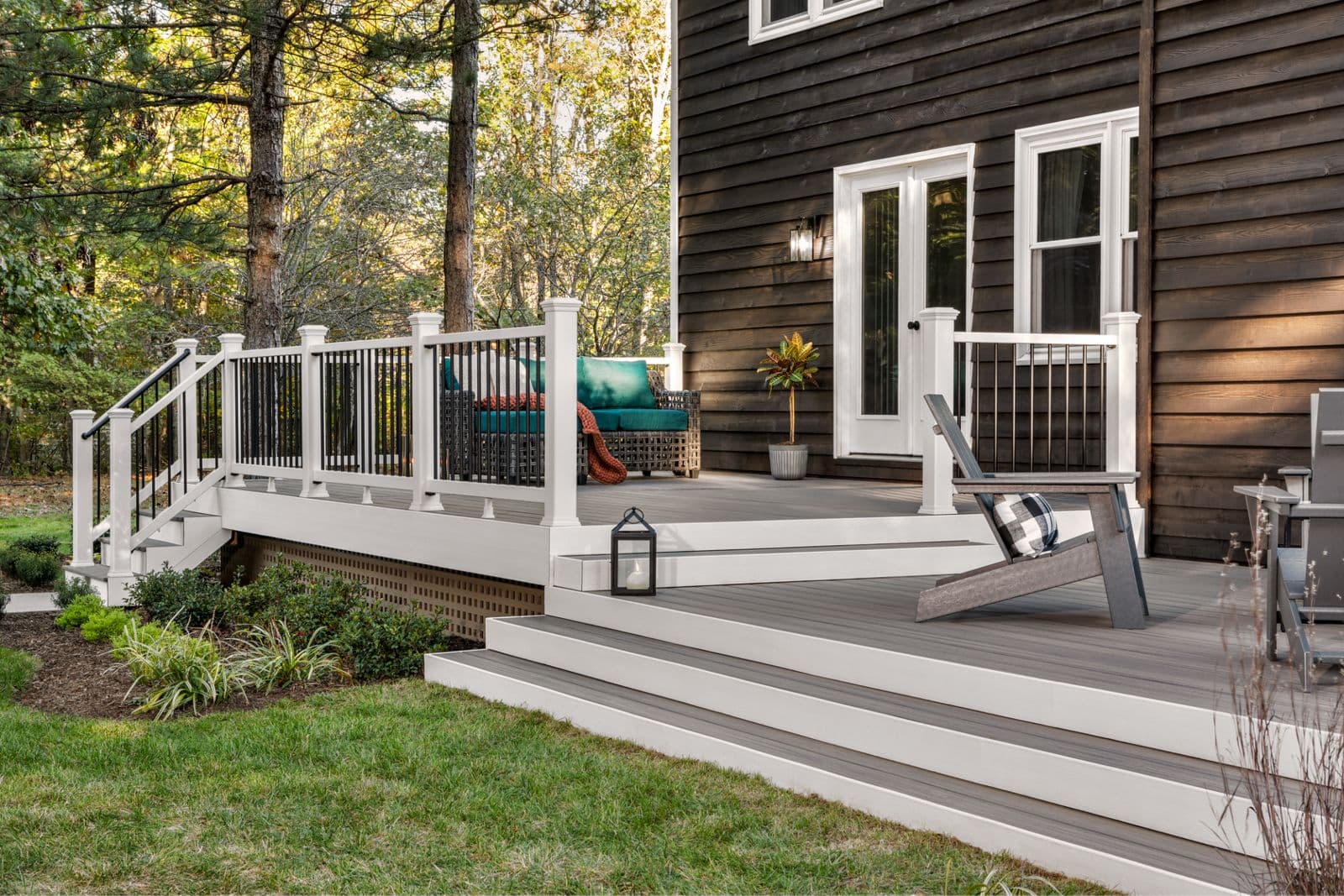
Choosing the Right Trex Collection for Your Austin Backyard
Trex offers several collections, each with distinct aesthetics and performance characteristics. For a backyard gathering space, the choice often comes down to desired appearance, texture, and budget. The Enhance, Select, and Transcend lines provide options ranging from traditional wood-grain looks to multi-tonal, exotic finishes. All lines share a core of 95% recycled material and a protective shell.
The Trex Enhance® Basics collection, with colors like Clam Shell, Beach Dune, and Saddle, offers a straightforward, lightweight option. Enhance® Naturals provides an authentic wood-grain appearance in multi-tonal colors such as Foggy Wharf and Rocky Harbor. For a mid-range option, Trex Select® Earth Tones features hallmark high-performance shell technology in colors like Pebble Grey and Winchester Grey. The flagship Transcend® line, available in Earth Tones (Gravel Path, Rope Swing) and Tropical (Havana Gold, Island Mist) collections, offers elevated aesthetics and enhanced durability. Consider how each collection's color and texture will complement your home and existing landscaping in Austin's bright climate.
Physical samples are recommended to assess colors and textures accurately, as digital swatches can vary. Confirming the availability of specific colors and profiles at your branch is also a practical step before finalizing your selection.
Planning Deck Dimensions and Layout
Careful planning of your deck's dimensions and layout is crucial for a functional and inviting gathering space. Consider the primary activities that will take place on the deck: dining, lounging, or a combination. A common mistake is underestimating the space needed for furniture and circulation. For example, a dining area typically requires at least 8x8 feet to accommodate a table and chairs comfortably, allowing for pull-out space.
Trex decking is available in 12, 16, and 20-foot lengths, and in both grooved and square-edge profiles. Planning your layout to minimize waste from cuts is economical. For larger decks, consider incorporating picture-frame borders or diagonal layouts to add visual interest and define different zones within the gathering space. Always account for proper board spacing as specified by the manufacturer to allow for expansion and contraction, especially in Austin's variable temperatures.
Coordinating Fascia and Edge Finishes
The fascia and edge finishes play a significant role in the overall aesthetic of your Trex deck, providing a polished and complete look. Fascia boards are typically used to cover the rim joists of the deck frame, concealing the substructure and creating a clean perimeter. Trex offers matching fascia boards for its decking collections, allowing for a seamless transition.
When planning, decide whether you prefer a contrasting or matching fascia. A contrasting color can create a visual border, while a matching color integrates the fascia subtly. For stairs, ensure the chosen fascia material and color are consistent with the main deck to maintain design harmony. Consider how the edge profile of your deck boards will interact with the fascia, especially for any exposed edges.
Fastening Systems for Security and Appearance
The choice of fastening system impacts both the structural integrity and the visual appeal of your Trex deck. Trex decking supports both hidden clip fasteners and face screws. Hidden fastening systems, used with grooved-edge boards, create a smooth, fastener-free surface, which is often preferred for gathering spaces where bare feet are common. These systems install clips into the board grooves, securing them to the joists from below.
Face screws, used with square-edge boards or for perimeter boards with grooved edges, involve driving screws through the top surface of the board. While visible, face screws offer a strong connection. If using face screws, ensure they are color-matched to the decking to minimize their visual impact. Always follow manufacturer guidelines for fastener type, spacing, and installation to ensure proper board performance and warranty validity.
Maintaining Your Trex Deck in Austin's Climate
One of the key advantages of Trex composite decking is its low maintenance requirements. Unlike traditional wood decks that may need regular staining, sealing, or oiling, Trex decks are designed for a simpler upkeep routine. This is particularly beneficial in Austin, where outdoor living is year-round and maintenance time can be better spent enjoying the space.
The manufacturer specifies a soap-and-water wash for routine cleaning. This helps remove dirt, pollen, and other environmental debris that can accumulate. Regular cleaning helps maintain the deck's appearance and keeps the warranty valid. Avoid harsh chemicals or pressure washers that can damage the deck surface. For Austin's climate, consider how direct sun exposure might affect the deck's surface temperature and plan for shade structures or lighter colors if heat retention is a concern.
Worked Example: Designing a 16x12 Foot Trex Deck for Gathering
Let's consider a hypothetical Austin backyard project: a 16-foot by 12-foot rectangular deck for a family gathering space. The homeowner desires a modern look with minimal visible fasteners.
1. **Decking Selection:** The homeowner chooses Trex Transcend® Tropical in "Island Mist" for its multi-tonal gray appearance, which complements their home's exterior and offers enhanced durability. They select grooved-edge boards for a hidden fastening system.
2. **Board Quantity Calculation:** The deck is 16 feet wide by 12 feet deep. Assuming boards run the 16-foot length, this means 12 feet / 5.5 inches (board width) = approximately 26.18 boards. Since boards are typically 16 feet long, 27 boards of 16-foot length would be a starting point. For the 12-foot depth, if boards run 12 feet, it would be 16 feet / 5.5 inches (board width) = approximately 34.9 boards. This would require 35 boards of 12-foot length. To minimize cuts and waste, running the 16-foot boards parallel to the 16-foot dimension would be ideal. This means 12 feet / 5.5 inches = 26.18 boards across the 12-foot width. Therefore, 27 full 16-foot grooved boards are needed. It's always advisable to add 5-10% for cuts and potential errors. Let's budget for 29 x 16-foot boards.
3. **Fascia:** For the perimeter, the homeowner requests matching "Island Mist" fascia. This requires two 16-foot fascia boards and two 12-foot fascia boards. Since fascia also comes in standard lengths, two 16-foot and two 12-foot fascia boards would be ordered, or three 16-foot boards with one cut to 12 feet, and the remaining piece used as needed.
Fastener kits usually come in specific quantities, so a bulk pack would be purchased.
5. **Substructure:** The existing deck frame is inspected and found to be in good condition, suitable for supporting the new composite decking. Adequate ventilation is confirmed to prevent moisture buildup beneath the deck, a common concern in humid climates.
This example illustrates the practical steps involved in material selection and quantity estimation for a Trex deck. Always consult specific installation guides for exact measurements and recommendations.
Before you order
- Determine the primary function of your gathering space (dining, lounging, mixed-use).
- Measure the exact dimensions of your proposed deck area.
- Select a Trex collection (Enhance, Select, Transcend) that aligns with your aesthetic and performance needs.
- Choose a color and finish that complements your home and environment (obtain physical samples).
- Decide on grooved-edge boards for hidden fasteners or square-edge for face fastening.
- Plan your board layout to optimize material use and minimize waste.
- Select matching or contrasting fascia for a finished perimeter.
- Consider any stairs or railings and coordinate their materials.
- Review manufacturer's installation guidelines for proper board spacing and substructure requirements.
- Plan for ongoing cleaning and maintenance with soap and water.
Confirm installation details, approved uses and warranty terms in the current instructions for the exact product and profile. Your installer should verify the substrate, structure and applicable project requirements.
This is a planning guide for projects in Austin, TX. Ask our team to confirm availability, delivery to your ZIP code and which branch can support your order.
Questions to help you decide
What is Trex decking made from?
Trex decking is made from 95% recycled materials, primarily reclaimed wood fibers and recycled plastic film. This composition gives it the look and feel of wood while offering enhanced durability and low maintenance.
How do I clean my Trex deck?
Trex decks are designed for low maintenance. Typically, a simple cleaning with soap and water is sufficient to remove dirt and debris. Avoid harsh chemicals or high-pressure washers, as these can potentially damage the surface. Always refer to the specific Trex cleaning guidelines for your product line.
Can Trex decking be installed over an existing wood frame?
In many cases, Trex decking can be installed over an existing wood frame, provided the frame is structurally sound, level, and meets all local building codes. It's crucial to inspect the existing frame for rot, damage, or inadequate spacing before installation. Proper ventilation under the deck is also important to ensure the longevity of both the frame and the composite decking.
Ready to Plan Your Trex Decking Project?
Request a material quote with your project dimensions, exact Trex profile, and ZIP code to confirm current availability and service options for your Austin backyard gathering space.
Request a material quote →