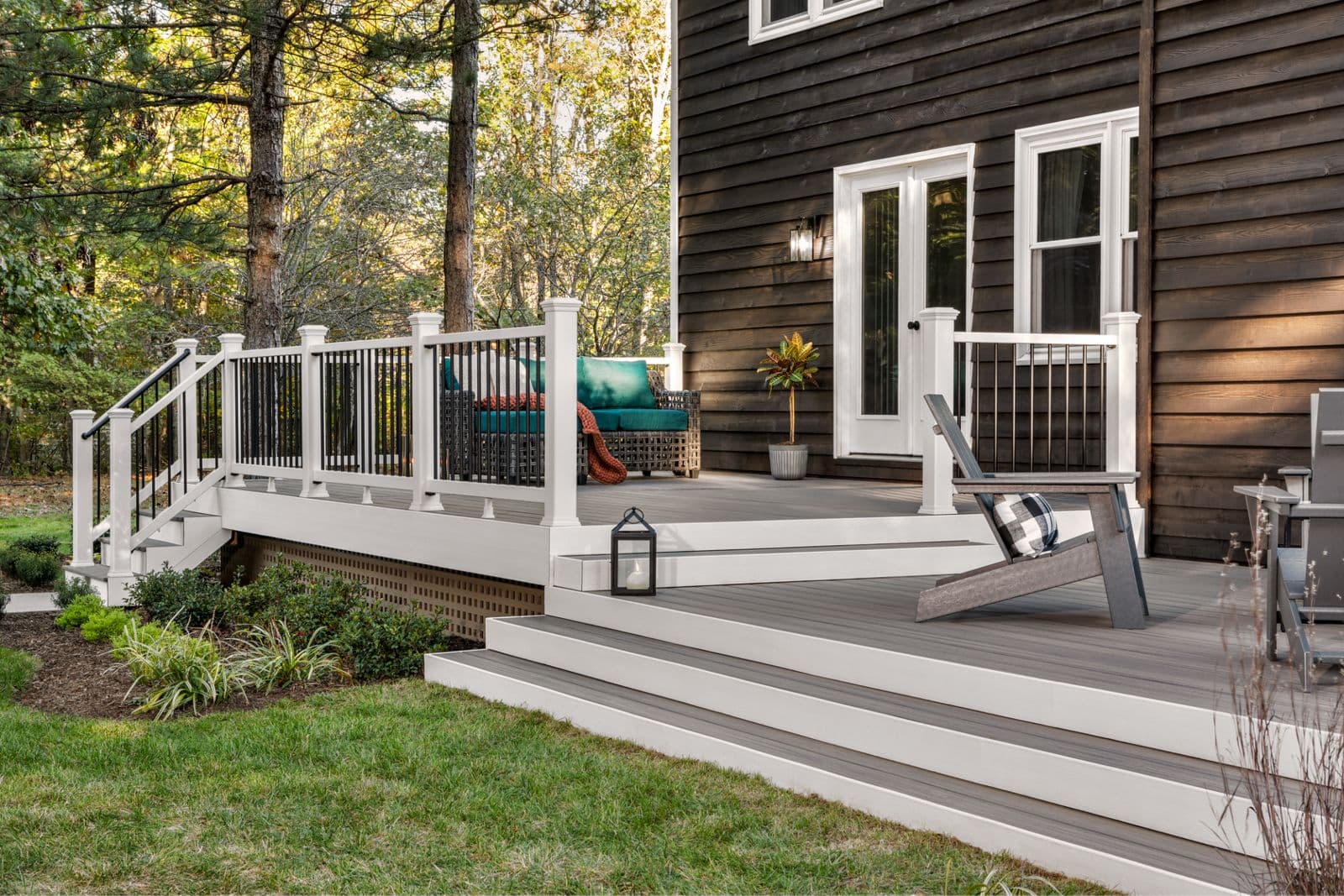
Selecting the Right Trex Collection for Your Albany Backyard
Trex offers several collections, each with distinct aesthetics and performance features. For an Albany backyard gathering space, consider how much foot traffic your deck will see and the desired visual impact. The Trex Transcend collection, with its Earth Tones and Tropical lines, provides a premium appearance and enhanced durability. These lines feature a deeper, more varied wood-grain pattern and a wide range of multi-tonal colors like "Island Mist" or "Vintage Lantern" to complement various home styles. The Transcend line is designed to maintain its color and finish over time, which can be a key factor in areas with noticeable seasonal transitions.
The Trex Select collection, specifically the Earth Tones, offers a balance of performance and value, featuring hallmark high-performance shell technology in nature-inspired colors such as "Pebble Grey" or "Woodland Brown." For projects where budget is a primary consideration, Trex Enhance, available in Basics and Naturals, provides a reliable entry-level composite option. Enhance Naturals, with colors like "Rocky Harbor" or "Toasted Sand," aims for an authentic wood-grain appearance. All Trex lines are capped on three sides and made from 95% recycled materials, providing a consistent core and low-maintenance shell across the board. The choice often comes down to the desired finish depth, color range, and aesthetic preference for your gathering space.
When making your selection, consider how the deck will integrate with existing landscaping, hardscaping, and your home's exterior. A sample of your chosen color viewed in different lighting conditions throughout the day can help confirm its suitability.
Planning Your Deck Dimensions and Layout
Effective planning of your deck's dimensions and layout is crucial for a functional gathering space. Begin by mapping out the activities you envision for the deck. Will it accommodate a dining area, a seating lounge, an outdoor kitchen, or a combination? Sketching these zones helps determine the overall footprint. Ensure adequate space for circulation around furniture and activity areas.
Trex boards are available in 12, 16, and 20-foot lengths. Planning your layout to minimize waste from cuts is practical for both cost and efficiency. Consider the orientation of the boards; running them perpendicular to the house can make a space feel wider, while running them parallel can make it feel longer. A diagonal layout can add visual interest but may result in more material waste. Incorporate any steps, railings, or built-in seating into your initial design. For a cohesive look, consider integrating a picture-frame border around the perimeter of your deck. This requires careful measurement and planning for the border boards and the main field boards to ensure proper alignment and fastening.
Coordinating Fascia and Edge Finishes
Fascia boards provide a finished look to the perimeter of your deck, concealing the substructure. Trex offers matching fascia boards for all its decking lines, ensuring a consistent aesthetic. These are typically thinner than deck boards and are designed to be face-fastened to the rim joists. When planning, account for the dimensions of the fascia to ensure a clean transition where the deck meets the ground or other elements.
For stairs, coordinating the fascia with stair risers creates a unified appearance. Consider how the edge of your deck will be perceived from different angles, especially from the yard or adjacent patios. A well-chosen fascia not only enhances the visual appeal but also protects the rim joists from weather exposure. Always confirm the availability of matching fascia in your chosen Trex color and collection during the material selection process.
Fastening Systems for a Clean Deck Surface
Trex decking can be installed using either hidden fastening clips or face screws. For a smooth, uninterrupted deck surface, hidden fasteners are often preferred for gathering spaces. These clips attach to the grooved edges of the deck boards and secure them to the substructure, leaving no visible screws on the deck surface. This not only enhances aesthetics but also provides a barefoot-safe surface, free from exposed fasteners. It is important to use the specific hidden fastening system recommended by Trex for compatibility and proper installation.
Face screws, which are driven through the top of the deck boards into the joists, are an alternative. While they provide a strong connection, the screw heads remain visible. If face-fastening is chosen, select screws that are color-matched to your Trex boards to minimize their visual impact. Regardless of the fastening method, proper spacing between boards is critical for drainage and to accommodate natural expansion and contraction of the composite material. Always refer to the specific installation instructions for the chosen Trex collection and fastening system to ensure correct gaps.
Maintaining Your Trex Deck in Albany's Climate
One of the primary advantages of Trex decking for an Albany backyard is its low maintenance requirements. Unlike traditional wood decks that require regular staining or sealing, Trex composite decking only needs a soap-and-water wash to maintain its appearance and validate its warranty. This makes it a practical choice for homeowners who prefer to spend less time on upkeep and more time enjoying their outdoor space.
For general cleaning, a soft brush and a solution of warm water and mild soap are typically sufficient. For more stubborn dirt or spills, follow Trex's specific cleaning recommendations. During winter months in Albany, avoid using metal shovels or sharp tools to clear snow and ice, as these can potentially damage the deck surface. Plastic shovels are generally suitable. Always ensure proper ventilation beneath your deck to prevent moisture buildup, which is important for the longevity of the substructure and the overall deck system.
Before you order
- Confirm the primary activities for your gathering space (dining, lounge, kitchen, etc.).
- Select a Trex collection (Enhance, Select, Transcend) that aligns with your aesthetic and durability needs.
- Choose a Trex color and obtain a physical sample to view in your backyard's lighting.
- Measure your project area accurately, accounting for all dimensions and potential zones.
- Determine board orientation (perpendicular, parallel, diagonal) and plan for seams and cut waste.
- Specify matching Trex fascia for the deck perimeter and any stair risers.
- Decide on a fastening system: hidden clips for a clean look or color-matched face screws.
- Verify the required spacing between boards for your chosen Trex product and fastening system.
- Plan for proper under-deck ventilation to manage moisture.
- Consider accessibility for cleaning and general maintenance.
Confirm installation details, approved uses and warranty terms in the current instructions for the exact product and profile. Your installer should verify the substrate, structure and applicable project requirements.
This is a planning guide for projects in Albany, NY. Ask our team to confirm availability, delivery to your ZIP code and which branch can support your order.
Questions to help you decide
What are the primary differences between Trex collections?
Trex collections primarily differ in their finish depth, color range, and aesthetic profiles. Enhance is the entry-level option, offering traditional colors. Select provides a mid-range balance of performance and nature-inspired colors. Transcend is the flagship line, offering elevated aesthetics, deeper wood-grain patterns, and a wider selection of multi-tonal tropical and earth tone colors. All share a 95% recycled core and a low-maintenance, three-sided protective shell.
Can I use Trex decking for a ground-level patio or only for elevated decks?
Trex decking can be used for both elevated decks and ground-level applications, provided the substructure is properly constructed and allows for adequate ventilation. For ground-level installations, ensuring proper drainage and airflow beneath the deck is critical to prevent moisture issues. Consult local building codes and Trex installation guidelines for specific requirements.
How do I calculate the amount of Trex decking I need for my project?
To calculate the amount of Trex decking needed, first determine the total square footage of your deck. Then, consider the length of the boards you plan to use (12, 16, or 20 feet) and the width of the boards (1" x 5.5"). Divide the total deck area by the area covered by a single board to get an approximate number of boards. Always add an extra 5-10% for cuts, waste, and future repairs. For example, a 10x10 foot deck (100 sq ft) using 5.5" wide boards would need about 218 linear feet of decking. If using 16-foot boards, that's roughly 14 boards. It is always recommended to draw a detailed layout to accurately account for cuts, picture framing, and any diagonal installations, as these can impact material requirements.
Ready to Plan Your Trex Decking Project?
Request a material quote with your project dimensions, exact Trex profile, and ZIP code to confirm current availability and service options for your Albany backyard gathering space.
Request a material quote →