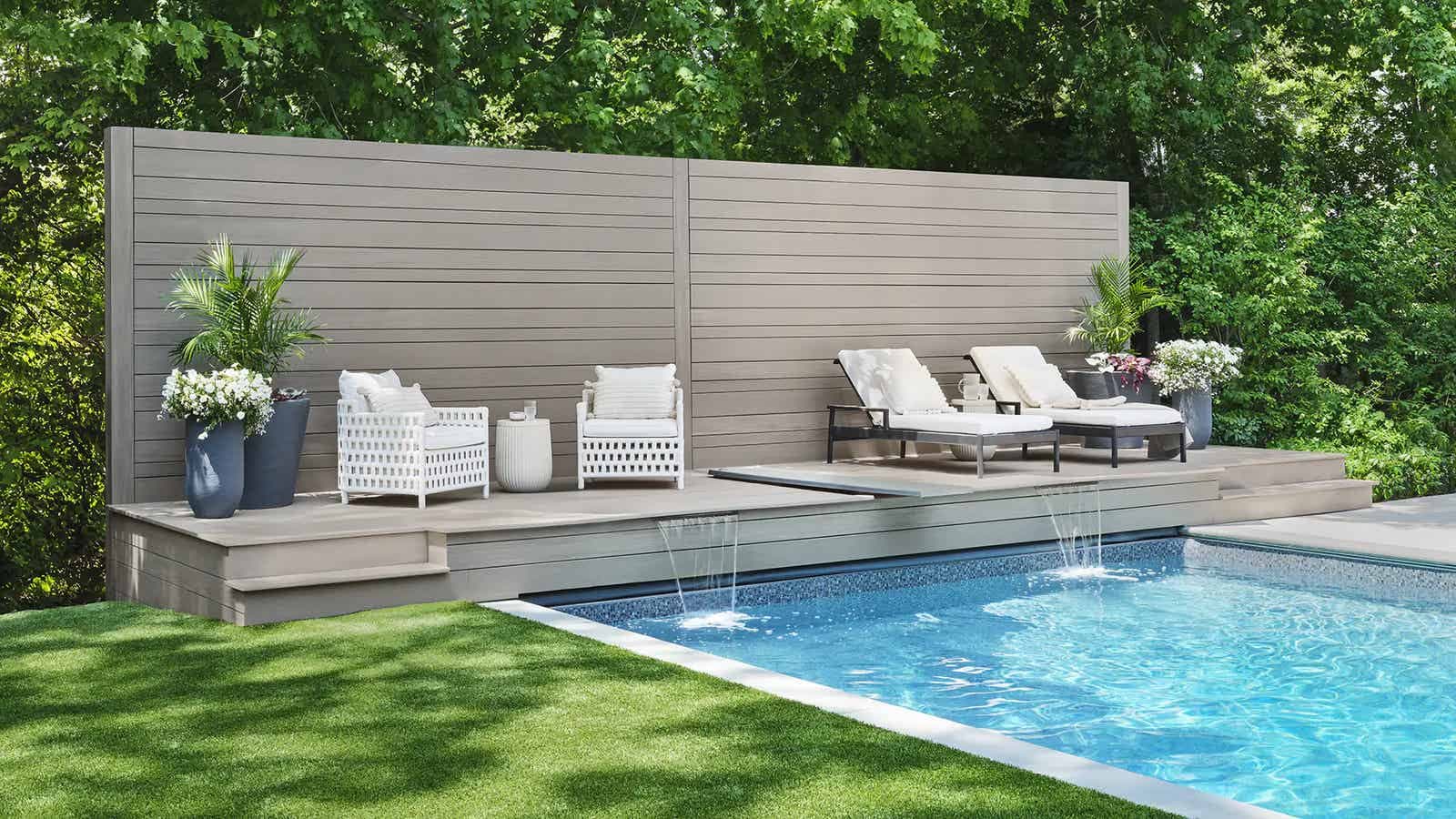
Why PVC Decking for Pool Terraces?
PVC (polyvinyl chloride) decking offers distinct advantages for pool surrounds. Its 100% synthetic composition means it contains no wood fibers. This is crucial for areas exposed to standing water, splash zones, or even salt spray, as there's nothing in the material to swell, stain, or rot when wet. This inherent waterproof quality sets it apart from other decking materials.
The advanced capping on PVC boards, such as those from TimberTech Azek, is designed to shed grease and wine, making cleanup with soap and water straightforward. This low-maintenance aspect is particularly appealing for a pool area where spills and splashes are common. Additionally, some PVC decking options offer heat-mitigating color choices, which can be a comfort feature for bare feet on sunny Albany afternoons.
PVC decking is also lighter than traditional hardwood and often lighter than composite decking. This can facilitate easier handling during installation, especially for larger pool terrace projects or those on elevated structures.
Key Design Considerations for a Pool Terrace
When planning your pool terrace in Albany, NY, consider the overall layout and how the decking integrates with the pool edge and surrounding landscaping. Think about board orientation – running boards parallel to the longest edge of the pool can create a sense of flow, while a diagonal pattern can add visual interest but may result in more material waste from cuts. Picture-frame borders can also define the space and provide a clean finish around the pool.
The color and finish of your PVC decking will significantly impact the look and feel of your pool area. Lighter colors can help reflect sunlight and may feel cooler underfoot. Deeper wood-look finishes, available in collections like Vintage, Landmark, and Harvest from TimberTech Azek, can provide a rich aesthetic while still offering the benefits of PVC. Consider how the decking color will complement your home's exterior and pool coping.
Ensure adequate drainage is planned for your deck. While PVC itself is waterproof, water should not be allowed to pool on the surface indefinitely. Proper grading and board spacing, as specified by the manufacturer, will help manage water runoff effectively.
Board Profiles and Fastening
PVC decking is available in various board widths and profiles. Standard widths are common, but wider boards can sometimes create a more expansive look. Most PVC decking systems are designed for hidden fastening systems, which result in a smooth, fastener-free surface that is ideal for bare feet around a pool. These systems typically use clips that secure the board to the substructure, maintaining consistent spacing.
For perimeter boards or stairs, face fastening might be necessary. Always use manufacturer-recommended fasteners that are compatible with PVC decking to prevent issues like staining or corrosion. Proper fastening ensures the stability and longevity of your pool terrace deck.
Substructure and Ventilation
Even though PVC decking is waterproof, the substructure beneath it is still critical. For a pool terrace, ensure the substructure is built to local building codes and can withstand moisture. Pressure-treated lumber or steel framing are common choices. Proper ventilation beneath the deck is essential to prevent moisture buildup, which can lead to issues with the substructure and potentially affect the decking over time, even with PVC.
Maintain appropriate ground clearance and consider installing vents in fascia boards if the deck is enclosed. This allows for air circulation, which helps keep the underside of the deck dry and prolongs the life of the entire assembly.
Worked Example: Designing a 12x20 Foot Pool Terrace
Let's consider a hypothetical pool terrace project for a rectangular pool, where the decking will create a 12-foot by 20-foot rectangular area adjacent to one side of the pool. For this example, we will use TimberTech Azek PVC decking boards, which typically come in lengths of 12, 16, or 20 feet and a standard width of 5.5 inches (0.458 feet).
If we run the 20-foot long boards parallel to the 20-foot length of the pool, we would need 12 feet / 0.458 feet per board = approximately 26.2 boards. Since we can't buy partial boards, we would need to purchase 27 boards, each 20 feet long. This covers the main field of the deck.
For a picture-frame border, we might use a contrasting color or the same color to frame the main deck area. If we plan a single 5.5-inch border around the 12x20-foot area, we would need two 20-foot boards for the long sides and two 12-foot boards for the short sides. However, the short-side border boards would need to be cut to fit between the long-side border boards, effectively reducing their length by two board widths (11 inches). This level of detail is important for accurate material takeoffs.
Total linear footage for main field: 27 boards * 20 feet/board = 540 linear feet. Border linear footage: (2 * 20 feet) + (2 * (12 feet - 11 inches)) = 40 feet + 2 * (11.08 feet) = 40 + 22.16 = 62.16 linear feet. This hypothetical example simplifies cuts and assumes no waste beyond the main field calculation for illustration purposes. Always account for waste in your final order, typically 5-10%.
Before you order
- Confirm local building codes for deck construction around pools in Albany, NY.
- Evaluate the sun exposure and potential for heat buildup; consider heat-mitigating color options.
- Determine the desired aesthetic (color, finish, board width) to complement your home and pool.
- Plan for adequate drainage and ventilation for the deck substructure.
- Decide on hidden fasteners versus face fasteners for the main deck surface.
- Consider accessibility for cleaning and maintenance around the pool.
- Measure your project dimensions accurately and account for cutting waste in material estimates.
- Verify manufacturer-specific installation requirements for board spacing and substructure.
Confirm installation details, approved uses and warranty terms in the current instructions for the exact product and profile. Your installer should verify the substrate, structure and applicable project requirements.
This is a planning guide for projects in Albany, NY. Ask our team to confirm availability, delivery to your ZIP code and which branch can support your order.
Questions to help you decide
Is PVC decking slippery when wet?
The texture of the board's surface can influence its slip resistance. Always exercise caution around wet pool areas, regardless of the decking material.
How do I clean PVC decking around a pool?
PVC decking is generally easy to clean. For routine maintenance around a pool, soap and water are often sufficient to remove dirt, pool chemicals, and light stains. For more stubborn marks, consult the manufacturer's specific cleaning guidelines for approved products to avoid damaging the surface.
Can PVC decking be installed directly over a concrete patio?
Installing PVC decking directly over a concrete patio is possible, but it requires careful planning to ensure proper drainage and ventilation. A sleeper system or a pedestal system is typically used to elevate the decking boards, creating an air gap and allowing water to drain away. Direct contact with concrete without proper airflow can lead to moisture issues.
Ready to Plan Your Pool Terrace Deck?
For your Albany, NY, pool terrace project, request a material quote with your project dimensions, exact profile preferences, and ZIP code. We can confirm current availability and service options for PVC decking. Visit our product page to explore the full range of PVC decking options.
Request a material quote →