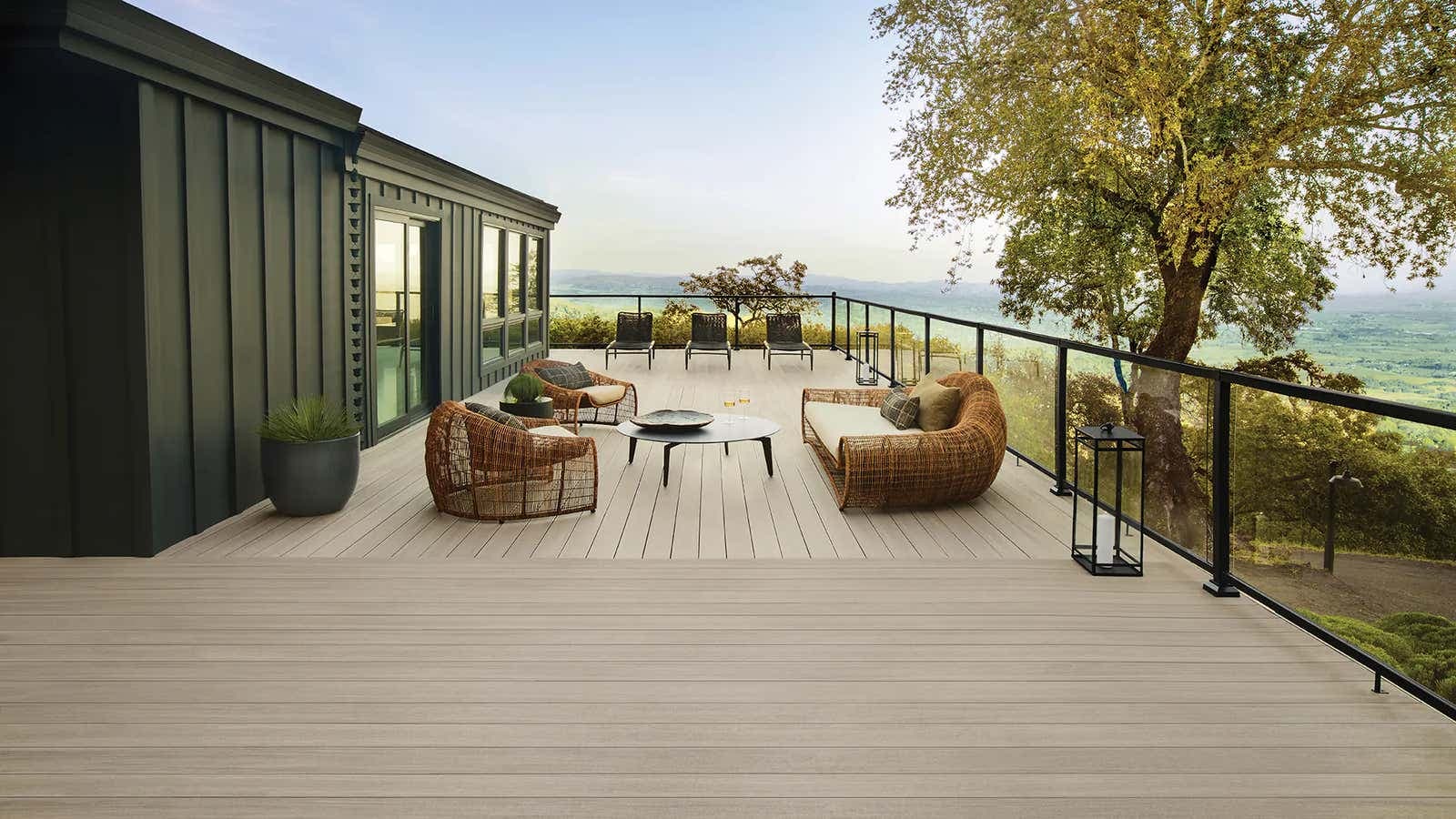
Understanding TimberTech Decking Lines for Stair Applications
TimberTech offers three main product lines: Azek (full PVC), Pro (capped composite), and Edge (capped composite). Each line has distinct characteristics that influence its suitability for stair components.
TimberTech Azek is a full polymer (PVC) material, meaning it contains zero wood fiber. This makes it impervious to moisture, a key advantage for ground-contact applications or areas prone to constant wetting, such as stairs exposed to rain or near a pool. Azek boards are also noted for staying cooler underfoot compared to standard composites. This line includes Vintage and Harvest collections.
TimberTech Pro is a four-sided capped composite decking with multi-tonal grain patterns and Mold Guard protection. It offers a balance of durability and wood-look aesthetics, suitable for high-traffic areas like deck stairs. This line includes Legacy and Terrain collections.
TimberTech Edge provides three-sided capped boards, offering a durable shell at a more accessible price point. While still a robust option, its aesthetic range is more straightforward. This line includes Prime and Premier collections. All three lines generally use the same fastening systems and fascia programs, which simplifies coordination across your deck and stair components.
The standard board profile across TimberTech lines is 1" x 5.5", available in both grooved and square-edge options. For stair treads, square-edge boards are typically preferred for a cleaner finish and easier fastening, while grooved boards are commonly used for the main deck surface with hidden fasteners.
Selecting Materials for Treads and Risers
The primary consideration for stair treads is durability and appearance. Since treads bear foot traffic, they need to be robust and provide a consistent surface. Risers, while not weight-bearing in the same way, contribute significantly to the stair's aesthetic.
For treads, square-edge TimberTech boards are generally used. The choice between Azek, Pro, or Edge will depend on the overall deck material, budget, and desired performance characteristics. For instance, if your main deck is Azek, continuing with Azek for treads ensures a perfect color and material match, as well as the benefit of moisture resistance and cooler surface.
Risers can be constructed using standard decking boards or with TimberTech fascia boards. Fascia boards, typically thinner and wider than standard decking, can offer a cost-effective solution for risers while maintaining a cohesive look. However, ensure the fascia material is compatible with the structural requirements for risers and local codes. Using the same decking boards for risers as for the treads creates a consistent appearance.
Structural Support and Joist Spacing for Stairs
Deck stairs require robust structural support underneath the decking material. This typically involves stringers, which are the angled structural members that support the treads and risers. The stringers must be spaced appropriately to adequately support the TimberTech decking boards.
For stair treads, this spacing is often reduced, or additional blocking is used, to prevent deflection and ensure rigidity underfoot. Always consult the specific TimberTech installation guide for stair applications and local building codes, as stair framing requirements can be more stringent than for the main deck.
The type of wood used for stringers and framing (e.g., pressure-treated lumber) should be considered for longevity and compatibility with the composite or PVC decking. Proper fastening of the TimberTech boards to the stringers is also critical for safety and durability.
Fastening Systems for TimberTech Deck Stairs
TimberTech offers different fastening options, including hidden clips and face-fastening with Cortex plugs. For stair treads, face-fastening is often the preferred method, as it provides a secure connection directly into the stringers and eliminates any potential movement that hidden clips might allow on the edge of a tread.
When face-fastening, using color-matched Cortex plugs can help conceal screw heads, maintaining a clean aesthetic similar to a hidden fastener system. This system involves pre-drilling, screwing in a specialized fastener, and then inserting a plug made from the actual decking material. Always follow TimberTech's specific instructions for fastener type, spacing, and installation to ensure warranty compliance and structural integrity.
For risers, face-fastening or using appropriate trim screws may be suitable, depending on whether standard decking or fascia boards are used. Ensure all fasteners are approved for outdoor use and compatible with the decking material to avoid staining or corrosion.
Worked Example: Designing a 3-Step Staircase
Let's consider a hypothetical staircase with a total rise of 21 inches, requiring 3 steps. We'll assume a standard riser height of 7 inches and a tread depth of 11 inches. For this example, we will use TimberTech Azek Vintage Collection boards (1" x 5.5" square edge profile) for both treads and risers to ensure a consistent, high-performance finish.
Each tread will be constructed from two 5.5-inch wide boards, laid side-by-side, creating an 11-inch deep tread. This requires precise cutting and fastening. Assuming a stair width of 48 inches, each tread will need two 48-inch long pieces of decking. For three treads, this totals six 48-inch pieces.
For the risers, we'll use a single 7-inch tall piece of the same TimberTech Azek board, cut to 48 inches in length. This means three 48-inch pieces for the risers. Since standard TimberTech boards are 5.5 inches wide, a 7-inch riser will require ripping down a 12-foot board to yield the 7-inch width, with careful planning to minimize waste.
The structural framing will consist of three pressure-treated stringers, spaced approximately 16 inches on center, cut to support the 7-inch rise and 11-inch run. The Azek decking boards will be face-fastened to the stringers using color-matched Cortex screws and plugs. This provides a secure and aesthetically pleasing finish.
Total material estimate for a 48-inch wide, 3-step stair using 1" x 5.5" x 12' TimberTech Azek boards:
Treads (6 pieces @ 48" each): This requires three 12-foot boards (each 12-foot board yields three 48-inch pieces).
Risers (3 pieces @ 48" each, cut to 7" width): This requires two 12-foot boards (each 12-foot board yields two 7-inch x 48-inch pieces, with some waste from ripping).
This is a simplified estimate; actual quantities may vary based on exact cuts, waste, and specific board lengths available (12, 16, 20 ft). Always round up to ensure sufficient material.
Local Code Compliance and Professional Review
Stair construction is subject to strict local building codes regarding rise, run, handrail requirements, and structural integrity. Before commencing any stair project, it is essential to consult your local building department and ensure your design and material choices comply with all regulations.
A professional contractor or deck builder experienced with TimberTech products can provide invaluable guidance on code compliance, structural design, and installation best practices. They can help verify stringer spacing, fastening methods, and overall stair geometry to ensure safety and longevity.
Always review the specific TimberTech installation guides for stair details, as manufacturer recommendations are designed to ensure product performance and warranty validity. These guides often provide detailed diagrams and instructions for various stair configurations.
Before you order
- Identify the specific TimberTech line (Azek, Pro, Edge) that matches your main deck.
- Decide between using standard decking boards or fascia for risers, considering aesthetics and code.
- Confirm local building codes for stair rise, run, width, and handrail requirements.
- Verify stringer spacing requirements for TimberTech stair treads, often more stringent than for main deck surfaces.
- Choose the appropriate fastening system (e.g., face-fastening with Cortex plugs) for treads and risers.
- Plan board cuts to minimize waste, especially for multi-board treads or ripped risers.
- Consult a professional contractor or local building department for structural review and code compliance.
Confirm installation details, approved uses and warranty terms in the current instructions for the exact product and profile. Your installer should verify the substrate, structure and applicable project requirements.
Questions to help you decide
Can I use grooved TimberTech boards for stair treads?
While grooved boards are designed for hidden fasteners on the main deck, square-edge boards are generally recommended for stair treads. This allows for face-fastening, which provides a more secure attachment to the stringers and a cleaner finished edge. If using grooved boards, the grooved edge would typically be visible or require special treatment to conceal the groove, which isn't ideal for a tread's leading edge.
What is the recommended joist spacing for TimberTech stair treads?
Always refer to the specific TimberTech installation guide for stair applications and consult local building codes, as stair framing is critical and often has more stringent requirements.
Are TimberTech fascia boards suitable for stair risers?
Yes, TimberTech fascia boards can be used for stair risers to create a cohesive look with the deck's perimeter. They are typically thinner than standard decking boards, so ensure their use as risers meets local building codes for structural integrity and attachment. Using the same decking board as the main deck or treads for risers is also a common and often preferred option for consistency.
Plan Your TimberTech Deck Stair Project
Ready to select TimberTech materials for your deck stairs? Request a material quote with your project dimensions, desired TimberTech profile, and ZIP code. We can help confirm current availability and service options for your area.
Request a material quote →