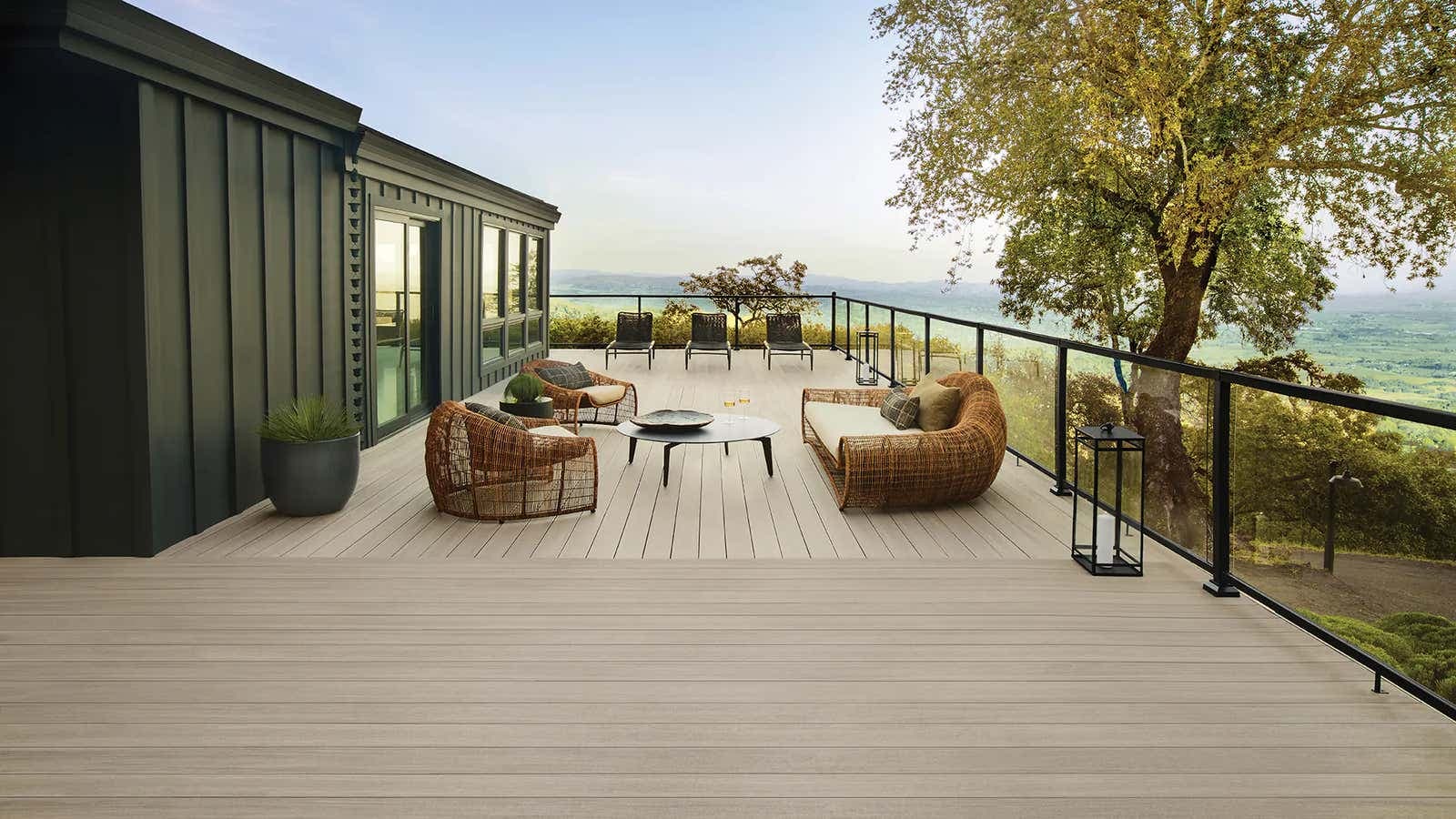
Understanding TimberTech's Two Technologies: Composite vs. PVC
TimberTech offers two distinct decking technologies: capped composite and advanced PVC. Each technology is engineered for different performance characteristics and applications, making it crucial to select the correct type for your project's specific demands.
Capped composite decking, found in the TimberTech Pro and Edge lines, consists of wood fibers and recycled plastics, encapsulated in a protective polymer shell. These boards are designed to offer a wood-like appearance with enhanced durability and resistance to stains and fading. They are a common choice for general backyard decks.
TimberTech Azek represents their advanced PVC line, which contains zero wood fiber. This full polymer composition makes Azek boards impervious to moisture, a critical advantage for applications like pool surrounds, docks, or ground-contact installations where water exposure is constant. Azek boards also tend to stay cooler underfoot compared to standard composites, a significant factor in sunny climates.
Board Dimensions and Profiles: Grooved vs. Square Edge
TimberTech decking boards are consistently manufactured with a nominal profile of 1 inch by 5.5 inches. However, within this standard dimension, you will find two primary edge profiles: grooved and square.
Grooved-edge boards are designed for use with hidden fastening systems, where clips fit into the grooves along the board's sides, creating a clean, fastener-free surface. This profile is typically used for the main deck surface where aesthetics are a priority.
Square-edge boards have straight, ungrooved sides, making them suitable for face-fastening. These boards are commonly used for the perimeter of a deck, stair treads, or as fascia boards where the fasteners are visible or where hidden fasteners are not practical. Some projects may require a combination of both profiles to achieve the desired look and structural integrity.
Available Lengths and Project Planning
TimberTech decking boards are available in several standard lengths: 12 feet, 16 feet, and 20 feet. Selecting the appropriate board lengths is a key part of project planning, aiming to minimize waste and reduce the number of seams on your deck surface.
For a typical deck, planning your layout to utilize full board lengths where possible can simplify installation and improve the finished appearance. For example, a 16-foot-long deck section might be best served by 16-foot boards rather than cutting down 20-foot boards or joining multiple shorter ones.
Always verify the specific joist spacing requirements for your chosen TimberTech line and local building codes.
Fastening Systems: Hidden Clips and Cortex Plugs
The choice of fastening system is directly tied to the board profile you select. TimberTech offers compatible fastening solutions for both grooved and square-edge boards.
Hidden clip systems are designed for grooved-edge boards, providing a smooth, fastener-free deck surface. These clips typically attach to the joists and engage the grooves of adjacent boards, securing them in place while allowing for proper spacing and drainage. This method is often preferred for its aesthetic appeal.
For square-edge boards or areas requiring face-fastening (such as stairs or perimeter boards), TimberTech offers Cortex plugs. These plugs are designed to conceal screws, providing a color-matched finish that blends with the decking. This system involves drilling, driving screws, and then inserting the plugs for a clean appearance.
Worked Example: Selecting Boards for a 12'x14' Deck
Let's consider a hypothetical deck project that measures 12 feet by 14 feet. The homeowner desires a clean, fastener-free surface for the main deck and plans to use square-edge boards for a perimeter picture frame border and stair treads.
For the main deck surface (12' x 14'), if boards are laid parallel to the 12-foot dimension, you would need boards that are at least 12 feet long. Using 12-foot grooved-edge boards minimizes cuts and seams. To cover the 14-foot width with 5.5-inch wide boards, you would need approximately 31 boards (14 feet * 12 inches/foot / 5.5 inches/board = ~30.5 boards). Allowing for slight variations and cuts, ordering 32 boards of 12-foot length would be a reasonable starting point.
For the 14-foot perimeter on the two long sides, and the 12-foot perimeter on the two short sides, square-edge boards would be used. You would need two 14-foot boards and two 12-foot boards. If stair treads are also planned, additional square-edge boards would be required, based on the width and number of stairs. This example illustrates how specific project dimensions influence the choice of board length and profile to optimize material use.
Before you order
- Confirm the primary use of the deck (e.g., general living, pool surround, ground contact).
- Determine if a hidden fastening system or face-fastening is preferred for the main surface.
- Measure the precise dimensions of your deck project to plan board lengths.
- Verify joist spacing requirements for your chosen TimberTech line and deck orientation (perpendicular vs. diagonal).
- Identify any special areas requiring square-edge boards (e.g., stairs, fascia, perimeter).
- Consider the local climate, especially sun exposure and moisture, when choosing between composite and PVC.
- Review the specific warranty terms for your selected TimberTech product line.
Confirm installation details, approved uses and warranty terms in the current instructions for the exact product and profile. Your installer should verify the substrate, structure and applicable project requirements.
Questions to help you decide
What is the main difference between TimberTech Azek and TimberTech Pro/Edge?
TimberTech Azek is a full PVC (polyvinyl chloride) decking product, meaning it contains zero wood fiber. This makes it impervious to moisture and often cooler underfoot. TimberTech Pro and Edge are capped composite decking, made from a blend of wood fibers and recycled plastics, encapsulated in a protective polymer cap. Azek is generally recommended for high-moisture environments like pool decks, while Pro and Edge are excellent for general outdoor living spaces.
Can I mix grooved-edge and square-edge boards on my deck?
Yes, it is common to mix grooved-edge and square-edge boards. Grooved-edge boards are typically used for the main deck surface with hidden fasteners for a clean look. Square-edge boards are often used for perimeter boards, stair treads, or fascia, where face-fastening is necessary or desired. Ensure you order the correct quantities of each profile for your specific design.
What lengths are TimberTech decking boards available in?
TimberTech decking boards are generally available in 12-foot, 16-foot, and 20-foot lengths. Choosing the appropriate lengths for your project can help minimize waste and reduce the number of visible seams on your deck surface.
Ready to Plan Your TimberTech Deck?
Request a material quote with your project dimensions, exact profile preferences, and ZIP code. We can help confirm current availability and service options for your TimberTech decking project.
Request a material quote →